How do you choose a book? How do you see it?
Or perhaps a better question is this: what makes something worthy of becoming a book in the first place? Is it the story, the ideas, the language, or simply the possibility that someone else’s mind might resonate with ours?
I have come to believe that the books we choose reveal where we stand at a particular stage of our lives.
Most of the time, I gravitate towards books that challenge me—books that introduce unfamiliar ways of thinking and quietly stretch the limits of my understanding. Yet there are periods when I feel isolated, when I crave belonging more than intellectual stimulation. During those times, I find myself reaching for books that everyone else seems to be reading. Not because they are necessarily better, but because reading them allows me to participate in a shared conversation. Even a brief conversation in front of a bookshelf can satisfy that deeply human desire to belong, if only for a little while, to the same imagined world.
Which brings me to another question.
How should one read a book?
I have taken courses on reading and literary analysis. I have written academic papers and learned countless methods for approaching a text. They all have their value. However, perhaps I had become a little spoiled by knowing those rules that I eventually felt the need to place them quietly in the background. I wanted to discover my own way of reading rather than constantly measuring myself against established criteria.
During the years when I was choosing my university major, several people encouraged me to study literature instead of translation studies. I always found myself resisting that advice. It was never because I lacked respect for literature—quite the opposite. I was simply more fascinated by the destination than by the journey. I was interested in the work that finally emerged rather than in every step that had led the writer there.
What fascinated me was never how a book came into existence, but what happened after it reached the reader. Because from that moment on, the journey no longer belonged solely to the writer. It belonged to me.
Reading became a way of observing not only the book, but also myself. The books I returned to, the ideas I resisted, the characters I admired or quietly disagreed with—all of them became subtle ways of understanding who I was becoming. Books have always felt like some of the safest companions in that process.
This approach may be wrong. It may be right. Or it may even be disrespectful.
Or it may even be exactly what many writers secretly hope for.
I have never read a book primarily to study its author. I read it for the universe it opens before me and for the candle it manages to light somewhere in my mind. Only after wandering through that universe that I begin to wonder about the person who created it—not the other way around. I have always enjoyed the ultimate stance of “art for people’s sake”.
Reading, for me, has never been passive. Every book eventually becomes a conversation.
Sometimes I imagine a different setting that feels more convincing to me. Sometimes I reshape the characters’ appearances according to my own imagination. If a detail is essential to the story, I do not erase it; I simply let my imagination bend around it until it finds room for both the author’s intention and my own.
Is that a betrayal of the book? Or is that precisely what literature is meant to awaken?
When we stand before a bookshelf, what are we really choosing?
Another culture or the comfort of our own?
A challenge to our assumptions or the reassurance of familiar expectations?
Do we read to learn, to escape, to belong, to witness another life, or simply to rest inside a quieter universe for a while?
Do we choose books in their original language because we want to hear the author’s own voice? Or do we look first at the translator or the publishing house because we trust the way they carry one world into another?
Most of us probably never stop to ask ourselves these questions. Our choices often feel instinctive. Yet perhaps those instincts are far from random.
Perhaps what happens in our minds when we reach for a book reveals more about us than we realize.
Like a detective studying scattered clues, what if we examined our reading habits with the same curiosity? Could our reading habits become a mirror?
Reading has never felt like a manual to me. It has always felt like an expedition. And I have come to believe that, on this journey, the only reliable guide is the reader themselves.
You may lose yourself between the lines. You may feel distant from an idea. You may not understand every word. You may read with your imagination more than with your eyes. You may become frustrated, delighted, or find yourself unable to decide what to think at all.
None of these are signs that you are reading incorrectly.
They are signs that, somewhere along the way, the book has begun to touch something uniquely yours.
Perhaps that is what “how to read a book” has always meant to me.
Not finding the most efficient method. Not reading according to academic expectations.
Not proving how intellectually capable we are. But discovering what kind of reader we naturally become.
The way we read is rarely accidental. It reflects not only who we are, but sometimes who we long to become. The worlds we repeatedly return to may be the ones we quietly seek in our own lives. The stories that comfort us may reveal the shelter we need. Even the books we cannot bring ourselves to finish may tell us something about ourselves. Sometimes, a book simply becomes a temporary refuge in a universe we may never inhabit beyond the page.
The books that stay with us are rarely the ones we have read “correctly.” They are the ones that reveal something about ourselves—what captures our attention, what unsettles us, what sparks our imagination, and what quietly lights another candle in our minds.
Knowing how you read a book, in the end, is another way of knowing who you are—or perhaps who you are becoming.
Because reading has never been merely about understanding books.
It is about slowly, quietly, and honestly learning to understand ourselves through them.
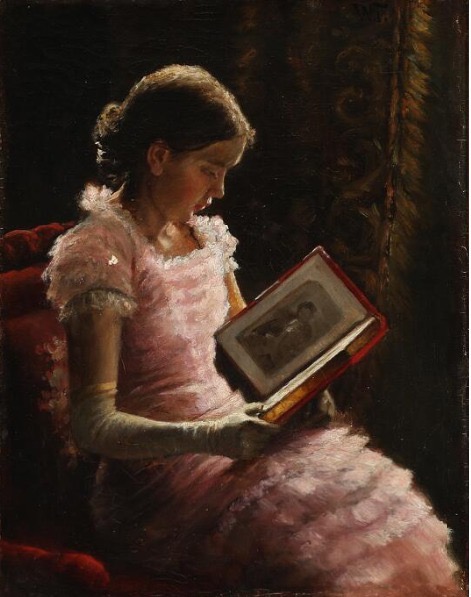
Artwork: A Girl in a Pink Dress Reading, Wenzel Tornøe


Leave a Reply