Whenever I visit a bookstore, my first approach is always towards the children’s books shelf. I have a habit of collecting books for the children around me, and I often give children’s books as presents to people who have started learning a new language.
There is a certain peace at that shelf.
For a long time, I could not quite explain why I kept returning to it. Somewhere in the back of my mind, I was thinking, “One day, I will write about this.” Then, a few days ago, at a completely unrelated shelf in a bookstore, I came across Why You Should Read Children’s Books, Even Though You Are So Old and Wise by Katherine Rundell. I immediately took it as a sign that this might be my next topic.
I am glad that bookshelves speak to me in their own ways.
We generally talk about “children” as if we were never there before. What made us so distant from the reality of being children ourselves? Is it simply because the Earth completed a few more rotations around the Sun and we decided that this was enough reason to cut our ties with that part of ourselves?
Rundell writes about the way we move through books. First, we read Spot the Dog, then Peter and Jane, then Narnia, then young adult novels, and eventually “graduate” into adult literature. Somewhere along the way, many of us begin to treat returning to children’s books as a step backwards, as if looking back meant losing status.
I find that idea fascinating because it feels so familiar.
We often speak about reading as a journey of advancement, but I am not sure that returning to a children’s book is a retreat. Sometimes it feels more like returning to a place where things are still close to their core.
That is what children’s books have always been for me: a portal back to the core.
Not necessarily to a particular childhood memory, but to something more fundamental. A reminder that anything and everything can be simple, yet touching and meaningful.
We feel happy. We feel exhausted. We experience grief. We experience jealousy. Sometimes we struggle to accept our physical features. Sometimes we simply want to be understood.
These things have always existed, and they always will.
They are some of the core experiences of being human.
Think about a place you have visited as an adult. Think about a goal you achieved, or something you wanted very much but could never quite make work.
When you read a children’s book about such a thing, do you remember the wind of that place against your face? Do you remember the humidity settling on your skin? Do you remember what you felt when you first set your sights on the thing you eventually achieved, and what achieving it actually made you feel?
Or think about something that simply would not work, no matter how hard you tried. Have you ever allowed yourself to admit that perhaps the wisdom created by that experience has become part of you?
This is where I see children’s books as a portal to awareness. They can take something we have already lived through as adults and bring us back to its simplest, most tangible core. They remind us not only of what happened, but of what it felt like to be there.
There are simple yet profound answers to many of these experiences in the language of children’s books. Yes, we are capable of more complex reasoning now, and of course we should enjoy our cognitive abilities. Growing older allows us to analyze, compare, question and connect ideas in ways that we could not as children.
But sometimes there is a particular joy in thinking and feeling plainly, without too much crowd around a thought.
Children’s books often remind me of that.
My own safe place was Charles Kingsley’s The Water-Babies. I still remember the sound of water I heard in those illustrations. And perhaps I never completely left that world behind; I can still take great pleasure in leaving the water behind and having pancakes with Pippi Longstocking.
Looking back, I find it remarkable that a few drawings on a page could create such a vivid sensation. Yet that is precisely the kind of magic children’s books seem to carry. They allow us to experience ideas, emotions and entire worlds before we have learned to explain them.
I also visit the children’s shelf regularly to see what is happening in the childhoods of other cultures.
What do children feel? What do they like to spread on their bread? What do they find funny? What are they curious about? What kinds of friendships, families and adventures fill their stories? Do they wear socks all summer, or run barefoot into the sea? Which questions are adults choosing to place into their hands?
Those children will become teenagers, young adults and eventually adults in only a few years.
There is something strangely emotional about that thought.
The illustrations and stories I encounter today may offer a small glimpse into the future generation of people I will one day meet. In that sense, children’s books are not only windows into childhood; they are also small maps of the generations that are still growing.
When you pick up a children’s book, you stand somewhere between the child you once were, the adult you have become, and the generation that comes after you.
Perhaps that is another reason I find that shelf so peaceful.
Of course, not every children’s book is profound. When people hear “children’s literature,” they may think of colorful dinosaur series jumping through sand dunes or other books that exist simply to entertain. And that is perfectly fine. Not every book needs to contain a grand lesson about the human condition.
Yet even those books tell us something. They become part of a generation’s shared references, shared jokes and shared memories. They, too, contribute to the cultural inheritance that children carry with them into adulthood.
The dynamics of life may seem complex, but so much of life begins with the simple depictions we find in children’s books. Not only emotions, but also philosophers, planets, master composers, basic physics and countless other subjects. Children’s books rarely offer the final word on these things. Instead, they offer something perhaps more important:
A beginning. A foundation.
They introduce children to ideas before those ideas become academic subjects, professional interests or lifelong passions. They help children name feelings before those feelings become difficult to carry. They offer companions in the form of characters who are frightened, curious, lonely, brave, confused or hopeful.
In that sense, children’s books are already helping to build the foundations of healthy adulthood.
Perhaps that is why I find myself thinking not only about reading children’s books, but also about making sure that children can reach them. If these books are such meaningful portals, perhaps one of the simplest things we can do as adults is to help keep that portal open. We can give books as gifts, share our favorites, and support the local libraries that quietly place entire worlds within a child’s reach.
The dynamics of life become increasingly complicated as we grow older. Yet underneath that complexity, many things remain surprisingly simple.
As in fairy tales, if there is fear, there is courage; if there is hardship, there is determination; if there is hunger, there is a way to satisfy it. But perhaps it is not the opposite poles of these experiences that matter most, but what happens in between — and where we decide to stand in the end.
The child reading that book wants to understand and to be understood. They want to belong. They are curious about the world around them. They search for meaning. They search for connection. So do you, adult. The core has never changed.
Children’s books do not necessarily bring us back to childhood. Our adulthood is, in many ways, already an extension of that childhood.
I believe they simply bring us a little closer to the core of what it means to be human.
And perhaps that is why, whenever I walk into a bookstore, I still find myself returning to that shelf.
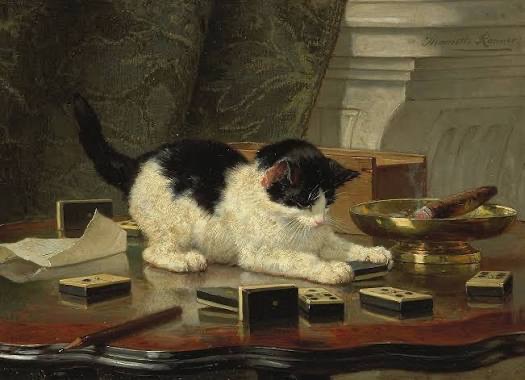
Artwork: Katjesspel, Henriëtte Ronner-Knip
2 responses to “It Is a Good Idea to Read Children’s Books”
-
I recently re-read ‘Danny the Champion of the World’ by Roald Dahl. I first read it when I was nine. I was part of the upper-reading book club in primary school (the top group – there were four of us and we had a reading table all to ourselves). Upon reading it, I was instantly transport back into both the warmth I had felt reading it, and the experience of being amongst that top group. It felt wonderful, but with it came a certain sadness that I’ll never get to experience that childlike wonder of a book – though as an adult, we appreciate it in different ways.
LikeLike
-
Thank you for inviting me to the table of your book club in primary school, and for letting me meet the adult version of that child 🙂 I think that “sadness” may be one of the powerful seeds that allows you to transport yourself back to that reading table. I think that is beautiful.
-


 Between Everywhere and Nowhere
Leave a comment