Between Everywhere and Nowhere

  • I Cannot Be a Hygge Girl

    I Cannot Be a Hygge Girl

    Too much anger, too much fury, too much negativity, too much exploitation, maybe too much reality.
    Whatever we choose to call it.

    Sometimes, I want to shed this crust of anger and awareness, to feel as light as possible, even for a moment. To soften. To float. To rest.
    But I cannot.

    We are constantly encouraged to heal inward. To slow down. To withdraw from the daily rush. Hygge, the Danish philosophy of coziness and intentional comfort, or meditation, which teaches us to focus on a single point and quiet the noise, all promise relief. And for some, they work.

    But I keep asking myself: what is the meaning of all this, if the magic disappears the moment you open your eyes?

    I cannot unsee what is happening around the world. I am not extraordinary in any sense, just another ordinary someone among millions. And yet, I feel deeply empathetic toward others, while simultaneously constructing dystopian future scenarios for myself, shaped by everything I witness around me. Awareness, once acquired, does not politely step aside when you ask for peace.

    Most of the time, I argue with myself.
    “You are under too much stress,” I say. “You cannot even focus on meditation or any kind of hygge mindset. But what real change could you possibly bring to the table, even if stress became your core identity? Probably not much. What would change if you turned that anger inside out? Nothing, most likely.”

    And yet, silencing it feels equally wrong.

    I find myself trapped in a constant rollercoaster of dilemma. A dilemma between self-preservation and moral alertness. There is that well-known prayer: God, give me the strength to accept the things I cannot change. Some days, I tell myself to prioritize my health, to step away from the current agenda, to go with the flow. Other days, this feels hollow, as if deliberately unseeing, deliberately tolerating, is a quiet betrayal of my own conscience.

    Lately, I have been wondering whether our obsession with escaping discomfort might be doing more harm than good. What if that persistent tightness in the chest, that boredom, that inner unrest is not a flaw to be corrected, but a signal to be interpreted? What if constantly soothing ourselves, numbing every sharp edge, slowly damages something more primitive in us, our survival instinct, our ability to sense when something is fundamentally wrong?

    At the core, I believe boredom begins when something in your life needs to change. The dynamics shift, and boredom becomes the warning light. In that sense, it is not laziness or indifference, but information. And I am afraid of becoming careless toward such vital signals, afraid of mistaking anesthetization for healing.

    Perhaps it is the over-exploiting nature of our time that makes focusing on inner peace feel almost unethical. Or perhaps we have internalized the long-term consequences of individualism for too long, confusing detachment with wisdom. I do not know.

    Of course, there must be a balanced space somewhere in between, between collapsing under the weight of the world and pretending it does not exist. I have not found that place yet. But for now, this unresolved tension itself has become one of my resolutions for 2026: not to escape discomfort too quickly, not to romanticize it either, but to listen before I attempt to quiet it.

    What I am searching for is not comfort, but my kind of hygge — one that can coexist with an awareness born from discomfort.
    For now, I remain outside of it.

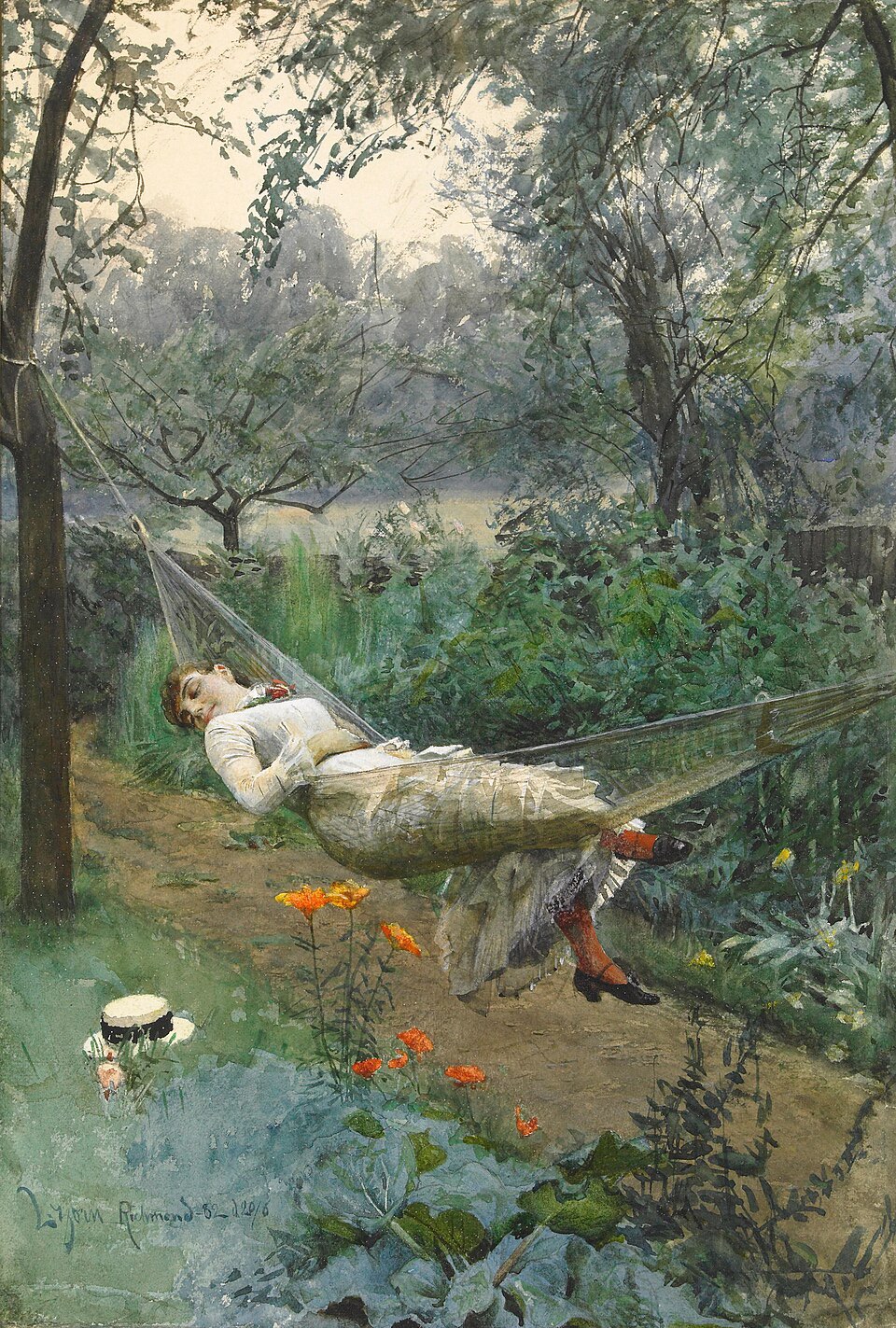
    🎨 In the Hammock by Anders Zorn

    Leave a comment

    💌hello@betweeneverywhereandnowhere.com

  • Merry Christmas & Happy New Year!

    Merry Christmas & Happy New Year!

    As we say goodbye to 2025, we welcome a brand-new chapter filled with new hopes, luck, good health, and joyful surprises.

    May 2026 bring you prosperity, inner peace, and a sense of fulfillment from your successes.

    Wishing you a wonderful holiday season with your loved ones and yourself! ✨🎁

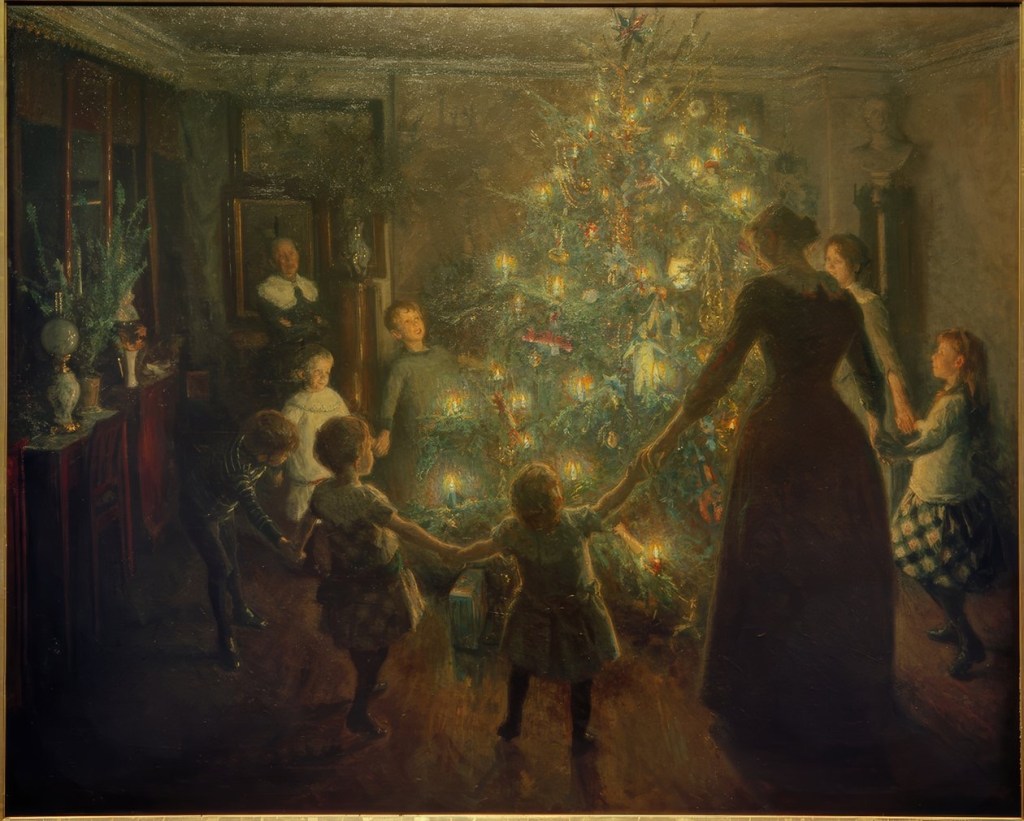
    🎨 Merry Christmas / Glade Jul  by Viggo Johansen

    Leave a comment

    💌hello@betweeneverywhereandnowhere.com

  • What a Year 2025 Has Been

    What a Year 2025 Has Been

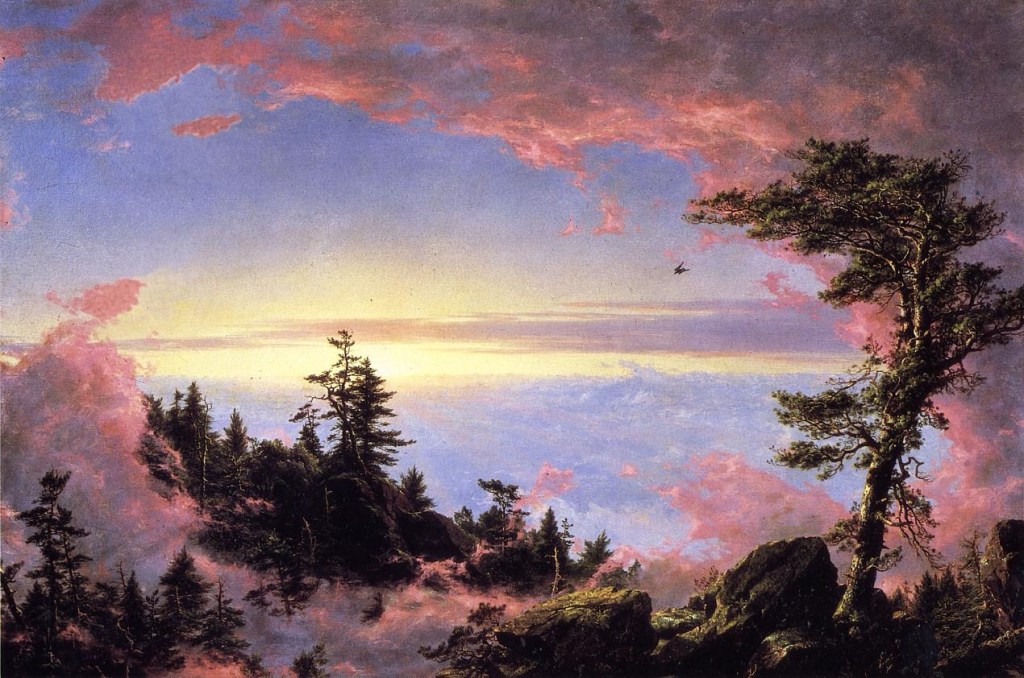
    Above the Clouds at Sunrise by Frederic Edwin Church

    A big, full twelve months is about to bid us farewell. And what a year 2025 has been.

    Looking back, the world felt louder than usual. New national leaders took office, Gen-Z-led protests filled the streets, and military attacks dominated the headlines far too often. In between, culture and history unfolded side by side: Anora won five Oscars, Taylor Swift got engaged, and we said goodbye to figures who once felt almost eternal, Pope Francis and Ozzy Osbourne among them.
    Science, meanwhile, moved forward quietly but steadily. The FDA approved its first cervical cancer test, and NASA’s Asteroid Terrestrial-impact Last Alert System detected Comet 3I/ATLAS, an interstellar object that may be the oldest known comet. So many events, so many shifts, all compressed into a single year.

    It would be easy to call 2025 turbulent – and it was. But strangely, I don’t look back on that turbulence with resentment. Quite the opposite. Somewhere between the noise, the uncertainty, and the constant sense of change, I found myself needing a place to pause, to process, and to put things into words. In an unexpected way, this very turbulence became my source of inspiration to start blogging.

    During this turbulent year, in my personal life as well, I began translating the ideas sitting in my mind into words, simply to create space for the challenges still ahead.

    At the beginning, I was deeply skeptical. I questioned whether my ideas would be worth reading, whether I should take up the time of people who might happen to stumble upon my thoughts, and many other doubts inevitably followed.
    But perhaps thanks to the age we live in, all it took was creating a quiet harmony between the keys of a keyboard and my ideas, as if I were a pianist giving life to notes. And somehow, that was enough.

    Through this blog, I discovered the quiet joy of sharing my thoughts and feelings in their simplest form, even with people I may never meet. Those of you who chose to spend your valuable time with my reflections became an unexpected gift of 2025, a birthday present I did not know I was waiting for. 

    And I am so grateful for that! Thank you so much!

    💌hello@betweeneverywhereandnowhere.com

    Leave a comment

    💌hello@betweeneverywhereandnowhere.com

  • Just Praising the Color Green

    Just Praising the Color Green

    The Equatorial Jungle by Henri Rousseau

    Have you ever realized that one single color can quietly occupy almost every corner of your life — and mostly in a gentle, reassuring way?

    We eat green to feel lighter, put our feet on green to ground ourselves, rest our eyes on green to soften our vision, and even speak of “earning green” when we talk about surviving, sustaining, continuing.

    It is December now, when red dominates the visual world with its urgency and celebration, green remains its silent companion — calmer, steadier, and somehow more enduring.

    I have always perceived green as a color that does not demand attention but earns it. It exists before interpretation, before symbolism, before we even needed a word to name it. Only later did language catch up: the word green derives from Old English grene, rooted in the Proto-Germanic grōni- and ultimately connected to the idea of growth — living, expanding, becoming. The color of growing plants was not defined first by sight, but by movement and vitality.

    Across mythologies and cultures, green has consistently been linked to life. In Greek mythology, it symbolized fertility and love; in Norse mythology, the evergreen tree represented cosmic order and eternal life. Folk traditions associated it with freshness, permanence, knowledge, liberty. Of course, green also carries less comforting connotations – unripe fruit, mold, decay, decomposition. Yet even these are not contradictions. They are warnings, transitions, signs that one phase is ending so another can begin.

    Perhaps this is why I experience green almost instinctively as a positive presence. An unripe fruit promises ripeness ahead, decay signals caution and awareness. Green does not deny discomfort — it integrates it into a broader cycle. It reminds me that life does not move in clean lines, but in layered processes.

    The color of life, of sources, of quiet hope – green announces itself without noise. You can sense it by stepping onto grass, by breathing near seaweed along a coast, by letting your eyes rest on forms shaped in green.

    And in art, green does something similar: it slows me down, steadies my perception, and invites me to feel rather than rush to understand.

    I began to recognize this feeling most clearly when green appeared not in nature, but in art – carried onto the canvas by gifted minds, through pigments synthetic in matter yet organic in awareness.

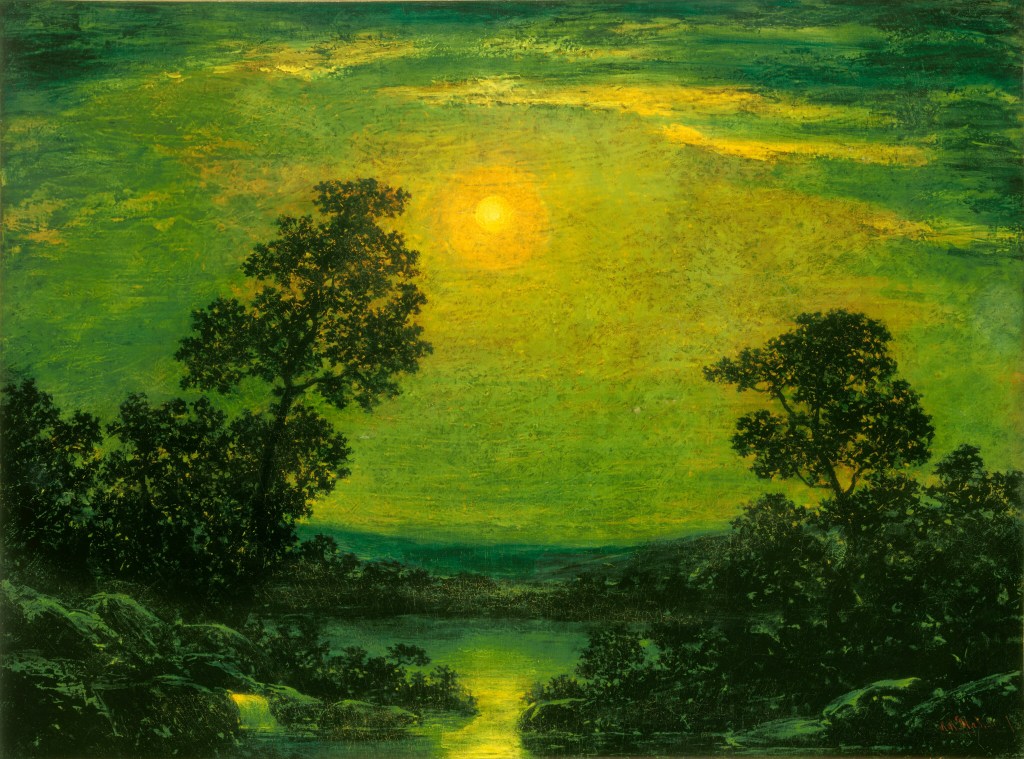
    Just look at the green moonlight in Ralph Albert Blakelock’s Moonlight. Do not analyze it too quickly – look and let yourself feel the harmony first. This is not a light that exposes; it is a light that settles. The green hue spreads softly across the landscape, not illuminating every detail, but allowing enough visibility to feel safe within the darkness.

    I imagine sitting under this quiet miracle: the green light resting on my skin, a gentle breeze brushing through my hair or catching the edge of my jacket. The night does not feel cold here; it feels attentive. And strangely, I find myself almost smelling the color green – damp earth, leaves holding onto moisture, air that has learned patience. Blakelock’s green is not decorative; it is immersive. It does not ask to be observed from a distance, but to be inhabited.

    In this moonlight, green becomes a mediator between shadow and reassurance. It does not promise clarity, but it offers presence – the kind that calms the mind without demanding explanation.

    Blakelock’s night feels inward. It asks for depth – the kind that requires honesty. It evokes a night in which you recognize the need for transformation, stop resisting it, and allow yourself to question who you are without defense or urgency.
    The green in his moonlight is not comforting; it is clarifying, it is empowering.
    The color green pats you on the back – encouraging, without insisting.

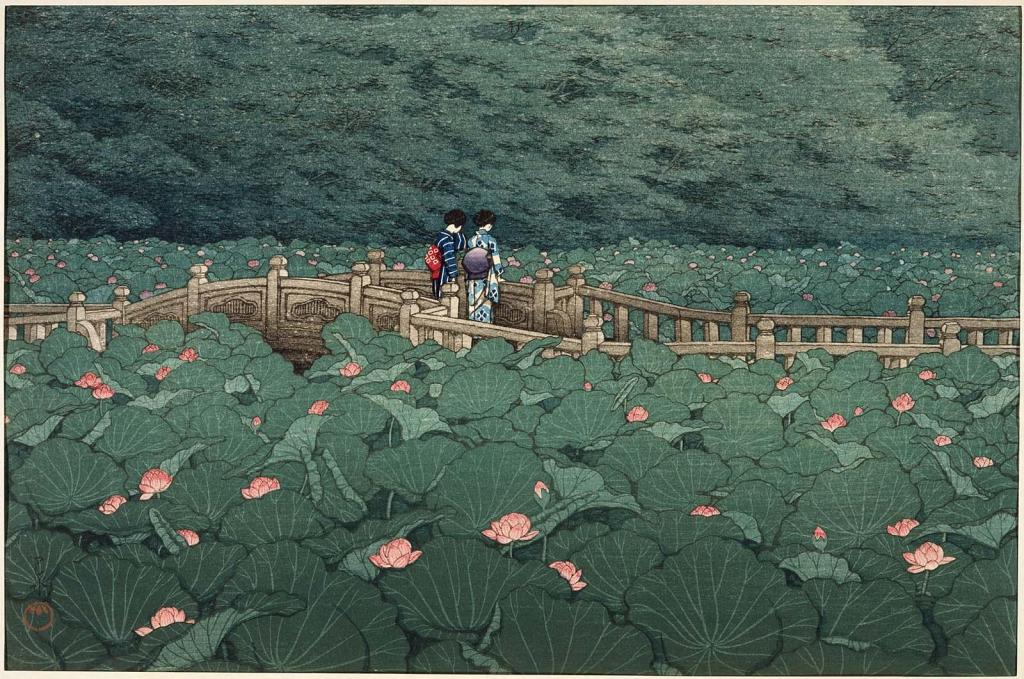
    I move on to The Pond at Benten Shrine in Shiba by Hasui Kawase:

    Serenity at its finest. Where Blakelock turns me inward, Hasui opens the scene outward. His green belongs to the day: calmer, steadier, almost ordinary – not because it lacks meaning, but because meaning has already settled. It is the moment when things fall into place, when you pause and realize where you are and how far you have come. No resistance, no transformation demanded, only presence.

    And Litzlberg on the Attersee by Gustav Klimt:

    Green feels like the clearest sign of a complete and secure life. A quiet certainty: I can live here. I can exist here. I can breathe deeply here.

    In Klimt’s landscape, I feel surrounded by green nature – hugged by trees, greeted by mountains. And the water, with its gentle reflections, gives us a kind of family portrait of the green we already possess.

    My reflections may not align with academic interpretations of these works, and my reading of green may remain incomplete. But perhaps art has always been about perception – about noticing, attributing meaning, and finding even the smallest space where we are allowed to speak.

    💌hello@betweeneverywhereandnowhere.com

    Leave a comment

    💌hello@betweeneverywhereandnowhere.com

  • The Importance of Balance in Eating

    The Importance of Balance in Eating

    Kvinne kjerner smør (ca. 1920) – Gustav Wentzel

    Do you live to eat, or do you eat to live?
    Or, perhaps, that isn’t even the real question.

    When we look closely at our daily rhythms, we notice something simple yet profound: food quietly accompanies the most significant moments of our lives.

    We celebrate achievements with dinners.
    We mourn losses with hot tea in quiet rooms.
    We reconnect with friends over coffee.
    We try to refocus by grabbing a snack “just to reset.”

    Food becomes an anchor, something around which conversations unfold, relationships deepen, and emotions settle. It is far more than a biological necessity; it’s a social script we all instinctively follow.

    Once we recognize this, eating stops being merely “fuel for our bodies.” Feeling full is only the most primitive part of the experience.

    Beyond that, eating carries emotional, cultural, psychological, and even spiritual meaning. Why else do we crave certain foods on stressful days, or why does a particular smell transport us instantly back to childhood?

    In these moments, balance becomes more than portion control. It becomes a form of self-care, a way of regulating our moods and honoring the rituals that shape our days.

    This understanding is not new. Throughout history, many scholars, thinkers, and even prophets have emphasized moderation as a foundation of well-being.

    Avicenna, for example, believed that regulating, and at times even reducing, food intake could help treat a range of illnesses.¹ His broader view suggested that an overloaded body burdens the mind, while moderation creates clarity and vitality.

    Interestingly, this ancient wisdom aligns with how many of us intuitively feel after eating too heavily: slow, foggy, less alert. It also resonates with today’s movement toward eating with intention rather than impulse.

    A similar idea appears not only in philosophy, but also in the evolution of gastronomy.

    In the 1970s, a group of French chefs, trained in the classical kitchens of Fernand Point, began shaping what would soon be known as nouvelle cuisine. They noticed that diners no longer wanted the heavy, elaborate dishes their parents and grandparents had enjoyed. Instead, people were asking for food that felt lighter, healthier, and more surprising, without losing depth, or flavor. The result was a quiet revolution: a cuisine designed not to overwhelm the body, but to leave it clear, energized, and awake.

    Modern science expands on these ideas through what we now call the gut–brain axis. Research shows that eating is influenced by far more than physiological hunger. Sensory cues, like the smell of freshly baked bread, can trigger appetite even when we are full. Emotional states also play a role: stress can shut down hunger or amplify cravings for sweet or salty foods. Hedonic mechanisms, habitual behaviors, sensory cues, and psychological factors all shape not only what we eat, but why we eat it.² Eating is not just a bodily act; it is a psychological and sensory conversation happening beneath our awareness.

    We can even see this dialogue between body and mind in the subtle signals our physiology sends us.

    Morgengabe (c. 1920), Brynolf Wennerberg

    And I notice this balance most clearly in my own body. When I eat in a way that is too one-sided, I feel a quiet heaviness, almost like something in me hasn’t quite settled. I’ve always been naturally distant from animal-based foods, simply because of my taste. But when my nails start breaking more easily, I take it as a gentle reminder to shift my intake and add a little more protein-rich food.

    The same happens with sugar. If I see small bumps on my skin that weren’t there before, I know I’ve been leaning too much on sweet comfort and I give refined sugar a pause. Our bodies speak long before they struggle. Often, they are not trying to control us, they are trying to guide us back to a way of eating that matches our lifestyle, rhythm, and even our genetics. In this sense, the body doesn’t betray us, it mirrors us. Its shape, energy, and appetite simply reflect the life we are living.

    Modern life complicates this search for balance even further. We live in a world overflowing with food stimuli: oversized portions in restaurants, carefully curated “food porn” images on social media, 24-hour markets offering instant gratification. Even our emotions get intertwined with eating, we reward ourselves after a long day, soothe boredom with snacks, or signal a moment of pause with a warm drink.

    These habits are not inherently harmful. But they do require awareness if we want to eat in a way that nourishes rather than numbs.

    Perhaps this is why the proverb “a man is known by the company he keeps” can be reimagined as “a man is known by the food he chooses to eat.” Our food choices often reflect our internal state, whether we are seeking comfort, routine, excitement, or grounding.

    What we take into our bodies doesn’t simply disappear; it becomes part of us. It enters our bloodstream and ultimately reaches our mind, shaping our mood, energy, and clarity. In this sense, eating is not just a physical act but an act of becoming.

    Balance, then, is not a strict discipline or a rigid rulebook. It is a relationship- one we learn, unlearn, and relearn throughout life. It means paying attention to why we reach for certain foods, noticing how they make us feel, and choosing nourishment that supports both our body and our mind.

    Sometimes balance means savoring a meal slowly. Other times it means stopping before fullness becomes discomfort. And often, it means sharing a humble dish with a friend simply because connection is part of nourishment too.

    Maybe the real question isn’t whether we live to eat or eat to live. Maybe it is how consciously we choose to nourish our lives – physically, emotionally, and spiritually – through the simple yet profound act of eating.

    💌hello@betweeneverywhereandnowhere.com

    Leave a comment

    💌hello@betweeneverywhereandnowhere.com

  • Kierkegaard as a Big Brother

    Kierkegaard as a Big Brother

    I have always believed that privacy is the real key, even as a little girl. Whether out of necessity or a desire to share knowledge, I have always preferred keeping the real storm inside me. Staying private felt like being “preserved” and “respectful to myself,” a way of honoring my own sense of truth.

    Fortunately, some rare and precious minds chose to share their innermost thoughts with the world. Kierkegaard was one of them. His ideas reached me in ways that felt profoundly personal. I call him my “big brother,” not to diminish his stature, but because he silently guided me in the ways I needed, probably in ways he never anticipated. Of course, this is my personal experience; Kierkegaard himself had no expectation of being seen this way.

    As I mentioned, I have always chosen to preserve my thoughts, questions, and ideas. Perhaps I was fortunate enough to share and discuss everything with my parents, so I never felt obliged to seek validation from others. But as I reached the early stages of young adulthood, I realized that I needed new boundaries, even with my parents. When I confided this to my mother, she said, “Whenever you need advice, you may consult a psychologist you trust.” At first, this seemed logical.

    After experimenting with this path and reflecting deeply, I realized that it wasn’t quite right for me. I had no major crises; my struggles were with myself. Paying someone to navigate my existential musings didn’t feel organic – it was transactional, almost obligatory. What did I expect, in the end?

    So, I turned to what had always been my refuge: the library. Its quiet halls became sacred portals, taking me to parallel heights in my mind. And one day, I found it, the book that would change my perspective: Either/Or by Søren Kierkegaard. Of course, I was not unfamiliar with philosophy or Kierkegaard but reading him in that moment hit differently. It was as if someone was reading my soul, gently guiding me, giving me what I needed before I even asked.

    I was mesmerized. I lost track of how many times I read that book. Then I moved on to The Present Age. How could someone born in 1813, living in Denmark, meet the mental and emotional needs of a girl in a completely different “modern” time and place?

    Kierkegaard became my big brother, a silent mentor guiding my thoughts across centuries. At first, I hesitated to share my perspective about a philosopher in this way, as it might seem too shallow or disrespectful. But I decided to share this view of mine, because philosophy is not only about knowing theories and concepts. It is about what it makes you think. About what it makes you feel. About the questions it forces you to ask. Probably, Kierkegaard would be surprised if he knew someone saw him this way.

    Through him, I learned that solitude can be nourishing and that privacy can be empowering. Even as social animals, my approach towards carrying myself was not abnormal.

    But perhaps the most meaningful thing I’ve learned from him is this: when I feel the need to change something in my life, or when I sense that I crave difference, I no longer interpret it as a betrayal of who I am. Instead, I see it as a sign of growth, as a transition into another chapter of my life. Kierkegaard helped me understand that change is not disloyalty to the self; it is the very process through which the self becomes more authentic.

    I am so grateful for Kierkegaard having that enormous impact on my life.

    “When I see myself cursed, abominated, hated for my coldness and heartlessness: then I laugh, then my wrath is satiated. If these good people could really put me in the wrong, if they could actually make me do wrong – well, then I should have lost.”

    — Either/Or, Søren Kierkegaard, Vol.1, p.39, Translated by David F. Swenson and Lillian Marvin Swenson

    💌hello@betweeneverywhereandnowhere.com

    Leave a comment

    💌hello@betweeneverywhereandnowhere.com

  • All Children We Could Not Protect

    All Children We Could Not Protect

    As a person who tends to see the glass as a whole and usually keeps a realistic stance, these days it feels almost impossible to keep up with what is happening around the world.

    Lola Daviet from France, Mattia Ahmet Minguzzi from Türkiye, Meya Åberg from Sweden…

    Too much pain to hold. And we are not even their acquaintances.

    When someone commits brutal harm, they do not only steal a life — they destroy the worlds of everyone who loved that life, who would love that life, and everyone and everything that life would touch.

    What feels even more disturbing is how people have started to sympathize more with the offender than with the victim.

    Consciously or not, victim-blaming has become a silent trend. Even when there is no open blame, some people somehow tend to devalue the victim’s place, as if suffering deserved to be examined before believed.

    Whenever such nightmares come to light, certain circles immediately start scanning both sides — weighing them as if morality could be balanced like a scale. “That side had this; the other side had that…”

    Yes, we all go through harsh experiences. Each person is unique — psychologically, biologically, and socio-economically. But none of these differences justify doing harm. Choosing evil is always the easiest.

    There are endless academic and scientific discussions about these issues, but here I speak simply as an ordinary person — one who tries to digest all these stories and comments that pass through her daily life.

    Over-sympathizing would not be such a problem if it weren’t always directed towards offenders.

    Being a minority, an immigrant, or a local gives no justification for cruelty. Humanity does not work by exceptions.

    During Mattia Ahmet’s hearing, one of the suspects’ attorneys said: “It was Ahmet’s bad luck that he was around the suspects that day.”

    Is it that simple? Has life become such a fragile accident? Is it normal to be a target of a hunting ideology in the middle of daily life? Really?

    It often feels like governments are deliberately choosing not to protect their citizens.

    When justice becomes selective, protection turns into privilege. And privileges, by their nature, exclude.

    If states over-protect certain sects of society, communities will inevitably over-react to those same sects. Simple logic 101.

    When justice fails to reflect fairness, it does not only harm the victims — it weakens the moral spine of a whole society.

    Each lenient decision, each ignored case, silently tells people that innocence has less value than power.

    And once people stop believing in justice, they stop believing in each other.

    Of course, this loss of trust does not happen overnight. It grows every time the media wraps cruelty in words that soften its weight — every time headlines frame victims through endless “ifs” and “buts,” as if they must earn their right to be protected.

    When injustice is repeated often enough, people begin to see it as ordinary.

    We must refuse to internalize such reasoning. Because every time we excuse cruelty, we make it easier for the next cruelty to happen.

    And criticism alone will never be enough unless it leads us to seek solutions — not only through laws, but through our shared conscience.

    Since reading this news, I have not been able to calm the sorrow inside me.

    When I watched Meya’s trembling speech on national TV, all I wanted was to reach out and hug her — even though I knew it wouldn’t be enough.

    People always assume it will be someone else’s tragedy. But the circle is getting smaller and smaller each day.
    Sooner or later, the distance between “them” and “us” disappears.

    We should remember the simplest truth about life. Put history, politics, and all the rest aside for a moment.

    We are all humans who long for a serene life lived with dignity. Learn to protect your own sense of integrity.

    As Aristophanes once said: “A man’s homeland is wherever he prospers.”

    Respect the boundaries of the place you live in. Respect your surroundings — whether they are living beings or artificial ones.

    And show tolerance to those who are doing their best to belong, to find their place in the community they are trying to be part of.

    Because peace does not come from similarity. It comes from coexistence.

    May we let all these innocent souls rest in peace, through our honest efforts to build a just and humane world.

    💌hello@betweeneverywhereandnowhere.com

    Leave a comment

    💌hello@betweeneverywhereandnowhere.com

  • The Very Concept of Vandalism Behind the Revolutionist Card

    The Very Concept of Vandalism Behind the Revolutionist Card

    This world has always had its problems — it never was, and probably never will be, any better than it is at the very moment. The difference now is that we can see it all. Technology has developed, and with it, our sense of awareness.

    Once, people were busy sweeping only in front of their own doors; today, with a phone in our hands, we can see an ordinary day of a person we would otherwise never meet. Even now, you are reading my thoughts, and normally, we might never cross paths.

    The more developed and connected we become, the more sensitive and reactive we grow. The easier it gets to reach basic needs, the more we focus on expressing ourselves. These days, everyone can be an activist, an advocate, a spokesperson for something — demonstrations, labor strikes, social media campaigns, petitions, or simply sitting in front of a building to make a point. There are countless ways to show your stance, to raise awareness, to push for change.

    But vandalism is not one of them. Intentions may be good, but your freedom ends where it interferes with someone else’s.

    Recently, two members of Futuro Vegetal were charged with a crime against heritage after allegedly throwing biodegradable red paint on a painting by José Garnelo at Madrid’s Naval Museum on Spain’s National Day. The museum says the artwork has been restored. But does that make the act acceptable?

    After all these years of progress, do we still not see that every extreme action gives birth to an equally extreme reaction? These works of art are part of humanity’s heritage — irreplaceable, fragile, and deeply symbolic. Damaging them in the name of a cause does not make you right; it just weakens your argument. You cannot claim to fight for life while destroying what was created to celebrate it.

    Image: BBC

    It seems these days, it’s easy to be something else. If I say, “I identify as a kebab fairy,” few would dare to question me — not out of understanding, but often out of fear of offending. But does that logic justify everything? Just because something feels right in the moment doesn’t mean it is right. So, you just cannot be an overly ardent advocate of something just because you think you are right when you start justifying and normalizing vandalism at some point.

    Why is it always the finest pieces that become the target? If you damage something that belongs to everyone — something that carries shared cultural meaning — you’re not an activist, you’re a vandal. And when you devalue the very cause you claim to defend, the message you try to deliver fades into noise.

    If we truly want change, we need to find ways that invite dialogue instead of destruction. Real change requires collaboration — a shared cause, a collective benefit. The world already has enough broken things; we don’t need to add art to the list. This is the best time to be human, and to channel our will toward change for the good of all of us.

    We should remember that whatever the cause we stand for, it is about us — the ordinary citizens of this world, regardless of our beliefs, identities, or orientations.

    True activism seeks to heal and connect, not to separate and destroy.

    💌hello@betweeneverywhereandnowhere.com

    Leave a comment

    💌hello@betweeneverywhereandnowhere.com

  • How a Sentence in The Economist Took Me Back to My Childhood

    How a Sentence in The Economist Took Me Back to My Childhood

    …and I could never have known!

    On a chilly October weekend, I started reading an article titled “Icebreakers – Cracking Stuff” in The Economist, which began with the line “Finland has something America wants.”

    I kept reading, expecting to find something about the current Greenland agenda. Then I came across a sentence by Jari Hurttia that struck me:

    “Ice is a kind of mystery.”

    Yes — ice, snow, winter, the cold — all are mysteries to those who have never truly experienced them.

    My hometown is a beautiful coastal city along the Mediterranean. I grew up with heat, endless sunshine, tanned skin, fresh vegetables and fruits, seafood culture, and countless touristic moments even without leaving my own circle.

    Tourists I met throughout my life would always tell me, “You’re so lucky — you live a full-time holiday life.”

    But that never meant much to me. This climate was simply my natural habitat, my everyday normal.

    For me, a holiday meant snow and winter — that postcard-perfect scene almost impossible to experience in my city.

    It has never snowed in my hometown. True winter existed only as a flawless concept in my mind. To let us experience it, our municipality used to bring real snow from the mountains by lorries — quite literally!

    When I first saw snow actually falling from the sky, I felt as if I were inside a snow globe. Those tiny cotton candies were drifting down, melting on my hands. The white blanket they created. The silence that followed. The chill that reached my bones.

    I wasn’t sweating — I was freezing! And it felt like another way of being alive. It was such a miracle.

    God, please let me experience this white miracle all my life,” I used to pray. “Please bless me with real winter — I already have enough summer.” That was my childish bargain with God.

    In my city, people had to drive up to higher altitudes to see the snow. Winter — real winter — was our luxury, our privilege. You had to make an effort to reach that miracle. Years later, I became fascinated by other winter wonderlands. Finland was, of course, one of them. 

    One day, I met a Finnish girl in my hometown. She told me, “You have no idea how lucky you are to be from the Mediterranean.”

    Maybe she was right. That conversation stayed with me for years — because it showed how easily we idealize what we don’t live in.

    Years later, when I visited Finland, I told a Finnish man, “You have no idea how lucky you are to be from Finland.”

    We always reveal our nature in what we admire. What we cannot easily reach always feels more precious. 

    Perhaps this is how distance creates desire — the snow for me, the sun for them.
     
    Or maybe these contrasts keep the world in balance — they make us curious enough to leave our own comfort zones and seek the lives that feel like our idealized opposites. 

    We rarely learn to appreciate what we already have — maybe because, as I once prayed in my childhood, we already have it, and we know we won’t lose it. 

    And back where I come from, the waves never stop whispering that we all long for what’s beyond our horizon.

    💌hello@betweeneverywhereandnowhere.com

    Leave a comment

    💌hello@betweeneverywhereandnowhere.com

  • Where Grace Outlives Us — Feriköy Latin Catholic Cemetery

    Where Grace Outlives Us — Feriköy Latin Catholic Cemetery

    Where do we feel ourselves closest to death? In hospital rooms, amid burial ceremonies, or while standing within a cemetery’s silent alleys?

    What stirs within you when you walk through a graveyard — goosebumps, longing, a shudder, calm, or something else altogether?

    To me, graveyards are secure havens, places where we entrust our dearest ones for eternity. They mirror faith and culture. Often, a cemetery becomes a canvas upon which the identity and spirit of the person who now lies beneath the soil are inscribed — transforming into part of nature’s quiet tapestry.

    Some cemeteries show us that even after our physical presence fades, we may still radiate grace and artistry. Through their final resting places — their eternal homes — some individuals continue to satisfy our souls aesthetically, even when their biological existence has ceased.

    One of the most beautiful examples of this, for me, is the Latin Catholic Cemetery in Feriköy, Istanbul.

    Image courtesy of bi-ozet.com

    Hidden in the heart of Şişli, this 19th-century cemetery carries the silent traces of Istanbul’s multicultural past. Established around the 1860s for the city’s Catholic and Levantine communities, it has become a peaceful sanctuary filled with marble angels, neoclassical tombs, and stories carved into stone.

    The Timothée Reboul tombstone in the Feriköy Catholic Cemetery. Image courtesy of levantineheritage.com

    Walking here feels like stepping into a forgotten gallery — each monument a piece of art, each name a different melody of the same city. Italian, French, Latin, and Turkish inscriptions intertwine; ivy and sunlight dance across sculpted faces. It’s a place where architecture, faith, and emotion meet in silence.

    The tomb of the important Orientalist painter Jean Brindesi
    Image courtesy of levantineheritage.com

    You don’t need to be religious to feel something here. You only need to pause. Between the whispering trees and white marble, there’s a quiet beauty that reminds you: even after we’re gone, we can still leave traces of grace behind.

    If you’re in Istanbul now, there is an exhibition called “Memento: Mermere Kazınmış Latin İstanbul” — free to visit until the 12th of October by booking an available slot. If you plan to visit the city soon, I highly recommend experiencing this extraordinary place with your own eyes.

    Image courtesy of bi-ozet.com

    What I love about humanity is that when we truly wish, we can turn anything into art and peace. We can satisfy our hunger for beauty even by visiting the eternal homes of people we’ve never met — those we only discover by chance while wandering among their resting places. Sometimes, a person can still give you calm and comfort through the very spot where they lie forever.

    May all our loved ones rest in peace, and may God bless us all with long, healthy, and meaningful lives. 🕯️

    Image courtesy of bi-ozet.com

    All images here belong to their respective owners.

    💌hello@betweeneverywhereandnowhere.com

    Leave a comment

    💌hello@betweeneverywhereandnowhere.com