Between Everywhere and Nowhere

  • The Unbearable Lightness of Uncertainty

    The Unbearable Lightness of Uncertainty

    What would it be like to enter this world with your life already drawn for you, inch by inch?

    Some people seem to be born into a story that has already been written. Long before they can choose anything for themselves, their place in the world is almost outlined for them: what they will become, what they will inherit, what they will be expected to achieve. Perhaps they are handed influence, privilege, or power, but perhaps the greatest privilege of all is the certainty of knowing that they are meant to become something.

    And then there are those who arrive without such a map.

    Have you ever heard of the journey of caretta carettas, or loggerhead sea turtles?

    After an incubation period of approximately sixty days, hatchlings break through their shells using a temporary egg-tooth. There is no one waiting to guide them, no path laid out for them to follow. They emerge by relying on their sensory cues, making their way out of the nest and eventually towards the open ocean, completely on their own.

    Even the timing of their emergence is shaped by uncertainty. During the day, the heat of the sand can act as a thermal inhibitor, keeping them beneath the surface. As the sand cools at night, the change in temperature signals that it is safer to emerge. They do not know what awaits them beyond the nest. They simply respond to what they can sense.

    And perhaps this is where uncertainty begins to look a little different.

    It is easy to think of uncertainty as the absence of something: the absence of a plan, a guarantee, a destination. But what if it is also the space in which we learn to navigate? What if not knowing exactly who we are going to become is not a weakness, but one of the things that keeps possibility alive?

    A caretta caretta does not emerge from the sand knowing what kind of life it will have. It has no promise of safety, no certainty of survival, no one telling it where it belongs. It has, for a moment, little more than its body, its senses, and the sand beneath it.

    And somehow, that is enough to begin.

    I see uncertainty as a form of freedom, honestly. And I only came to see it this way relatively recently.

    I have always been an ambitious person, but my ambition was mostly directed towards academic and educational pursuits. I was raised by overly affectionate parents, under a very peaceful roof, with plenty of everything I could have wanted. And yet there was one thing I always felt I could not get enough of from my parents: an answer to the question, What could I become?

    Whenever I brought up this question, the answer I received was always the same: You can be anything and everything you want, and we will support you.

    When I was younger, this lack of direction drove me crazy. I wanted to be navigated towards something. I wanted a field, a destination, a sign telling me where I belonged. In my mind, I was living in a story in which I was lacking a sense of belonging. I was all alone. I was one of those caretta carettas.

    Now, as a young adult, I am more than grateful for the uncertainty my parents gave me.

    Thanks to this uncertainty, my dreams are still vivid and fluid. I can still be anything and everything, or nothing.

    I realized that this kind of uncertainty serves as fuel: a reason to remain willing to exist, to explore, to change direction, to become someone I have not yet imagined.

    This uncertainty opened up a lifelong journey in which I carry the sweet possibility of wearing any hat—or perhaps never finding a hat that fits me at all. Anything possible or everything impossible. This is not even the issue.

    Sometimes I feel like I am inside an arthouse film whose ending has deliberately been left open.

    And perhaps uncertainty is what makes me wonder: Is that film an absolute expression of me, or am I simply part of a story that was never meant to be carefully plotted? According to whom am I the director? According to whom am I a side character? According to whom am I the starring actress?

    In the hands of uncertainty, I can create a thousand questions and give a thousand different answers. Maybe all of them are correct. Maybe all of them are wrong.

    Maybe that is precisely the point.

    Uncertainty does not simply take certainty away from us. Paradoxically, it makes us more aware of the certainties we already carry.

    For a caretta caretta, there is the shell, its sensory cues, its instinct to move towards the sea. For us, perhaps, there is something less tangible but no less real: our essence, our stance, our will.

    When there is no map, we begin to notice what we already have.

    I see the uncertainties we wish to be certainties as our little fairies, constantly nudging us to find our own path.

    Maybe this is what uncertainty ultimately gives us. Not the certainty of knowing where we are going, but the certainty of knowing that we can navigate. Not a promise of who we will become, but the freedom to discover it. 

    To stop fighting the windmills. To have no idea who you are going to be, while slowly realizing that you already carry everything you need to begin. 

    This is the unbearable lightness of uncertainty.

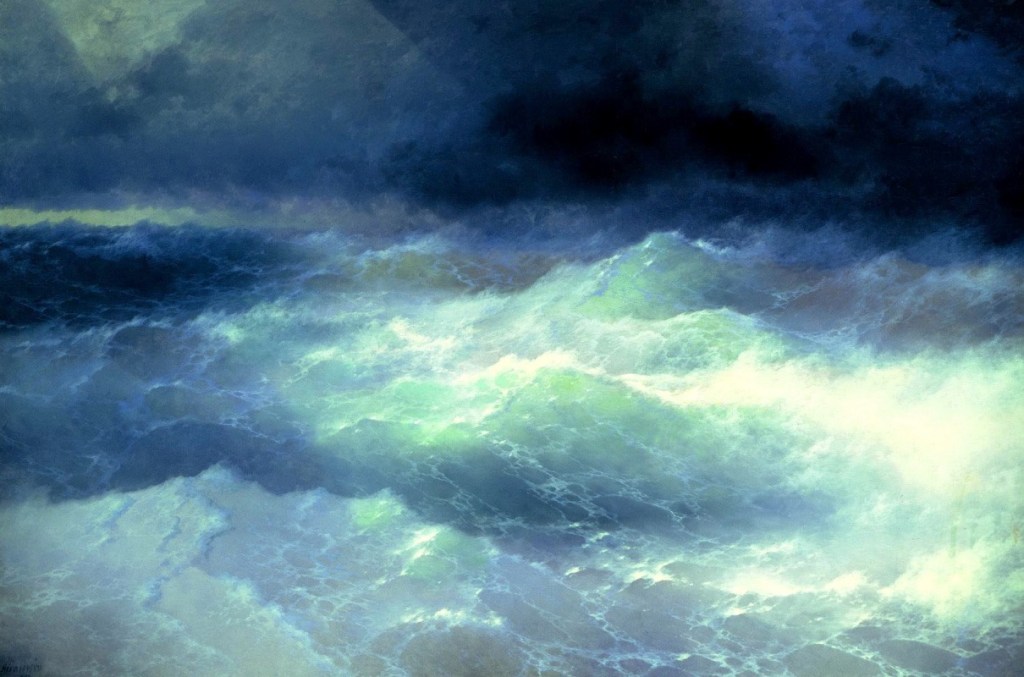
    Artworks: 1Among the Waves, Ivan Konstantinovich Aivazovsky
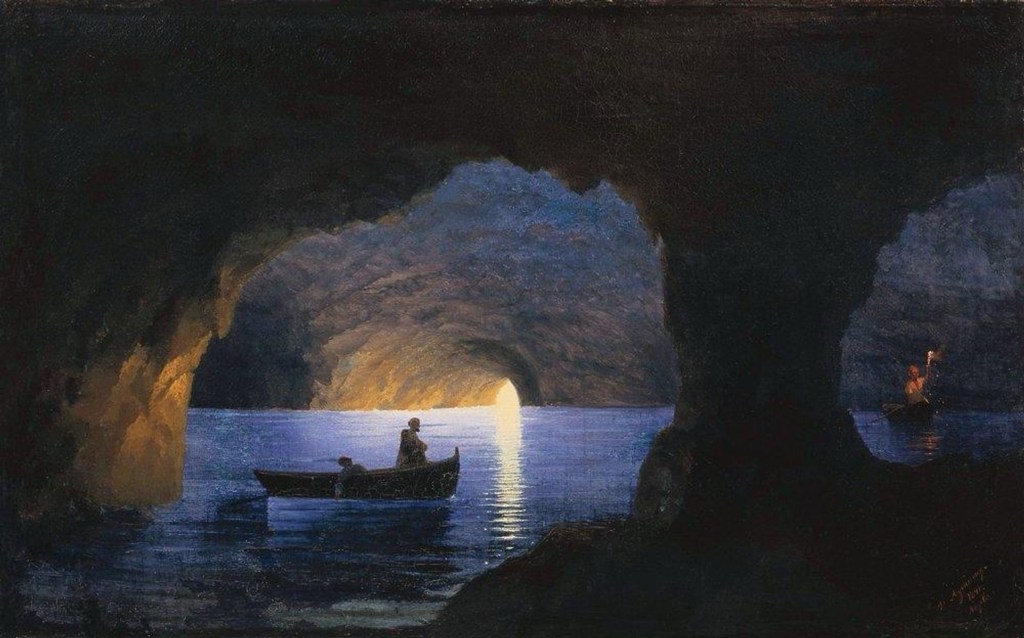
    2Azure Grotto. Naples, Ivan Konstantinovich Aivazovsky

    Leave a comment

    💌hello@betweeneverywhereandnowhere.com

  • It Is a Good Idea to Read Children’s Books

    It Is a Good Idea to Read Children’s Books

    Whenever I visit a bookstore, my first approach is always towards the children’s books shelf. I have a habit of collecting books for the children around me, and I often give children’s books as presents to people who have started learning a new language.

    There is a certain peace at that shelf.

    For a long time, I could not quite explain why I kept returning to it. Somewhere in the back of my mind, I was thinking, “One day, I will write about this.” Then, a few days ago, at a completely unrelated shelf in a bookstore, I came across Why You Should Read Children’s Books, Even Though You Are So Old and Wise by Katherine Rundell. I immediately took it as a sign that this might be my next topic.

    I am glad that bookshelves speak to me in their own ways.

    We generally talk about “children” as if we were never there before. What made us so distant from the reality of being children ourselves? Is it simply because the Earth completed a few more rotations around the Sun and we decided that this was enough reason to cut our ties with that part of ourselves?

    Rundell writes about the way we move through books. First, we read Spot the Dog, then Peter and Jane, then Narnia, then young adult novels, and eventually “graduate” into adult literature. Somewhere along the way, many of us begin to treat returning to children’s books as a step backwards, as if looking back meant losing status.

    I find that idea fascinating because it feels so familiar.

    We often speak about reading as a journey of advancement, but I am not sure that returning to a children’s book is a retreat. Sometimes it feels more like returning to a place where things are still close to their core.

    That is what children’s books have always been for me: a portal back to the core.

    Not necessarily to a particular childhood memory, but to something more fundamental. A reminder that anything and everything can be simple, yet touching and meaningful.

    We feel happy. We feel exhausted. We experience grief. We experience jealousy. Sometimes we struggle to accept our physical features. Sometimes we simply want to be understood.

    These things have always existed, and they always will.

    They are some of the core experiences of being human.

    Think about a place you have visited as an adult. Think about a goal you achieved, or something you wanted very much but could never quite make work.

    When you read a children’s book about such a thing, do you remember the wind of that place against your face? Do you remember the humidity settling on your skin? Do you remember what you felt when you first set your sights on the thing you eventually achieved, and what achieving it actually made you feel?

    Or think about something that simply would not work, no matter how hard you tried. Have you ever allowed yourself to admit that perhaps the wisdom created by that experience has become part of you?

    This is where I see children’s books as a portal to awareness. They can take something we have already lived through as adults and bring us back to its simplest, most tangible core. They remind us not only of what happened, but of what it felt like to be there.

    There are simple yet profound answers to many of these experiences in the language of children’s books. Yes, we are capable of more complex reasoning now, and of course we should enjoy our cognitive abilities. Growing older allows us to analyze, compare, question and connect ideas in ways that we could not as children.

    But sometimes there is a particular joy in thinking and feeling plainly, without too much crowd around a thought.

    Children’s books often remind me of that.

    My own safe place was Charles Kingsley’s The Water-Babies. I still remember the sound of water I heard in those illustrations. And perhaps I never completely left that world behind; I can still take great pleasure in leaving the water behind and having pancakes with Pippi Longstocking.

    Looking back, I find it remarkable that a few drawings on a page could create such a vivid sensation. Yet that is precisely the kind of magic children’s books seem to carry. They allow us to experience ideas, emotions and entire worlds before we have learned to explain them.

    I also visit the children’s shelf regularly to see what is happening in the childhoods of other cultures.

    What do children feel? What do they like to spread on their bread? What do they find funny? What are they curious about? What kinds of friendships, families and adventures fill their stories? Do they wear socks all summer, or run barefoot into the sea? Which questions are adults choosing to place into their hands?

    Those children will become teenagers, young adults and eventually adults in only a few years.

    There is something strangely emotional about that thought.

    The illustrations and stories I encounter today may offer a small glimpse into the future generation of people I will one day meet. In that sense, children’s books are not only windows into childhood; they are also small maps of the generations that are still growing.

    When you pick up a children’s book, you stand somewhere between the child you once were, the adult you have become, and the generation that comes after you.

    Perhaps that is another reason I find that shelf so peaceful.

    Of course, not every children’s book is profound. When people hear “children’s literature,” they may think of colorful dinosaur series jumping through sand dunes or other books that exist simply to entertain. And that is perfectly fine. Not every book needs to contain a grand lesson about the human condition.

    Yet even those books tell us something. They become part of a generation’s shared references, shared jokes and shared memories. They, too, contribute to the cultural inheritance that children carry with them into adulthood.

    The dynamics of life may seem complex, but so much of life begins with the simple depictions we find in children’s books. Not only emotions, but also philosophers, planets, master composers, basic physics and countless other subjects. Children’s books rarely offer the final word on these things. Instead, they offer something perhaps more important:

    A beginning. A foundation.

    They introduce children to ideas before those ideas become academic subjects, professional interests or lifelong passions. They help children name feelings before those feelings become difficult to carry. They offer companions in the form of characters who are frightened, curious, lonely, brave, confused or hopeful.

    In that sense, children’s books are already helping to build the foundations of healthy adulthood.

    Perhaps that is why I find myself thinking not only about reading children’s books, but also about making sure that children can reach them. If these books are such meaningful portals, perhaps one of the simplest things we can do as adults is to help keep that portal open. We can give books as gifts, share our favorites, and support the local libraries that quietly place entire worlds within a child’s reach.

    The dynamics of life become increasingly complicated as we grow older. Yet underneath that complexity, many things remain surprisingly simple.

    As in fairy tales, if there is fear, there is courage; if there is hardship, there is determination; if there is hunger, there is a way to satisfy it. But perhaps it is not the opposite poles of these experiences that matter most, but what happens in between — and where we decide to stand in the end.

    The child reading that book wants to understand and to be understood. They want to belong. They are curious about the world around them. They search for meaning. They search for connection. So do you, adult. The core has never changed.

    Children’s books do not necessarily bring us back to childhood. Our adulthood is, in many ways, already an extension of that childhood.

    I believe they simply bring us a little closer to the core of what it means to be human.

    And perhaps that is why, whenever I walk into a bookstore, I still find myself returning to that shelf.

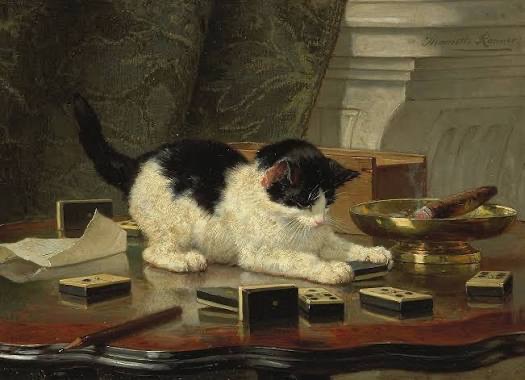
    Artwork: Katjesspel, Henriëtte Ronner-Knip

    2 responses to “It Is a Good Idea to Read Children’s Books”

    1. theharlequinheart Avatar

      I recently re-read ‘Danny the Champion of the World’ by Roald Dahl. I first read it when I was nine. I was part of the upper-reading book club in primary school (the top group – there were four of us and we had a reading table all to ourselves). Upon reading it, I was instantly transport back into both the warmth I had felt reading it, and the experience of being amongst that top group. It felt wonderful, but with it came a certain sadness that I’ll never get to experience that childlike wonder of a book – though as an adult, we appreciate it in different ways.

      Like

      1. betweeneverywhereandnowhere Avatar

        Thank you for inviting me to the table of your book club in primary school, and for letting me meet the adult version of that child 🙂 I think that “sadness” may be one of the powerful seeds that allows you to transport yourself back to that reading table. I think that is beautiful.

        Liked by 1 person

    Leave a comment

    💌hello@betweeneverywhereandnowhere.com

  • I Used My Natal Chart…

    I Used My Natal Chart…

    To Better Understand My Life Path

    I think anything and everything can be a means of understanding our minds, our lives, the dynamics surrounding us, and so on.

    As I mentioned before, I have been interested in astrology for some time now. Honestly, I do not take astrology as fortune-telling or a way of predicting the future. I rather see it as a way of attributing some meaning retrospectively — a different lens through which I can look at my own life.

    In order to better understand what my existence might mean to me, I decided to take my natal chart into account. Of course, none of this is science-backed or concrete. Still, there is something fascinating — even a little fluttering — about the thought that the universe, the planets, and their mathematical relationships might have left some kind of imprint at the very moment you started breathing in this world.

    It may mean something. Or it may mean nothing.

    But I find it interesting to look at it anyway.

    Honestly, my natal chart seems to have received quite a generous share of oppositions and squares — the so-called challenging aspects — rather than conjunctions, trines, and sextiles, which are generally considered more harmonious. It is often said that having more harmonious aspects may indicate that life flows more easily.

    Apparently, I was not given the smoothest possible version of the tutorial.

    Sun Square Saturn

    This is one of the most prominent aspects of my natal chart.

    While the Sun represents core identity, self-expression, authority, and, traditionally, the father, Saturn is associated with restrictions, delays, responsibility, maturity, and limitations. When they form a square, no wonder it is considered a difficult aspect.

    I have even come across a few places saying something along the lines of, “We feel very sorry when we see this aspect in a woman’s chart.” One can easily be convinced that this aspect means lower self-esteem, hardships in life, delays in self-realization, problems with authority, even difficulties involving one’s father, and so on.

    But I think there is something easily underestimated here.

    If you were born under this aspect, and if Sun Square Saturn is one of the main themes of your life, then never forget that you are a Sun Square Saturn, too.

    You develop endurance because your life requires it. You become patient because things take time. You learn to think strategically because not everything can be forced.

    And once you realize and accept that this is simply one of the ways your life tends to unfold, you stop spending so much energy asking, “Why me?”. Instead, you start moving forward consciously, knowing what you are dealing with.

    Here is the perk of a difficult aspect: not an easy life, but a stronger self. And a stronger self knows how to appreciate what it has achieved.

    You know how much effort, patience, and intention went into it. You appreciate it more consciously and more maturely, because you know exactly what it took to get there.

    And what you build may stay with you longer, simply because you were an active and conscious part of building it.

    Moon Opposition Mercury-Jupiter-Uranus-Neptune

    My Cancer Moon forms oppositions to all of the planets I mentioned above in Capricorn, with the exception of my Aquarius Uranus.

    This opposition is also considered one of the more challenging configurations, as it creates a tension between the Cancer-Capricorn axis.

    According to astrology, my life would always be somewhat of a rollercoaster between my emotional and material needs.

    And honestly, my emotional side can be in turbulence almost all the time.

    Yet, I am still grateful for the tension this aspect represents.

    First of all, I know and respect my feelings.

    I know how my body and mind tend to react to a certain feeling. I have learned to recognize my emotional surges. I am learning when to simply feel and when to step back and think.

    I have learned to get to know both my mind and my emotional side because of this turbulence.

    Maybe Saturn saved me with its trine in this case. Who knows?

    The more I read about astrology and think about life paths, the more I realize that perhaps everything we go through can somehow navigate us towards what we are supposed to do.

    From an astrological perspective, the North Node is said to give us clues about our journey in this lifetime.

    North Node in Libra in the 5th House

    The more I looked into my chart, the more I became interested in the idea of the North Node.

    Mine is in Libra, a sign associated with harmony, diplomacy, justice, partnership, and balance. It is also in the 5th house, traditionally associated with pleasure, joy, creativity, art, self-expression, and the things we do simply because they make us feel alive.

    So perhaps all the turbulence I mentioned above is also leading me somewhere very different from where I might instinctively go.

    Perhaps I am meant to learn to express myself without putting pressure on myself to be flawless.

    To deliberately choose the lightness of life. To enjoy art and music.

    To spend time with people and build meaningful bonds. To allow myself to experience pleasure without feeling that I first have to earn it.

    And maybe, most importantly, to understand that life does not always have to be a problem that needs solving.

    But what did my chart give me to work with in order to get there, apart from all the rollercoaster rides?

    Jupiter Conjunction Mercury & My Gemini Ascendant

    When I retrospectively analyze my natal chart, I like to think that this aspect points towards one small corner of the direction suggested by my North Node.

    Jupiter conjunct Mercury is said to be associated with an interest in writing, a love of learning, curiosity, broad thinking, problem-solving, and many other things that I happen to enjoy.

    My Gemini Ascendant seems to reinforce the same theme. Gemini is associated with curiosity, communication, collecting information, making connections between ideas, and, naturally, words.

    So maybe the universe did not necessarily want me to have an easy life.

    Maybe it wanted me to exist among all the crises while feeding my brain, trying to understand who I truly am, and sharing what I think — even if what I think is not exactly rocket science.

    Perhaps this is why writing feels less like a separate activity and more like one of the ways I make sense of all of it.

    And Apparently, I Have the Potential to Be an Alchemist

    There is another interpretation of my chart that I find particularly amusing.

    When the aspects in my chart are interpreted as a whole, I am said to have the potential of an alchemist — someone who can transform difficulties into something meaningful, turning the heavier experiences of life into something valuable.

    I have to admit; I am not quite there yet. I am still in the phase of turning my life experiences into panic attacks rather than alchemy.

    Apparently, I still have some work to do.

    I am still learning how to navigate my difficult moments. I am still figuring out what certain experiences are trying to teach me, and sometimes I am simply trying to get through them.

    Maybe that is also part of the process.

    Perhaps we do not always have to become as impressive as our supposed potential suggests.

    Maybe not being the “alchemist”, our chart promises us to be just yet is also a way of flowing with life.

    Maybe we are allowed to be ordinary while becoming who we are supposed to become.

    Maybe This Is What the Chart Is For

    Life — or simply the dynamics around us — makes us face a lot of challenges.

    I do not think squares and oppositions have to be interpreted as punishments, just as I do not think trines and sextiles are guarantees of an easy life.

    Perhaps they can simply be ways of looking at the things we repeatedly encounter in ourselves.

    The point, for me, is not whether my natal chart actually predicted my life. It probably did not.

    The point is that looking at it made me notice things I had already experienced but had never put into words.

    It made me look at my difficulties from a little distance.

    It made me think about what they have taught me, what they have taken from me, and, perhaps more importantly, what they have given me.

    Perhaps, in this lifetime, we are meant to learn when to be selective like Saturn — to practice Schopenhauer’s hedgehog dilemma, finding a distance where we are close enough to form a warm circle, but far enough not to reach each other’s spines. Perhaps Saturn’s rings remind us that stability does not always mean keeping the world away, but having enough gravity to decide what becomes part of our orbit.

    Perhaps we are meant to become aware of our power like the Sun — of the fact that the same force that nourishes can also burn — and learn to shape that power through our will and reason.

    Perhaps we are meant to learn from the Moon that nurturing does not mean having no boundaries. That we can care deeply for others while still protecting the parts of ourselves that need protection.

    Perhaps we are meant to become mature enough, like Jupiter, to decide what deserves to grow.

    Because not everything we encounter needs to be expanded.

    Not every thought needs more attention, not every desire needs to become a pursuit, and not every possibility needs to become a reality.

    Maybe that is what all these symbols are ultimately pointing towards: not becoming someone who has mastered every aspect of life, but becoming someone who knows what to do with what the flow has given them.

    Maybe we are not meant to get rid of all those sharp corners in our charts, but to smooth them out until we create our own version of a harmonious flow.

    Maybe we are meant to look at our squares and oppositions as aesthetic objects, move through them, and use them as portals to a more mature version of ourselves.

    Or maybe we are simply meant to find our conjunctions and sextiles without constantly bumping into the corners of our squares and bruising ourselves along the way.

    Maybe we are allowed to decide what it all means.

    Maybe what we want is exactly what is supposed to happen.

    Or maybe even thinking that way is part of the plan.

    Who knows?

    Note: If you are interested in the symbolic and romantic meanings attached to the planets, you might also want to listen to Gustav Holst’s The Planets. It is a completely different way of imagining the planets. Another way of hearing the harmony in all of this.

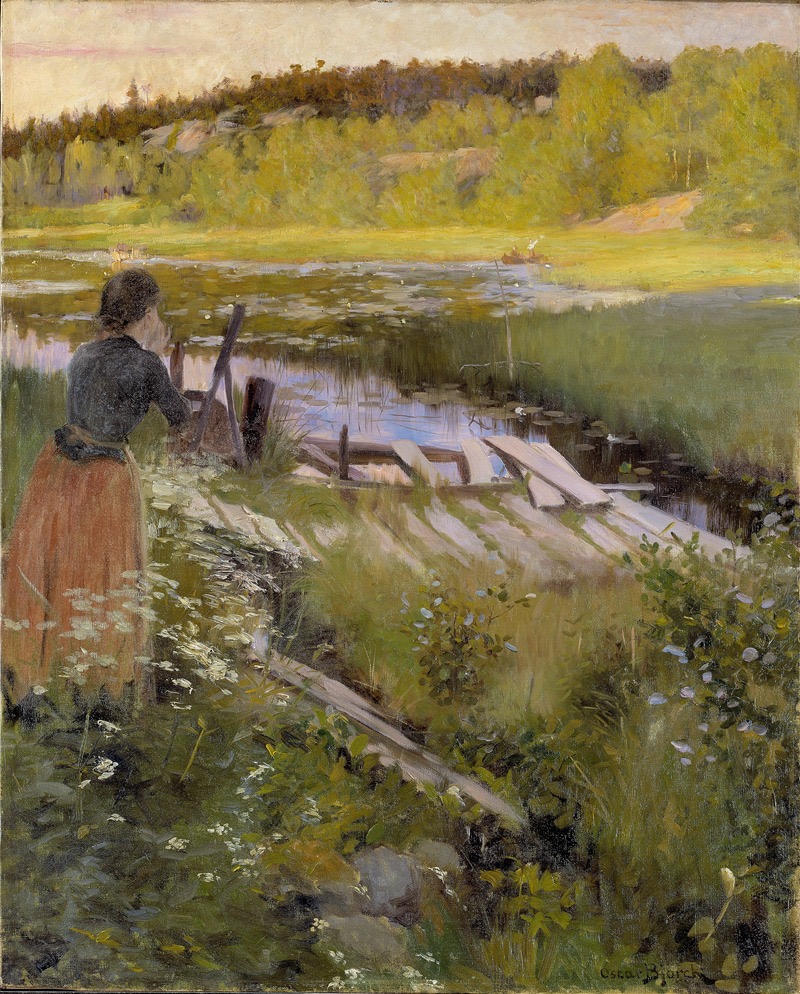
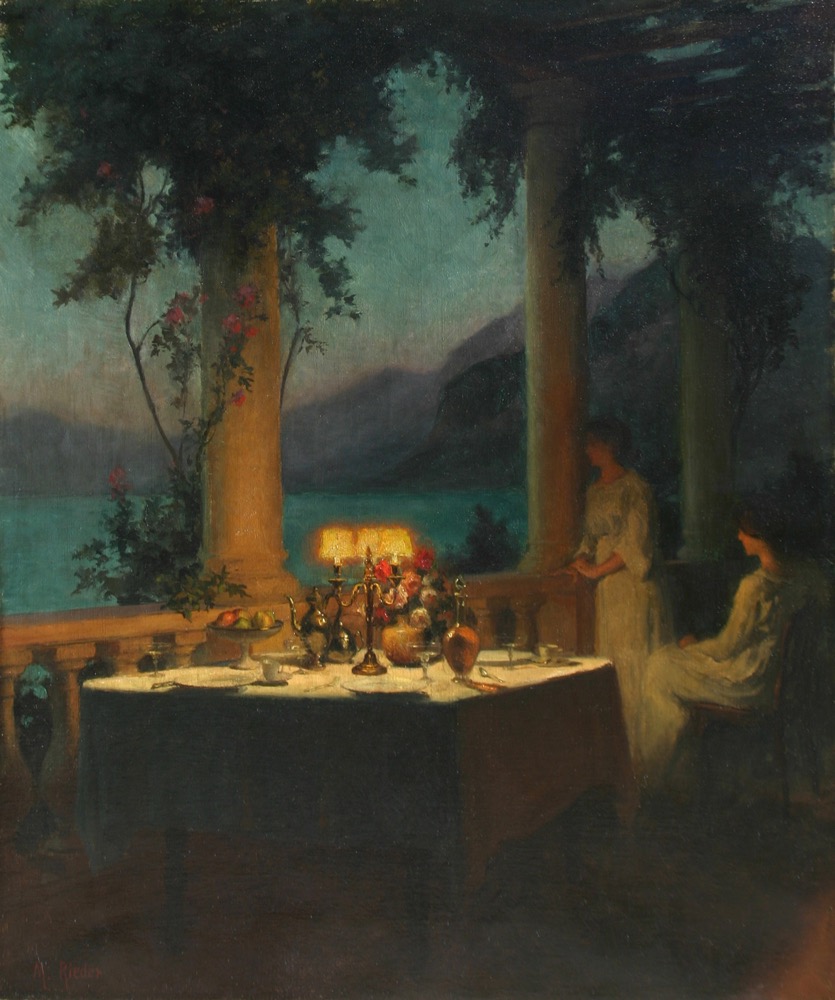
    Artwork: Vid insjön. Motiv från Balingsta, Oscar Björck
    Leave a comment

    💌hello@betweeneverywhereandnowhere.com

  • All It Takes Is a Piece of Art

    All It Takes Is a Piece of Art

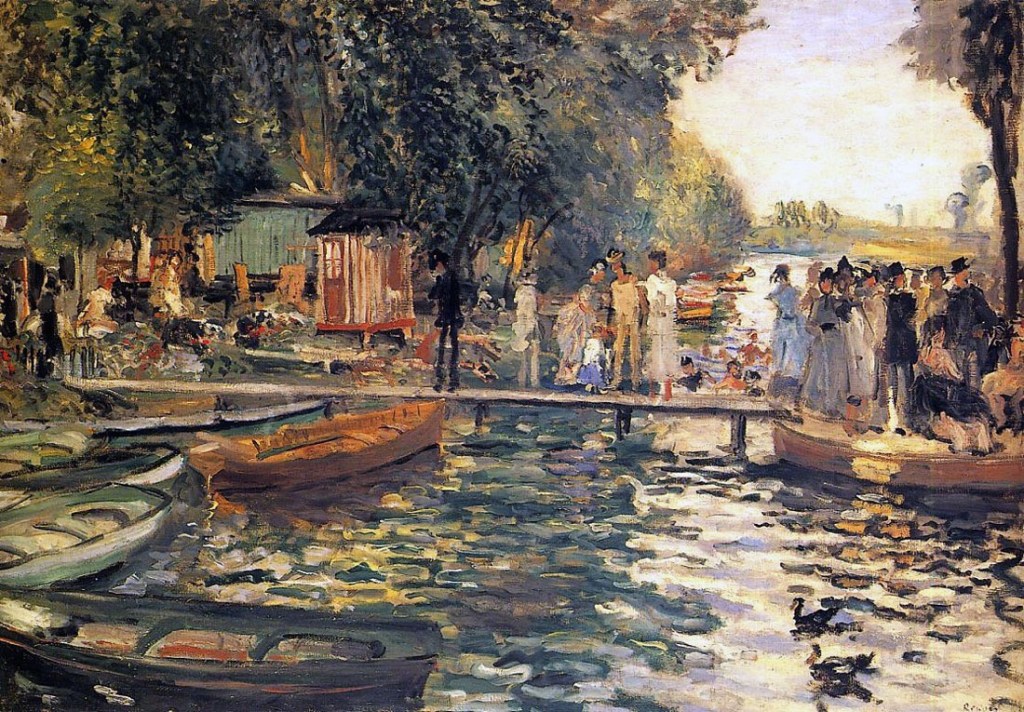
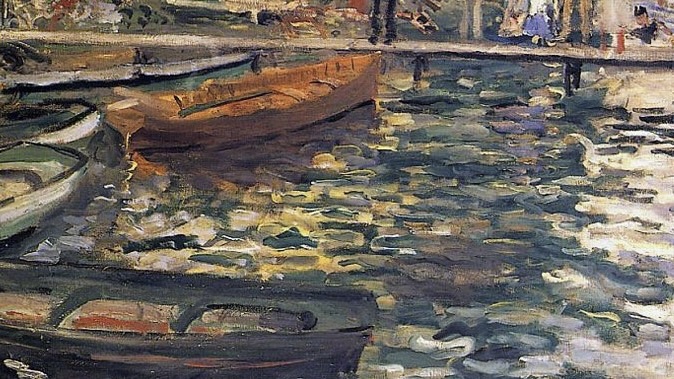
    I have come across La Grenouillère by Pierre-Auguste Renoir many times before. Recently, I found myself returning to it once again.

    Every time I encounter it, a different detail seems to call for my attention. Yet each encounter reveals something even more interesting: I am no longer the same person who stood before it the last time.

    The painting itself has never changed. I have.

    Sometimes, all it takes is a piece of art.

    But then again, what is a piece of art, anyway?

    Is it a classical painting hanging in a museum? A musical composition? A novel? A flower you planted in your garden? A journal filled with your own thoughts? Or perhaps even a phonk track that unexpectedly speaks to you on an ordinary afternoon?

    Maybe art is simply whatever awakens something within you.

    Whatever makes you pause for a moment, fuels your energy for the day, or quietly catches your attention and asks you to look a little closer.

    I often think that art reveals itself in far more places than we usually allow it to. Why did that particular song catch your ear? Why does that brand appeal to your taste? Why did you choose that print for your wall instead of countless others? What made you plant that particular flower?

    Those choices may seem insignificant, but they are rarely random.

    And perhaps spending time with our tastes is one of the simplest ways to get to know ourselves. Not because our preferences define us completely, but because they leave small clues behind. They reveal what draws us in, what comforts us, what we long for, and what we instinctively notice before anything else.

    In the rush of everyday life, many of these choices become automatic. We consume, choose, scroll, decorate, listen, and move on without ever asking ourselves why.

    But what if we did ask?

    What if we paid a little more attention to the things that consistently catch our eye?

    For me, looking at La Grenouillère this time felt strangely similar to opening an old journal and realizing how quietly my identity has evolved over the years.

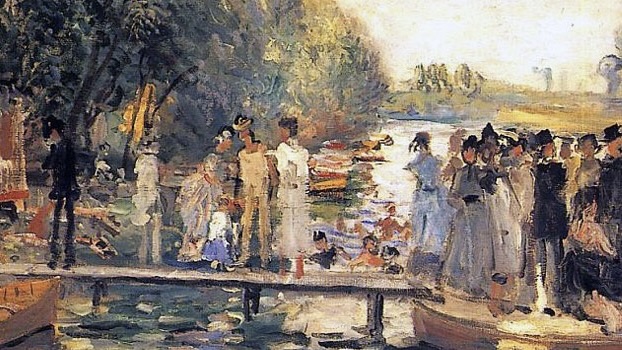
    The first time I truly paid attention to the painting, my eyes were drawn to the crowd. I could almost hear the conversations, the movement on the bridge, the liveliness—perhaps even an unrefined rush—of people making their way home.

    This time, however, I noticed something entirely different.

    I heard the gentle movement of the water. I noticed the small boats floating peacefully.

    Instead of the noise of the crowd, I imagined the quiet humming that might have existed within each person. I could almost smell the mossy air surrounding the river. Rather than focusing on the people themselves, I found myself absorbed by the serenity holding the entire scene together.

    The painting had not changed. The story I found within it had.

    Whenever I read analyses of La Grenouillère, they often describe something entirely different from what it awakens in me. And perhaps that is exactly the point.

    I am less interested in discovering what Renoir intended than in understanding what the painting reveals about me.

    Art, to me, has never been about finding the correct interpretation. It is about witnessing the quiet dialogue between the artwork and the person standing before it.

    And this may be why some forms of art feel distant or even cold to us. Not because they lack meaning, but because they are speaking a language that is not ours. They still move someone, inspire someone, or reveal something to someone. They simply may not be speaking to us—or at least not to the version of us standing before them today.

    And this may be where many people lose their connection with art. We often assume that art must look a certain way, belong in certain places, or require a particular kind of knowledge to be appreciated. But art does not have to hang in a museum to be art.

    The issue may not be that we do not understand art. Perhaps we simply have not yet discovered the forms of it that speak to us.

    Nowadays, we constantly feel the urge to produce, to be seen, to improve ourselves, to turn every experience into something useful. We often approach the world expecting every book, conversation, trip, or hobby to teach us something immediately.

    But how often do we simply allow ourselves to experience something?

    To pause. To notice. To absorb.

    To let something exist for the simple experience of being present, of feeling alive, of meeting ourselves where we are.

    Perhaps that is why paying attention to what we call art matters. Not because art will tell us who we are, but because it often shows us where our attention naturally goes.

    Perhaps that is why art keeps finding us.

    Not because it changes. But because we do.

    To relax, to realize, to pause, to awaken our senses, to quiet the talkative fairies in our heads, to meet ourselves—sometimes, all it takes is a piece of art.

    Leave a comment

    💌hello@betweeneverywhereandnowhere.com

  • What I Read, What I Become

    What I Read, What I Become

    How do you choose a book? How do you see it?

    Or perhaps a better question is this: what makes something worthy of becoming a book in the first place? Is it the story, the ideas, the language, or simply the possibility that someone else’s mind might resonate with ours?

    I have come to believe that the books we choose reveal where we stand at a particular stage of our lives.

    Most of the time, I gravitate towards books that challenge me—books that introduce unfamiliar ways of thinking and quietly stretch the limits of my understanding. Yet there are periods when I feel isolated, when I crave belonging more than intellectual stimulation. During those times, I find myself reaching for books that everyone else seems to be reading. Not because they are necessarily better, but because reading them allows me to participate in a shared conversation. Even a brief conversation in front of a bookshelf can satisfy that deeply human desire to belong, if only for a little while, to the same imagined world.

    Which brings me to another question.

    How should one read a book?

    I have taken courses on reading and literary analysis. I have written academic papers and learned countless methods for approaching a text. They all have their value. However, perhaps I had become a little spoiled by knowing those rules that I eventually felt the need to place them quietly in the background. I wanted to discover my own way of reading rather than constantly measuring myself against established criteria.

    During the years when I was choosing my university major, several people encouraged me to study literature instead of translation studies. I always found myself resisting that advice. It was never because I lacked respect for literature—quite the opposite. I was simply more fascinated by the destination than by the journey. I was interested in the work that finally emerged rather than in every step that had led the writer there.

    What fascinated me was never how a book came into existence, but what happened after it reached the reader. Because from that moment on, the journey no longer belonged solely to the writer. It belonged to me.

    Reading became a way of observing not only the book, but also myself. The books I returned to, the ideas I resisted, the characters I admired or quietly disagreed with—all of them became subtle ways of understanding who I was becoming. Books have always felt like some of the safest companions in that process.

    This approach may be wrong. It may be right. Or it may even be disrespectful.

    Or it may even be exactly what many writers secretly hope for.

    I have never read a book primarily to study its author. I read it for the universe it opens before me and for the candle it manages to light somewhere in my mind. Only after wandering through that universe that I begin to wonder about the person who created it—not the other way around. I have always enjoyed the ultimate stance of “art for people’s sake”.

    Reading, for me, has never been passive. Every book eventually becomes a conversation.

    Sometimes I imagine a different setting that feels more convincing to me. Sometimes I reshape the characters’ appearances according to my own imagination. If a detail is essential to the story, I do not erase it; I simply let my imagination bend around it until it finds room for both the author’s intention and my own.

    Is that a betrayal of the book? Or is that precisely what literature is meant to awaken?

    When we stand before a bookshelf, what are we really choosing?

    Another culture or the comfort of our own?

    A challenge to our assumptions or the reassurance of familiar expectations?

    Do we read to learn, to escape, to belong, to witness another life, or simply to rest inside a quieter universe for a while?

    Do we choose books in their original language because we want to hear the author’s own voice? Or do we look first at the translator or the publishing house because we trust the way they carry one world into another?

    Most of us probably never stop to ask ourselves these questions. Our choices often feel instinctive. Yet perhaps those instincts are far from random.

    Perhaps what happens in our minds when we reach for a book reveals more about us than we realize.

    Like a detective studying scattered clues, what if we examined our reading habits with the same curiosity? Could our reading habits become a mirror?

    Reading has never felt like a manual to me. It has always felt like an expedition. And I have come to believe that, on this journey, the only reliable guide is the reader themselves.

    You may lose yourself between the lines. You may feel distant from an idea. You may not understand every word. You may read with your imagination more than with your eyes. You may become frustrated, delighted, or find yourself unable to decide what to think at all.

    None of these are signs that you are reading incorrectly.

    They are signs that, somewhere along the way, the book has begun to touch something uniquely yours.

    Perhaps that is what “how to read a book” has always meant to me.

    Not finding the most efficient method. Not reading according to academic expectations.

    Not proving how intellectually capable we are. But discovering what kind of reader we naturally become.

    The way we read is rarely accidental. It reflects not only who we are, but sometimes who we long to become. The worlds we repeatedly return to may be the ones we quietly seek in our own lives. The stories that comfort us may reveal the shelter we need. Even the books we cannot bring ourselves to finish may tell us something about ourselves. Sometimes, a book simply becomes a temporary refuge in a universe we may never inhabit beyond the page.

    The books that stay with us are rarely the ones we have read “correctly.” They are the ones that reveal something about ourselves—what captures our attention, what unsettles us, what sparks our imagination, and what quietly lights another candle in our minds.

    Knowing how you read a book, in the end, is another way of knowing who you are—or perhaps who you are becoming.

    Because reading has never been merely about understanding books.

    It is about slowly, quietly, and honestly learning to understand ourselves through them.

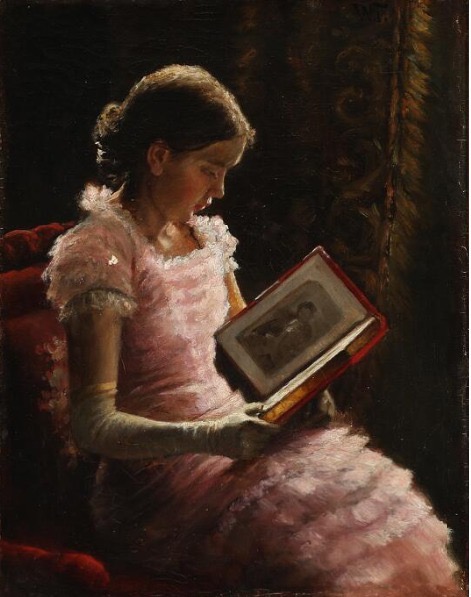
    Artwork: A Girl in a Pink Dress Reading, Wenzel Tornøe

    Leave a comment

    💌hello@betweeneverywhereandnowhere.com

  • My Life Had Stood a Loaded Gun

    My Life Had Stood a Loaded Gun

    There are certain sentences that feel less like literature and more like recognition. You do not simply read them; you recognize something that has been quietly living within you all along.

    This is how I feel whenever I truly pause at Emily Dickinson’s My Life Had Stood a Loaded Gun. Words written by a stranger, perhaps centuries ago, can suddenly become mirrors for thoughts I had never managed to articulate myself.

    My Life Had Stood – a Loaded Gun –.

    The metaphor has stayed with me ever since.

    What if my life has stood like a loaded gun, and every experience I have lived has become another bullet?

    But then another question followed.

    What are these bullets really made of?

    Could words themselves become my bullets in this lifetime?

    Who decides where they are aimed?

    Am I truly capable of deciding what this gun will yield, or am I merely the one carrying it?

    For a long time now, I have been trying not to resist what people often call the flow. Yet before surrendering to an idea, I cannot help questioning it.

    Can we truly persuade ourselves that such a thing exists?

    We speak of flow as though it were self-evident. We encourage one another to trust it, surrender to it, and stop resisting it. Yet if there truly is a flow, why am I being carried into this one and not another? Could its mystery lie in never knowing its direction, its contents, or the story into which it has already placed us?

    Despite these questions, I still believe in free will. I believe in planning, determination, responsibility, and conscious decisions. Yet I cannot ignore that life continually confronts us with boundaries we never chose ourselves: the things that happen, the things that never happen, the opportunities that quietly appear, the ones that disappear despite every effort, and the unexpected situations into which we somehow find ourselves being pulled.

    If there truly is a flow, perhaps we do not simply believe in it—we eventually recognize it through the shape our lives take.

    For as long as I can remember, I have believed that nothing happens in vain.

    And for me, it has never been Why me?

    It has always been Why this?

    Life simply keeps happening to everyone.

    Beautiful things. Painful things.

    Ordinary things. Life-changing things.

    None of them belong exclusively to us.

    What fascinates me is not that these things happen.

    It is how differently they continue to exist after they have happened.

    The very same event may quietly dissolve into one person’s memory while becoming another person’s identity.

    A conversation, a rejection, a delayed train, a city, a diagnosis, a book, a success, or even a stranger encountered only for a brief moment may continue living within someone for years—not because the event itself was extraordinary, but because of the meaning gradually woven around it.

    Perhaps this is also why I have never felt comfortable with how easily we reduce life’s turning points to heartbreak.

    Is that really the case?

    Perhaps we call it heartbreak because every outcome eventually finds its way into the heart. Every ending, every disappointment, every unanswered question seems to leave something behind there.

    But does everyone truly carry life in the heart?

    Or do some carry it somewhere else? Or nowhere at all?

    Perhaps that is another question altogether.

    There are heartbreaks, certainly.

    But along with heartbreaks, there are also mind-breaks.

    Dream-breaks. Ideal-breaks. Identity-breaks.

    And countless quieter fractures that rarely have a name.

    Sometimes what changes us is not the loss of a person, but the loss of an idea. A certainty. A future we had already begun living inside our minds. A version of ourselves that never came into existence.

    Perhaps these are the bullets.

    Not the events themselves, but the meanings we slowly forge from them.

    The bullet is not the rejection, the city, the illness, the book, the success, or the heartbreak. Those belong to life.

    The bullet is what remains after they pass through us—the meaning that quietly settles within us, gradually shaping how we understand ourselves and, eventually, how we move through the world.

    Maybe that is why nothing happens in vain.

    Not because every event carries an objective purpose waiting to be discovered, but because meaning is never entirely contained within the event itself. It comes into existence in the encounter between life and the person living it.

    Perhaps this is also why I have never been interested only in asking what happened.

    I find myself asking a different question nowadays.

    Who did it happen to?

    Because perhaps that is where meaning truly begins.

    The event may be ordinary. The person who carries it never is.

    That ordinary event may eventually become a painting, a piece of writing, a photograph, a melody, a conversation remembered years later, or even a small pin attached to someone’s bag.

    The event belongs to life.

    The meaning gradually becomes part of the person.

    So why am I here, thinking these thoughts and sharing them?

    And why are you here, reading and witnessing my possible bullets?

    Out of all the places in this virtual universe and out of all the words ever written, why would our paths happen to cross here, in this particular moment?

    Maybe there is no answer.

    Or perhaps there never needed to be one.

    Perhaps what we spend a lifetime carrying is not the weight of our experiences, but the meanings we create from them.

    And perhaps what this loaded gun ultimately yields has never depended solely on what happened to us, but on who we became while carrying every bullet.

    Artwork: Expectations, Sir Lawrence Alma-Tadema

    Leave a comment

    💌hello@betweeneverywhereandnowhere.com

  • Mind Your Own Mind

    Mind Your Own Mind

    What makes you who you are?

    Your name?

    Your nationality?

    Your profession?

    Your family?

    They all tell a part of your story. But if someone were to quietly remove every label attached to you, I believe there would still be one thing left.

    Your mind.

    Not simply your thoughts, but your way of perceiving, interpreting, remembering, imagining, fearing, and hoping. The invisible place through which every experience must pass before it becomes yours.

    If I had to describe the mind in one sentence, I would say this:

    It is the ultimate digestion of our lives.

    Some experiences are unavoidable—the main course served to every one of us. Others are chosen deliberately, like the appetizers we pick ourselves: the books we read, the people we love, the conversations we revisit, the fears we rehearse, the songs that become memories, and the ideas we repeatedly feed ourselves.

    Our minds digest all of them.

    Eventually, they become us.

    Perhaps this is why I find it difficult to separate myself from my mind. Knowing my own mind feels remarkably close to knowing myself.

    We spend remarkable amounts of time protecting what matters to us.

    We monitor our blood pressure, check our cholesterol, apply sunscreen, lock our doors, and create increasingly complicated passwords. We have become more willing than ever to talk about mental health, and I am genuinely glad we do.

    Yet I sometimes wonder whether we have become so focused on repairing the mind that we forget to become acquainted with it.

    Most conversations begin only after something goes wrong.

    Stress.

    Burnout.

    Anxiety.

    Depression.

    Exhaustion.

    Only then that we ask what the mind needs.

    But perhaps there is another question worth asking long before that.

    What kind of mind do I actually have?

    Not the ideal mind promoted by productivity books.

    Not the perfectly balanced mind described on social media.

    Not someone else’s mind.

    Mine.

    What calms it?

    What overwhelms it?

    What makes it curious?

    What quietly exhausts it?

    Perhaps the healthiest relationship with our minds begins not by trying to optimize them, but by learning their language.

    Have you ever noticed what almost every horror story has in common?

    Before the monster attacks the body, it attacks the mind.

    The victim begins doubting reality.

    They stop trusting their memories.

    They question what is real.

    Long before physical danger arrives, the real battlefield has already moved inward.

    The greatest horror has never been seeing a monster.

    It has always been losing confidence in your own perception.

    Ghosts, haunted houses, and demons become frightening only after they convince someone that their own mind is no longer a trustworthy place to live.

    That idea has always fascinated me.

    Even the creatures we imagine existing beyond human understanding somehow know the shortest path to defeating us.

    Not through the body. Through the mind.

    Perhaps horror stories remind us of something we rarely acknowledge.

    The mind is where reality first takes shape.

    Stress alone can produce genuine physical symptoms. Health anxiety can persuade someone that ordinary bodily sensations signal serious illness. A person may continue feeling pain in a limb that no longer exists because the brain still carries its map. There are even neurological conditions in which someone may no longer recognize a perfectly healthy part of their own body as belonging to them.

    These examples are very different from one another.

    Yet they all point toward the same conclusion.

    Reality is not merely something that happens to us.

    It is also something interpreted by the mind.

    That realization makes the mind both our greatest strength and our greatest vulnerability.

    It shapes how we see ourselves.

    How we respond to uncertainty.

    How we regulate anger.

    How we trust.

    How we love.

    How we forgive.

    How we decide whether to continue—or finally stop.

    If there is a remote control for our lives, I suspect it is the mind.

    This is why I have become increasingly interested in paying attention to my own.

    Not improving it. Not optimizing it. Simply getting to know it.

    I have no formal education in psychology or neuroscience, apart from a few unforgettable psycholinguistics courses that first made me realize how mysterious the mind truly is.

    I am simply an ordinary person who depends on it every single day.

    As someone who works with languages and translation, I know what it feels like for the mind to continue working long after the laptop has been closed. Sentences quietly keep rewriting themselves while I make coffee or walk down the street.

    Over time, I have realized that my mind has preferences just as individual as my personality.

    Perhaps yours does too.

    Maybe your mind genuinely enjoys crowded cafés.

    Maybe mine prefers silence.

    Maybe someone else’s mind settles after running five kilometers.

    Maybe mine simply wants to spend an hour beneath the warm glow of a floor lamp with a novel while the rest of the world quietly waits outside.

    No article can tell us these things.

    No expert can answer them for us.

    Only our own minds can.

    Perhaps learning to know them is a form of respect we rarely speak about.

    Our minds accompany every second of our existence without ever introducing themselves. 

    We usually notice them only when something begins to fail. 

    Maybe we should become familiar with them before that moment.

    Not because every uncomfortable feeling needs fixing.

    Not because we should become obsessed with protecting our minds.

    But because they are irreplaceable.

    We spend a lifetime trying to understand the world.

    Perhaps we should also spend some time understanding the only place from which we will ever experience it.

    Our own mind.

    Perhaps mind your own business was never the advice we needed.

    Perhaps we should begin somewhere even closer.

    Mind your own mind.

    Because every experience in your life will pass through only one place before it becomes yours.

    Your own mind.

    And perhaps knowing that mind is the closest you will ever come to knowing yourself.

    Artwork: The Sun, Edvard Munch

    Leave a comment

    💌hello@betweeneverywhereandnowhere.com

  • Ears Are Calling for Attention

    Ears Are Calling for Attention

    When our eyes get tired, we close them.

    When our skin is exposed to the sun, we protect it.

    When our muscles ache, we slow down and let them recover.

    But when was the last time you thought about your ears?

    To be honest, most of us probably never do.

    Perhaps because they rarely complain. They don’t become visibly red after a long day. They don’t ask us to blink or stretch. They simply keep listening.

    And maybe that is exactly why we expect so much from them.

    Ironically, every time we try to give our eyes a break, we ask our ears to work even harder.

    We replace books with audiobooks. We switch from scrolling to podcasts. We wear headphones while working, exercising, commuting, studying—even while trying to fall asleep. Earphones have become part of our outfits as much as our accessories.

    Without realizing it, we’ve turned listening into a full-time job.

    Yet our ears do far more than deliver sounds.

    They help us stay balanced, literally. They constantly collect information about our surroundings, allowing us to locate danger, recognize familiar voices, enjoy music, learn languages, and communicate with one another. Every sound we hear is translated into electrical signals before our brain turns them into something meaningful.

    They quietly connect us with the world.

    And they have always meant more than anatomy alone.

    Across different cultures, ears symbolize attention, wisdom, obedience, and the willingness to receive truth. Protective earrings have been worn for centuries, believed to ward off harmful spirits. In my own culture, when we hear something unpleasant, we gently pull one of our earlobes—as if hoping those words never become part of our reality.

    Perhaps people have always understood that ears deserve a certain kind of respect.

    Time, however, reminds us how fragile they are.

    Every passing year changes what we can hear. Our ability to detect high frequencies gradually fades, often so slowly that we never notice it happening. Somewhere around us, a bird may still be singing exactly the same song it always has. The sound hasn’t disappeared. Our ears have simply become unable to meet it.

    Perhaps that is one of the reasons I enjoy listening to classical music now rather than saving it for later.

    People around me often say, “I’ll appreciate classical music when I’m older. Right now is the time for louder, livelier things.” I understand what they mean. But I sometimes wonder if we assume our ears will always be waiting for us.

    The truth is, they won’t.

    The ears I have today are not the ears I will have twenty or thirty years from now. The delicate overtones of a violin, the quiet resonance of a piano, the subtle layers hidden inside an orchestra—some of them may gradually become harder to hear. Not because the music has changed, but because I have.

    It reminds me of how easily we adapt to volume. A new pair of headphones can seem overwhelmingly loud at first, yet after a while the same setting feels perfectly normal. We keep turning the volume up, rarely noticing that our hearing has quietly adapted—or quietly faded.

    Perhaps some sounds are not meant to be postponed.

    Maybe that is also why silence is not an absence at all.

    It is a form of care.

    Research suggests that intentional periods of silence may reduce stress hormones, support emotional regulation, improve attention, and even encourage changes in the brain associated with learning and memory. We often think of silence as something empty, but perhaps it is one of the richest gifts we can offer our minds—and our ears.

    We spend our lives asking our ears to listen.

    To conversations.

    To notifications.

    To traffic.

    To music.

    To the endless soundtrack of modern life.

    Yet we rarely ask what they need in return.

    Perhaps they ask for two things.

    Moments of silence.

    And beautiful sounds while they are still able to hear them in all their richness.

    Don’t save them for another season of your life.

    Your ears are growing older, too.

    Artwork: The Great Wave off Kanagawa, Katsushika Hokusai.

    Additional note: Claude Debussy admired this iconic woodblock print so deeply that a cropped version of it was chosen for the cover of the first published edition of La Mer (1905), one of the most celebrated orchestral works inspired by the sea.1

    Leave a comment

    💌hello@betweeneverywhereandnowhere.com

  • Maybe We Were Meant to Be Strangers

    Maybe We Were Meant to Be Strangers

    Sometimes all it takes is a single word.

    Not a conversation. Not a life-changing event. Just a word that catches your eye and quietly settles somewhere in your mind.

    That was exactly what happened when I first saw the cover of Strangers by Belle Burden.

    The word stayed with me for days.

    Strangers.

    Such a simple word, yet deeply unsettling.

    It made me think about relationships—not only romantic ones, but all the meaningful connections we build throughout our lives.

    Love and relationships have long inspired art, literature, philosophy, and no small amount of emotional turmoil—along with more than a few conversations in therapists’ offices. We talk endlessly about butterflies in our stomachs, the lightness of happiness, the feeling of trust, the excitement of discovering another human being, and the comfort of feeling understood.

    But what exists on the other side of the coin?

    What causes the deepest disappointment? What prevents some people from fully embracing romance, even when they long for it?

    I sometimes think it is the fear of becoming strangers one day.

    Not heartbreak itself. Not rejection.

    But the possibility that someone who once knew your thoughts, habits, fears, dreams, and vulnerabilities may eventually become someone you no longer know at all.

    No one enters a relationship expecting it to end.

    No one gets married planning for divorce.

    No one opens their heart hoping to close it again someday.

    Yet there is something curious about the way we approach relationships. We acknowledge that life is finite, but we often struggle to accept that relationships are finite too.

    Being alive is the clearest reminder that everything we experience is temporary. Relationships are not exempt from that reality.

    Perhaps this is where idealization enters the story.

    When we fall in love, we rarely see reality alone. We see possibilities, projections, expectations, and stories we have already written in our minds. Sometimes we idealize the other person. Sometimes we idealize ourselves. We create a scenario and unconsciously expect reality to follow the script.

    Maybe this is why we often imagine ourselves living in a romantic Hollywood film.

    We envision meaningful conversations, grand gestures, lifelong companionship, and a happy ending patiently waiting at the end of the story.

    Then one day, we find ourselves in a desperate Russian novel, wondering where all the romance went.

    How do we end up there?

    Often, it is not the relationship itself that takes us there, but the gap between reality and our idealization of it.

    The more attached we become to the fantasy, the more disappointed we feel when reality introduces itself.

    At some point, we may find ourselves chasing the ghost of our own idealization rather than getting to know the person as they truly are.

    Maybe the problem is not that relationships end, but that we expect them to fulfill a story we have already written in our minds.

    Perhaps we need to learn how to recognize the ghost of our own idealization before we mistake it for reality.

    Perhaps the hardest part of recognizing our idealizations is admitting that they rarely begin with other people.

    For a long time, I believed that if someone crossed my path, there had to be something extraordinary about them. I placed people on pedestals they had never asked to stand on and expected them to live up to a potential that often existed only in my imagination.

    What I failed to realize was that I treated myself the same way.

    I had become a demanding and unforgiving partner to myself—a quiet dictator of my own expectations.

    I expected constant growth, certainty, and purpose. I mapped out a route for my life and assumed that the people who entered it would naturally fit the story I had written.

    But neither they nor I were meant to be extraordinary all the time.

    Perhaps one of the most humbling lessons of adulthood is accepting our own ordinariness—not as a limitation, but as a shared human experience.

    Because when we allow ourselves to be imperfect, we become more capable of seeing others as they truly are: not as potential, not as projections, but as people.

    Sometimes, the headache is not the relationship itself.

    Sometimes, it is the impossible expectations we place on ourselves—and, inevitably, on others.

    And once we let go of those expectations, a different question emerges.

    I remember a friend once saying to me, “For just one day, let’s not learn anything. Let’s not split the atom. Let’s simply stare at the wall for a while.”

    Then they asked me a question that stayed with me long after the conversation ended:

    “Why is that so difficult for you?”

    At the time, I did not have an answer.

    I had become so focused on growth, progress, and meaning that I had forgotten something simple: not every moment needs to become insight, and not every experience needs to turn into a lesson.

    Sometimes, a single sentence is enough.

    Sometimes, people arrive not to redirect the entire course of our lives, but simply to remind us to stop resisting its flow.

    For so long, I tried to plan the speed and direction of every wave.

    What I needed to learn instead was how to stop fighting the current.

    As I grow older, I find myself thinking less about whether relationships last forever and more about why people enter each other’s lives in the first place.

    I believe that everyone crosses paths with us for a reason.

    Some people help us heal.

    Some challenge us.

    Some expose our insecurities.

    Some teach us trust.

    Others teach us boundaries.

    Some remind us of our strengths.

    And some arrive only to teach us how to say goodbye.

    One way or another, I believe that people encounter each other to heal, challenge, polish, or discover parts of themselves that might otherwise remain hidden.

    Perhaps this is why I no longer see every relationship through the lens of permanence.

    Not every meaningful relationship is meant to end with “happily ever after.”

    Some relationships are meant to end.

    Some are meant to transform.

    Some are meant to leave us with a lesson we could not have learned otherwise.

    A relationship does not have to last forever to be meaningful. It does not have to resemble a fairy tale—or a fairy tale gone wrong.

    Perhaps it simply unfolds the way it was meant to for that particular chapter of our lives.

    Or perhaps it was never about the fairy tale at all.

    Perhaps it was about who we became because of it.

    Healing sometimes comes after learning to let go. Life is not linear, and neither are relationships.

    There are seasons of closeness and distance, certainty and confusion, connection and separation.

    Some relationships end because they were never meant to continue. Others end because they have already fulfilled their purpose.

    This may sound uncomfortable, but I do not believe that a relationship ending in separation automatically makes it a failure.

    Likewise, a relationship ending in marriage does not automatically make it a success.

    Success is not always staying.

    Sometimes success is learning.

    Sometimes success is growing.

    Sometimes success is accepting what is beyond our control.

    A relationship can leave two people wiser, more self-aware, and more compassionate than they were before. If that happens, was it truly a failure?

    I do not think so.

    There is another thought that often comes to my mind.

    None of us is truly irreplaceable.

    At first glance, this may sound cold.

    But I do not mean that people are disposable or insignificant.

    What I mean is that love loses much of its meaning the moment it becomes a necessity rather than a choice.

    If two people stay together only because they have no alternative, there is little beauty in that.

    What gives a relationship value is choice.

    Every day, among countless possibilities, two people continue choosing one another.

    Not because they must. Not because they are trapped. Not because they cannot survive alone.

    But because they believe that learning, growing, healing, laughing, struggling, and experiencing life together is a journey worth sharing.

    Perhaps love is not about finding someone who can never be replaced.

    Perhaps it is about choosing each other again and again—not because life conveniently carries you in the same direction, but because despite the unexpected turns, changing circumstances, disappointments, and transformations that life inevitably brings, you still find meaning in walking together.

    After all, neither of you will remain exactly who you are today.

    And perhaps this is also why becoming strangers is not the tragedy we often imagine it to be.

    Becoming strangers does not erase what once existed.

    It does not erase the conversations, the growth, the lessons, the memories, or the version of yourself that emerged because that person was once part of your life.

    Some people stay. Some leave. Some become strangers.

    But all of them contribute something to the story of who we become.

    So, if there is anything I have learned, it is this:

    Do not be too hard on yourself.

    Allow yourself to feel happiness, anger, disappointment, gratitude, regret, hope, and heartbreak when they come.

    Digest the experience rather than rushing to label it a success or a failure.

    Get to know yourself before trying to understand someone else.

    Learn what kind of people you attract, what kind of people you are attracted to, and what patterns keep repeating themselves throughout your life.

    There are answers hidden inside those patterns.

    And whenever possible, look through the lens of healthy realism rather than idealization.

    Because in the end, life is not a collection of permanent possessions.

    It is a collection of experiences.

    And relationships, regardless of how long they last, remain some of the most meaningful experiences we will ever have.

    Perhaps that is why I no longer see them as successes or failures.

    Only experiences.

    Some shorter.

    Some longer.

    All meaningful in their own way.

    Perhaps that is enough.

    Artwork: At the Mirror, Gerda Wegener

    Leave a comment

    💌hello@betweeneverywhereandnowhere.com

  • This Virtual Corner Turns One

    This Virtual Corner Turns One

    A year ago, I decided to create a small corner for myself in the vast ocean of the internet.

    I called it between everywhere and nowhere because it seemed to capture exactly what I was trying to do: bringing together nowhere—the virtual world—and everywhere—the places my thoughts had travelled.

    At the time, I did not have a master plan. If anything, this blog began as a small act of rebellion against my own habits.

    I wanted to prove to myself that not everything needs to be optimized, categorized, justified, or turned into an achievement. Some things can exist simply because they are worth doing. Because they help us reflect. Because they help us understand ourselves a little better. Because sharing an experience can sometimes be reason enough.

    I assumed these posts would quietly occupy a few servers somewhere in the world and little more.

    What I did not anticipate was how much writing here would change my understanding of sharing.

    I have always considered thoughts to be among the most private and sacred parts of a person.

    Not because they are necessarily brilliant or unique, but because of what they are made of.

    A thought is rarely just a thought. It is an accumulation of observations, mistakes, curiosities, disappointments, discoveries, memories, conversations, and countless invisible connections made somewhere within the mental faculty. It is evidence that a person has passed through life in a particular way and attempted to make sense of it.

    For that reason, I kept many of my thoughts to myself for a long time. Publishing them felt vulnerable, unsurprisingly.

    Yet over the past year, I realized that sharing a thought does not diminish its intimacy. Sometimes, it even expands its purpose.

    What feels deeply personal to one person may feel deeply familiar to another.

    Somewhere in the world, there may be someone asking the same question, carrying the same uncertainty, navigating the same experience, or searching for words for something they have never quite been able to articulate.

    Perhaps this blog has simply been my way of saying:

    “I experienced this. I reflected on it. This is what remained after I tried to understand it. Here it is. If any part of it resonates with your own journey, you are welcome to take it with you.”

    Here, I have offered neither a lesson nor a universal truth. Only an experience and the meaning I happened to draw from it.

    What continues to fascinate me is how a thought, once released, can be received through lives, beliefs, perspectives, and stories that may have little in common with my own.

    It returns in different coats—critical or compassionate, skeptical or spiritual, certain or questioning—and yet it arrives all the same. Meeting beneath the same sky of human experience.

    Looking back, I think this blog has also been my way of letting go. For most of my life, I kept my thoughts close to myself.

    Then one day, I folded them into little virtual paper boats and released them into the vast ocean of the internet.

    I did not know where they would drift. I did not know whether they would disappear among millions of other voices.

    Instead, I watched them travel.

    Across screens. Across cities. Across countries.

    Across lives I will probably never know.

    In a very tangible sense, this blog became my farewell to a certain kind of reserve I had always carried with me.

    It also became a quiet reminder that I do not always have to resist the currents.

    Some things in life are not meant to be controlled, only released.

    Writing, I discovered, is one of them.

    Another unexpected gift of this blog was the permission it gave me to use language differently.

    For years, I had grown accustomed to using my mind and my sentences almost exclusively in service of professional purposes.

    To translate. To explain. To communicate. To solve.

    Somewhere along the way, I had placed a seal over the more aesthetic and exploratory side of my relationship with language. This blog helped me remove it.

    It reminded me that sentences can be built not only for others, but also for oneself. Not only to arrive somewhere, but also to wander.

    Beneath that old seal, I discovered colors I had almost forgotten were there.

    You have accompanied these virtual paper boats on their journey.

    You have spent a few minutes with thoughts that once existed only inside my own mind.

    You have challenged them, expanded them, questioned them, and sometimes embraced them.

    You have reminded me that once a thought enters the world, it no longer belongs entirely to the person who created it. And that is a beautiful thing.

    The internet often feels vast, noisy, and impersonal.

    Yet somehow, within that immeasurable ocean, these thoughts found their way from one screen to another. 

    From nowhere. To everywhere. For that, I am genuinely grateful.

    And who knows?

    Perhaps somewhere among all these crossings of thoughts and experiences, there is a bottle drifting through the same waters carrying a life-changing insight, an unexpected truth, or a joke so good that it alters the course of a day.

    Perhaps I will find it tomorrow.

    Or perhaps, I already have.

    Either way, thank you for spending part of your journey between everywhere and nowhere.

    Artwork: Breakfast In The Loggia, John Singer Sargent

    Leave a comment

    💌hello@betweeneverywhereandnowhere.com