Tag: Reflections

  • All It Takes Is a Piece of Art

    All It Takes Is a Piece of Art

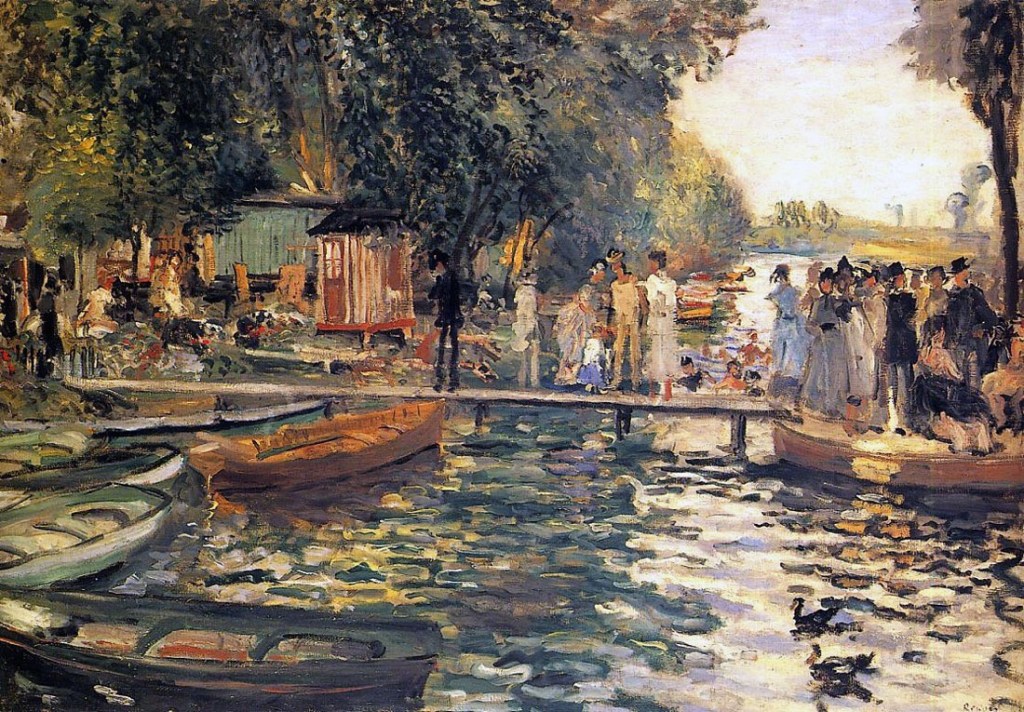
    I have come across La Grenouillère by Pierre-Auguste Renoir many times before. Recently, I found myself returning to it once again.

    Every time I encounter it, a different detail seems to call for my attention. Yet each encounter reveals something even more interesting: I am no longer the same person who stood before it the last time.

    The painting itself has never changed. I have.

    Sometimes, all it takes is a piece of art.

    But then again, what is a piece of art, anyway?

    Is it a classical painting hanging in a museum? A musical composition? A novel? A flower you planted in your garden? A journal filled with your own thoughts? Or perhaps even a phonk track that unexpectedly speaks to you on an ordinary afternoon?

    Maybe art is simply whatever awakens something within you.

    Whatever makes you pause for a moment, fuels your energy for the day, or quietly catches your attention and asks you to look a little closer.

    I often think that art reveals itself in far more places than we usually allow it to. Why did that particular song catch your ear? Why does that brand appeal to your taste? Why did you choose that print for your wall instead of countless others? What made you plant that particular flower?

    Those choices may seem insignificant, but they are rarely random.

    And perhaps spending time with our tastes is one of the simplest ways to get to know ourselves. Not because our preferences define us completely, but because they leave small clues behind. They reveal what draws us in, what comforts us, what we long for, and what we instinctively notice before anything else.

    In the rush of everyday life, many of these choices become automatic. We consume, choose, scroll, decorate, listen, and move on without ever asking ourselves why.

    But what if we did ask?

    What if we paid a little more attention to the things that consistently catch our eye?

    For me, looking at La Grenouillère this time felt strangely similar to opening an old journal and realizing how quietly my identity has evolved over the years.
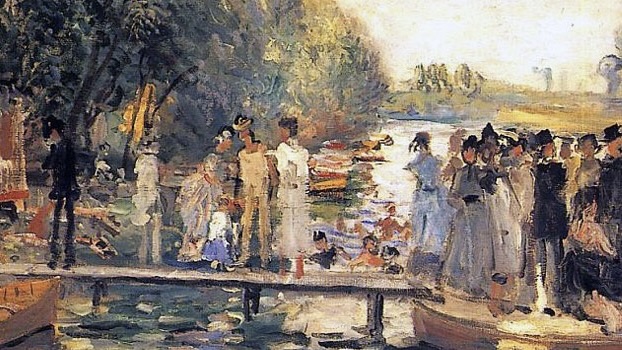
    The first time I truly paid attention to the painting, my eyes were drawn to the crowd. I could almost hear the conversations, the movement on the bridge, the liveliness—perhaps even an unrefined rush—of people making their way home.

    This time, however, I noticed something entirely different.
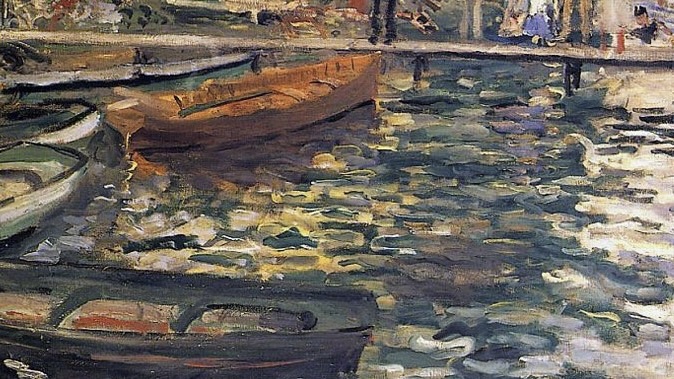
    I heard the gentle movement of the water. I noticed the small boats floating peacefully.

    Instead of the noise of the crowd, I imagined the quiet humming that might have existed within each person. I could almost smell the mossy air surrounding the river. Rather than focusing on the people themselves, I found myself absorbed by the serenity holding the entire scene together.

    The painting had not changed. The story I found within it had.

    Whenever I read analyses of La Grenouillère, they often describe something entirely different from what it awakens in me. And perhaps that is exactly the point.

    I am less interested in discovering what Renoir intended than in understanding what the painting reveals about me.

    Art, to me, has never been about finding the correct interpretation. It is about witnessing the quiet dialogue between the artwork and the person standing before it.

    And this may be why some forms of art feel distant or even cold to us. Not because they lack meaning, but because they are speaking a language that is not ours. They still move someone, inspire someone, or reveal something to someone. They simply may not be speaking to us—or at least not to the version of us standing before them today.

    And this may be where many people lose their connection with art. We often assume that art must look a certain way, belong in certain places, or require a particular kind of knowledge to be appreciated. But art does not have to hang in a museum to be art.

    The issue may not be that we do not understand art. Perhaps we simply have not yet discovered the forms of it that speak to us.

    Nowadays, we constantly feel the urge to produce, to be seen, to improve ourselves, to turn every experience into something useful. We often approach the world expecting every book, conversation, trip, or hobby to teach us something immediately.

    But how often do we simply allow ourselves to experience something?

    To pause. To notice. To absorb.

    To let something exist for the simple experience of being present, of feeling alive, of meeting ourselves where we are.

    Perhaps that is why paying attention to what we call art matters. Not because art will tell us who we are, but because it often shows us where our attention naturally goes.

    Perhaps that is why art keeps finding us.

    Not because it changes. But because we do.

    To relax, to realize, to pause, to awaken our senses, to quiet the talkative fairies in our heads, to meet ourselves—sometimes, all it takes is a piece of art.
    Leave a comment

  • What I Read, What I Become

    What I Read, What I Become

    How do you choose a book? How do you see it?

    Or perhaps a better question is this: what makes something worthy of becoming a book in the first place? Is it the story, the ideas, the language, or simply the possibility that someone else’s mind might resonate with ours?

    I have come to believe that the books we choose reveal where we stand at a particular stage of our lives.

    Most of the time, I gravitate towards books that challenge me—books that introduce unfamiliar ways of thinking and quietly stretch the limits of my understanding. Yet there are periods when I feel isolated, when I crave belonging more than intellectual stimulation. During those times, I find myself reaching for books that everyone else seems to be reading. Not because they are necessarily better, but because reading them allows me to participate in a shared conversation. Even a brief conversation in front of a bookshelf can satisfy that deeply human desire to belong, if only for a little while, to the same imagined world.

    Which brings me to another question.

    How should one read a book?

    I have taken courses on reading and literary analysis. I have written academic papers and learned countless methods for approaching a text. They all have their value. However, perhaps I had become a little spoiled by knowing those rules that I eventually felt the need to place them quietly in the background. I wanted to discover my own way of reading rather than constantly measuring myself against established criteria.

    During the years when I was choosing my university major, several people encouraged me to study literature instead of translation studies. I always found myself resisting that advice. It was never because I lacked respect for literature—quite the opposite. I was simply more fascinated by the destination than by the journey. I was interested in the work that finally emerged rather than in every step that had led the writer there.

    What fascinated me was never how a book came into existence, but what happened after it reached the reader. Because from that moment on, the journey no longer belonged solely to the writer. It belonged to me.

    Reading became a way of observing not only the book, but also myself. The books I returned to, the ideas I resisted, the characters I admired or quietly disagreed with—all of them became subtle ways of understanding who I was becoming. Books have always felt like some of the safest companions in that process.

    This approach may be wrong. It may be right. Or it may even be disrespectful.

    Or it may even be exactly what many writers secretly hope for.

    I have never read a book primarily to study its author. I read it for the universe it opens before me and for the candle it manages to light somewhere in my mind. Only after wandering through that universe that I begin to wonder about the person who created it—not the other way around. I have always enjoyed the ultimate stance of “art for people’s sake”.

    Reading, for me, has never been passive. Every book eventually becomes a conversation.

    Sometimes I imagine a different setting that feels more convincing to me. Sometimes I reshape the characters’ appearances according to my own imagination. If a detail is essential to the story, I do not erase it; I simply let my imagination bend around it until it finds room for both the author’s intention and my own.

    Is that a betrayal of the book? Or is that precisely what literature is meant to awaken?

    When we stand before a bookshelf, what are we really choosing?

    Another culture or the comfort of our own?

    A challenge to our assumptions or the reassurance of familiar expectations?

    Do we read to learn, to escape, to belong, to witness another life, or simply to rest inside a quieter universe for a while?

    Do we choose books in their original language because we want to hear the author’s own voice? Or do we look first at the translator or the publishing house because we trust the way they carry one world into another?

    Most of us probably never stop to ask ourselves these questions. Our choices often feel instinctive. Yet perhaps those instincts are far from random.

    Perhaps what happens in our minds when we reach for a book reveals more about us than we realize.

    Like a detective studying scattered clues, what if we examined our reading habits with the same curiosity? Could our reading habits become a mirror?

    Reading has never felt like a manual to me. It has always felt like an expedition. And I have come to believe that, on this journey, the only reliable guide is the reader themselves.

    You may lose yourself between the lines. You may feel distant from an idea. You may not understand every word. You may read with your imagination more than with your eyes. You may become frustrated, delighted, or find yourself unable to decide what to think at all.

    None of these are signs that you are reading incorrectly.

    They are signs that, somewhere along the way, the book has begun to touch something uniquely yours.

    Perhaps that is what “how to read a book” has always meant to me.

    Not finding the most efficient method. Not reading according to academic expectations.

    Not proving how intellectually capable we are. But discovering what kind of reader we naturally become.

    The way we read is rarely accidental. It reflects not only who we are, but sometimes who we long to become. The worlds we repeatedly return to may be the ones we quietly seek in our own lives. The stories that comfort us may reveal the shelter we need. Even the books we cannot bring ourselves to finish may tell us something about ourselves. Sometimes, a book simply becomes a temporary refuge in a universe we may never inhabit beyond the page.

    The books that stay with us are rarely the ones we have read “correctly.” They are the ones that reveal something about ourselves—what captures our attention, what unsettles us, what sparks our imagination, and what quietly lights another candle in our minds.

    Knowing how you read a book, in the end, is another way of knowing who you are—or perhaps who you are becoming.

    Because reading has never been merely about understanding books.

    It is about slowly, quietly, and honestly learning to understand ourselves through them.

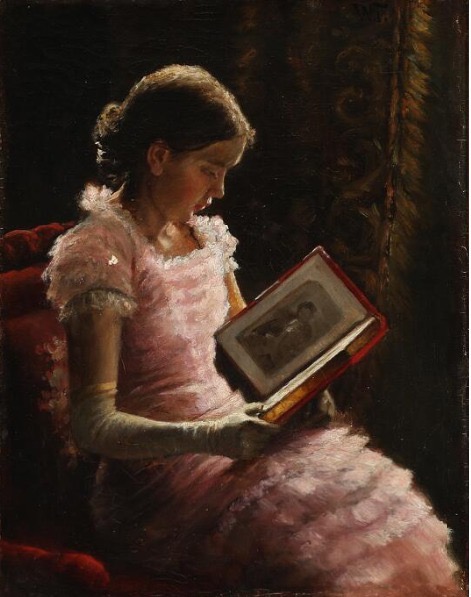
    Artwork: A Girl in a Pink Dress Reading, Wenzel Tornøe

    Leave a comment

  • My Life Had Stood a Loaded Gun

    My Life Had Stood a Loaded Gun

    There are certain sentences that feel less like literature and more like recognition. You do not simply read them; you recognize something that has been quietly living within you all along.

    This is how I feel whenever I truly pause at Emily Dickinson’s My Life Had Stood a Loaded Gun. Words written by a stranger, perhaps centuries ago, can suddenly become mirrors for thoughts I had never managed to articulate myself.

    My Life Had Stood – a Loaded Gun –.

    The metaphor has stayed with me ever since.

    What if my life has stood like a loaded gun, and every experience I have lived has become another bullet?

    But then another question followed.

    What are these bullets really made of?

    Could words themselves become my bullets in this lifetime?

    Who decides where they are aimed?

    Am I truly capable of deciding what this gun will yield, or am I merely the one carrying it?

    For a long time now, I have been trying not to resist what people often call the flow. Yet before surrendering to an idea, I cannot help questioning it.

    Can we truly persuade ourselves that such a thing exists?

    We speak of flow as though it were self-evident. We encourage one another to trust it, surrender to it, and stop resisting it. Yet if there truly is a flow, why am I being carried into this one and not another? Could its mystery lie in never knowing its direction, its contents, or the story into which it has already placed us?

    Despite these questions, I still believe in free will. I believe in planning, determination, responsibility, and conscious decisions. Yet I cannot ignore that life continually confronts us with boundaries we never chose ourselves: the things that happen, the things that never happen, the opportunities that quietly appear, the ones that disappear despite every effort, and the unexpected situations into which we somehow find ourselves being pulled.

    If there truly is a flow, perhaps we do not simply believe in it—we eventually recognize it through the shape our lives take.

    For as long as I can remember, I have believed that nothing happens in vain.

    And for me, it has never been Why me?

    It has always been Why this?

    Life simply keeps happening to everyone.

    Beautiful things. Painful things.

    Ordinary things. Life-changing things.

    None of them belong exclusively to us.

    What fascinates me is not that these things happen.

    It is how differently they continue to exist after they have happened.

    The very same event may quietly dissolve into one person’s memory while becoming another person’s identity.

    A conversation, a rejection, a delayed train, a city, a diagnosis, a book, a success, or even a stranger encountered only for a brief moment may continue living within someone for years—not because the event itself was extraordinary, but because of the meaning gradually woven around it.

    Perhaps this is also why I have never felt comfortable with how easily we reduce life’s turning points to heartbreak.

    Is that really the case?

    Perhaps we call it heartbreak because every outcome eventually finds its way into the heart. Every ending, every disappointment, every unanswered question seems to leave something behind there.

    But does everyone truly carry life in the heart?

    Or do some carry it somewhere else? Or nowhere at all?

    Perhaps that is another question altogether.

    There are heartbreaks, certainly.

    But along with heartbreaks, there are also mind-breaks.

    Dream-breaks. Ideal-breaks. Identity-breaks.

    And countless quieter fractures that rarely have a name.

    Sometimes what changes us is not the loss of a person, but the loss of an idea. A certainty. A future we had already begun living inside our minds. A version of ourselves that never came into existence.

    Perhaps these are the bullets.

    Not the events themselves, but the meanings we slowly forge from them.

    The bullet is not the rejection, the city, the illness, the book, the success, or the heartbreak. Those belong to life.

    The bullet is what remains after they pass through us—the meaning that quietly settles within us, gradually shaping how we understand ourselves and, eventually, how we move through the world.

    Maybe that is why nothing happens in vain.

    Not because every event carries an objective purpose waiting to be discovered, but because meaning is never entirely contained within the event itself. It comes into existence in the encounter between life and the person living it.

    Perhaps this is also why I have never been interested only in asking what happened.

    I find myself asking a different question nowadays.

    Who did it happen to?

    Because perhaps that is where meaning truly begins.

    The event may be ordinary. The person who carries it never is.

    That ordinary event may eventually become a painting, a piece of writing, a photograph, a melody, a conversation remembered years later, or even a small pin attached to someone’s bag.

    The event belongs to life.

    The meaning gradually becomes part of the person.

    So why am I here, thinking these thoughts and sharing them?

    And why are you here, reading and witnessing my possible bullets?

    Out of all the places in this virtual universe and out of all the words ever written, why would our paths happen to cross here, in this particular moment?

    Maybe there is no answer.

    Or perhaps there never needed to be one.

    Perhaps what we spend a lifetime carrying is not the weight of our experiences, but the meanings we create from them.

    And perhaps what this loaded gun ultimately yields has never depended solely on what happened to us, but on who we became while carrying every bullet.

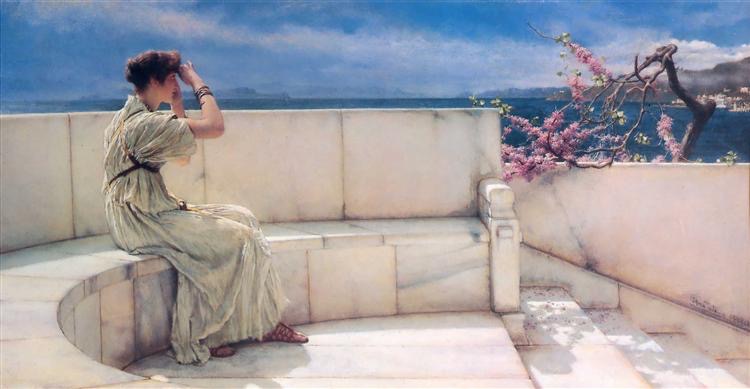
    Artwork: Expectations, Sir Lawrence Alma-Tadema

    Leave a comment

  • The Importance of Balance in Eating

    The Importance of Balance in Eating

    Do you live to eat, or do you eat to live?
    Or, perhaps, that isn’t even the real question.

    When we look closely at our daily rhythms, we notice something simple yet profound: food quietly accompanies the most significant moments of our lives.

    We celebrate achievements with dinners.
    We mourn losses with hot tea in quiet rooms.
    We reconnect with friends over coffee.
    We try to refocus by grabbing a snack “just to reset.”

    Food becomes an anchor, something around which conversations unfold, relationships deepen, and emotions settle. It is far more than a biological necessity; it’s a social script we all instinctively follow.

    Once we recognize this, eating stops being merely “fuel for our bodies.” Feeling full is only the most primitive part of the experience.

    Beyond that, eating carries emotional, cultural, psychological, and even spiritual meaning. Why else do we crave certain foods on stressful days, or why does a particular smell transport us instantly back to childhood?

    In these moments, balance becomes more than portion control. It becomes a form of self-care, a way of regulating our moods and honoring the rituals that shape our days.

    This understanding is not new. Throughout history, many scholars, thinkers, and even prophets have emphasized moderation as a foundation of well-being.

    Avicenna, for example, believed that regulating, and at times even reducing, food intake could help treat a range of illnesses.¹ His broader view suggested that an overloaded body burdens the mind, while moderation creates clarity and vitality.

    Interestingly, this ancient wisdom aligns with how many of us intuitively feel after eating too heavily: slow, foggy, less alert. It also resonates with today’s movement toward eating with intention rather than impulse.

    A similar idea appears not only in philosophy, but also in the evolution of gastronomy.

    In the 1970s, a group of French chefs, trained in the classical kitchens of Fernand Point, began shaping what would soon be known as nouvelle cuisine. They noticed that diners no longer wanted the heavy, elaborate dishes their parents and grandparents had enjoyed. Instead, people were asking for food that felt lighter, healthier, and more surprising, without losing depth, or flavor. The result was a quiet revolution: a cuisine designed not to overwhelm the body, but to leave it clear, energized, and awake.

    Modern science expands on these ideas through what we now call the gut–brain axis. Research shows that eating is influenced by far more than physiological hunger. Sensory cues, like the smell of freshly baked bread, can trigger appetite even when we are full. Emotional states also play a role: stress can shut down hunger or amplify cravings for sweet or salty foods. Hedonic mechanisms, habitual behaviors, sensory cues, and psychological factors all shape not only what we eat, but why we eat it.² Eating is not just a bodily act; it is a psychological and sensory conversation happening beneath our awareness.

    We can even see this dialogue between body and mind in the subtle signals our physiology sends us.

    Morgengabe (c. 1920), Brynolf Wennerberg

    And I notice this balance most clearly in my own body. When I eat in a way that is too one-sided, I feel a quiet heaviness, almost like something in me hasn’t quite settled. I’ve always been naturally distant from animal-based foods, simply because of my taste. But when my nails start breaking more easily, I take it as a gentle reminder to shift my intake and add a little more protein-rich food.

    The same happens with sugar. If I see small bumps on my skin that weren’t there before, I know I’ve been leaning too much on sweet comfort and I give refined sugar a pause. Our bodies speak long before they struggle. Often, they are not trying to control us, they are trying to guide us back to a way of eating that matches our lifestyle, rhythm, and even our genetics. In this sense, the body doesn’t betray us, it mirrors us. Its shape, energy, and appetite simply reflect the life we are living.

    Modern life complicates this search for balance even further. We live in a world overflowing with food stimuli: oversized portions in restaurants, carefully curated “food porn” images on social media, 24-hour markets offering instant gratification. Even our emotions get intertwined with eating, we reward ourselves after a long day, soothe boredom with snacks, or signal a moment of pause with a warm drink.

    These habits are not inherently harmful. But they do require awareness if we want to eat in a way that nourishes rather than numbs.

    Perhaps this is why the proverb “a man is known by the company he keeps” can be reimagined as “a man is known by the food he chooses to eat.” Our food choices often reflect our internal state, whether we are seeking comfort, routine, excitement, or grounding.

    What we take into our bodies doesn’t simply disappear; it becomes part of us. It enters our bloodstream and ultimately reaches our mind, shaping our mood, energy, and clarity. In this sense, eating is not just a physical act but an act of becoming.

    Balance, then, is not a strict discipline or a rigid rulebook. It is a relationship- one we learn, unlearn, and relearn throughout life. It means paying attention to why we reach for certain foods, noticing how they make us feel, and choosing nourishment that supports both our body and our mind.

    Sometimes balance means savoring a meal slowly. Other times it means stopping before fullness becomes discomfort. And often, it means sharing a humble dish with a friend simply because connection is part of nourishment too.

    Maybe the real question isn’t whether we live to eat or eat to live. Maybe it is how consciously we choose to nourish our lives – physically, emotionally, and spiritually – through the simple yet profound act of eating.

    Header: Kvinne kjerner smør (ca. 1920) – Gustav Wentzel

    💌hello@betweeneverywhereandnowhere.com

    Leave a comment

  • Artificial Intelligence Is Not to Blame for Your Stupidity

    Artificial Intelligence Is Not to Blame for Your Stupidity

    Lately, I’ve been surrounded by studies, tweets, and heated conversations all warning the same thing: artificial intelligence is making us dumber, lazier, and creatively numb. Some even argue that it will slowly replace our ability to think for ourselves.

    Ironically, I was the only person in my circle still living with pens and notebooks—no AI planning apps, no AI writing tools, not even AI search. As a translator, I thought that made me somewhat cool. But instead of being praised for my independence, I was criticized for being outdated, slow to adapt, even resistant to change. Classic human hypocrisy.

    Curious to test this for myself, I started using ChatGPT non-stop for a few months, in every possible area of my daily life. From writing emails to planning meals, from brainstorming ideas to drafting work notes—even for terminology discussions in translation assignments.

    What I discovered is simple: AI doesn’t make you stupid. You become mentally passive only if you hand over your thinking to a ready-made mechanism because it feels easier, not because it is inevitable.

    Fed by human data, AI does its best to navigate you, meet your demands, and address you in different voices. But here’s the key question: how much trust do you place in your own voice, your research skills, and your expertise? During this trial, ChatGPT couldn’t change my voice or override what I wanted to say—simply because I didn’t let it.

    The Real Risk

    As human beings, we dramatize new technologies far too much. Instead of sinking into the warm arms of laziness, we should use technology the way it was intended: as a support, not a substitute.

    Workloads are heavy, deadlines are unrealistic, and underpayment is exhausting. Sometimes, we don’t even have the energy left to think. Depending on AI may seem like salvation in those moments. But this dependency is dangerous, as recent research warns. An arXiv preprint even explored how people develop intimate, emotional bonds with AI partners, blurring the lines between authentic human interaction and machine-mediated connection.

    Balance Is Key

    That’s why I believe everything beyond reference is poison. Keep things in balance. Don’t lose your own voice or your mental battery. Don’t forget the joy of researching and creating.

    While it’s impossible to isolate ourselves completely from new technologies, we can choose how much we let them shape us. AI was created by humans—by us, fragile beings in flesh prisons. It is still just a tool, idle until you ask it to produce.

    Don’t let anything, or anyone, pull you away from your humanness or make your abilities seem less worthy. And don’t let opportunists persuade you that it’s normal to be replaceable. 

    Just let technology be your servant, not the other way around.

    💌hello@betweeneverywhereandnowhere.com

    Leave a comment