What makes you who you are?
Your name?
Your nationality?
Your profession?
Your family?
They all tell a part of your story. But if someone were to quietly remove every label attached to you, I believe there would still be one thing left.
Your mind.
Not simply your thoughts, but your way of perceiving, interpreting, remembering, imagining, fearing, and hoping. The invisible place through which every experience must pass before it becomes yours.
If I had to describe the mind in one sentence, I would say this:
It is the ultimate digestion of our lives.
Some experiences are unavoidable—the main course served to every one of us. Others are chosen deliberately, like the appetizers we pick ourselves: the books we read, the people we love, the conversations we revisit, the fears we rehearse, the songs that become memories, and the ideas we repeatedly feed ourselves.
Our minds digest all of them.
Eventually, they become us.
Perhaps this is why I find it difficult to separate myself from my mind. Knowing my own mind feels remarkably close to knowing myself.
We spend remarkable amounts of time protecting what matters to us.
We monitor our blood pressure, check our cholesterol, apply sunscreen, lock our doors, and create increasingly complicated passwords. We have become more willing than ever to talk about mental health, and I am genuinely glad we do.
Yet I sometimes wonder whether we have become so focused on repairing the mind that we forget to become acquainted with it.
Most conversations begin only after something goes wrong.
Stress.
Burnout.
Anxiety.
Depression.
Exhaustion.
Only then that we ask what the mind needs.
But perhaps there is another question worth asking long before that.
What kind of mind do I actually have?
Not the ideal mind promoted by productivity books.
Not the perfectly balanced mind described on social media.
Not someone else’s mind.
Mine.
What calms it?
What overwhelms it?
What makes it curious?
What quietly exhausts it?
Perhaps the healthiest relationship with our minds begins not by trying to optimize them, but by learning their language.
Have you ever noticed what almost every horror story has in common?
Before the monster attacks the body, it attacks the mind.
The victim begins doubting reality.
They stop trusting their memories.
They question what is real.
Long before physical danger arrives, the real battlefield has already moved inward.
The greatest horror has never been seeing a monster.
It has always been losing confidence in your own perception.
Ghosts, haunted houses, and demons become frightening only after they convince someone that their own mind is no longer a trustworthy place to live.
That idea has always fascinated me.
Even the creatures we imagine existing beyond human understanding somehow know the shortest path to defeating us.
Not through the body. Through the mind.
Perhaps horror stories remind us of something we rarely acknowledge.
The mind is where reality first takes shape.
Stress alone can produce genuine physical symptoms. Health anxiety can persuade someone that ordinary bodily sensations signal serious illness. A person may continue feeling pain in a limb that no longer exists because the brain still carries its map. There are even neurological conditions in which someone may no longer recognize a perfectly healthy part of their own body as belonging to them.
These examples are very different from one another.
Yet they all point toward the same conclusion.
Reality is not merely something that happens to us.
It is also something interpreted by the mind.
That realization makes the mind both our greatest strength and our greatest vulnerability.
It shapes how we see ourselves.
How we respond to uncertainty.
How we regulate anger.
How we trust.
How we love.
How we forgive.
How we decide whether to continue—or finally stop.
If there is a remote control for our lives, I suspect it is the mind.
This is why I have become increasingly interested in paying attention to my own.
Not improving it. Not optimizing it. Simply getting to know it.
I have no formal education in psychology or neuroscience, apart from a few unforgettable psycholinguistics courses that first made me realize how mysterious the mind truly is.
I am simply an ordinary person who depends on it every single day.
As someone who works with languages and translation, I know what it feels like for the mind to continue working long after the laptop has been closed. Sentences quietly keep rewriting themselves while I make coffee or walk down the street.
Over time, I have realized that my mind has preferences just as individual as my personality.
Perhaps yours does too.
Maybe your mind genuinely enjoys crowded cafés.
Maybe mine prefers silence.
Maybe someone else’s mind settles after running five kilometers.
Maybe mine simply wants to spend an hour beneath the warm glow of a floor lamp with a novel while the rest of the world quietly waits outside.
No article can tell us these things.
No expert can answer them for us.
Only our own minds can.
Perhaps learning to know them is a form of respect we rarely speak about.
Our minds accompany every second of our existence without ever introducing themselves.
We usually notice them only when something begins to fail.
Maybe we should become familiar with them before that moment.
Not because every uncomfortable feeling needs fixing.
Not because we should become obsessed with protecting our minds.
But because they are irreplaceable.
We spend a lifetime trying to understand the world.
Perhaps we should also spend some time understanding the only place from which we will ever experience it.
Our own mind.
Perhaps mind your own business was never the advice we needed.
Perhaps we should begin somewhere even closer.
Mind your own mind.
Because every experience in your life will pass through only one place before it becomes yours.
Your own mind.
And perhaps knowing that mind is the closest you will ever come to knowing yourself.
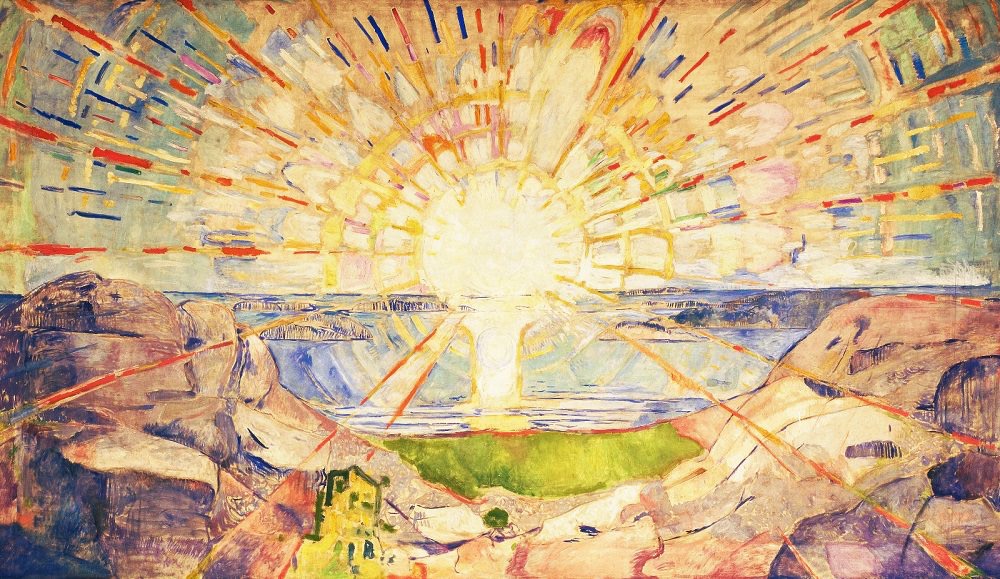
Artwork: The Sun, Edvard Munch


Leave a Reply