Tag: self-realization

  • What Do You Feel?

    What Do You Feel?

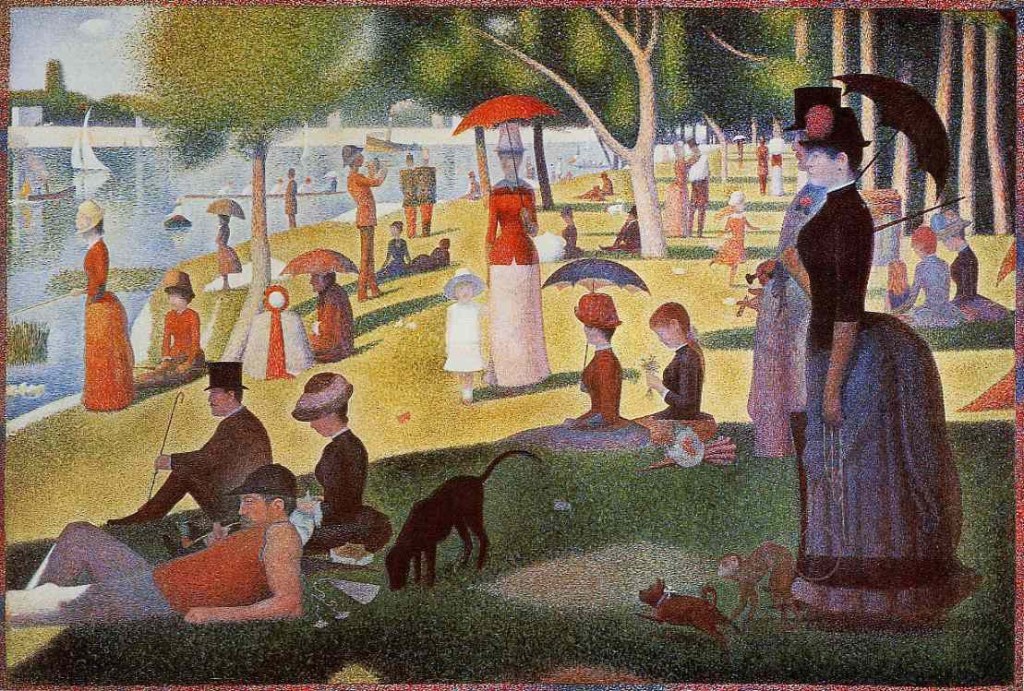
    A Sunday Afternoon on the Island of La Grande Jatte, Georges Seurat

    You woke up and started the day.

    What do you truly feel?

    Busy schedules, traffic jams, overpriced tags on the shelves…
    Life moves fast, almost mechanically.

    But somewhere in between all this — what is it that you actually feel?

    Have you ever paused, even for a minute, to notice what is passing through your mind, your heart, your body?
    Not only to explain or justify it, but simply to notice it.

    What is “to feel” anyway?
    Dictionaries define it simply as experiencing something physical or emotional. A simple definition for something that rarely feels simple.

    We know many names for what we feel: happy, sad, overwhelmed, devastated, embarrassed, angry.

    But there are moments when none of these quite fit — moments when language feels insufficient, and we find ourselves explaining a single feeling with entire paragraphs.

    Maybe the problem is not that we don’t feel enough.
    Maybe we just don’t always have the words.

    And when we don’t have the words, we sometimes begin to treat the feeling itself as if it doesn’t quite belong — as if it is too vague, too much, or simply unnecessary.

    But perhaps it is not the feeling that is unfamiliar, only the language surrounding it.

    I have never been someone who is consumed by emotions, nor someone who ignores them.

    I tend to sit with them, to make sense of them — sometimes at length.

    I could write pages about a single feeling.

    And yet, sometimes, what I look for is just one word.
    One term that reminds me I am not the only one who has felt this.

    This is where languages quietly step in.

    What has always fascinated me about them is this:
    Some seem to have paused longer on certain emotions — long enough to give them a name.

    There are moments when time suddenly feels limited — when you start measuring your life against invisible deadlines, and a quiet anxiety settles in.
    Not loud, not dramatic, but persistent.
    In German, there is a word for this: Torschlusspanik.

    Or those rare moments when you are completely immersed in the present — when nothing else seems to exist beyond what you are living right now.
    A kind of joy that is calm rather than loud.
    In Welsh, they call this Hwyl.

    Or the restless anticipation of waiting for someone — checking the door, looking outside, feeling time stretch in an almost physical way.
    In Inuit, this becomes Iktsuarpok.

    And then there is that quiet, almost bittersweet awareness that something is beautiful precisely because it will pass.
    Not despite its impermanence, but because of it.
    The Japanese have a word for this: Mono no aware.

    Even the darker corners of being human have found their place in language.

    That subtle, uncomfortable moment when someone else’s misfortune brings a sense of satisfaction you didn’t ask for.
    In German: Schadenfreude.

    If you notice closely, these words do more than describe emotions.
    They carry their weight, their rhythm, their texture.
    Some feel light, others heavy. Some linger longer than others.

    And perhaps this is where something deeper reveals itself:

    Being human may be a shared condition, but the way we are allowed to experience it is not always the same.

    Some cultures make space for certain emotions, while others leave them unnamed — and therefore, often unnoticed.

    And when a feeling has no name in the language we live in,
    it becomes easier to overlook it.
    Not because it is insignificant, but because it has nowhere to stay.

    Yet these experiences are not foreign to us.

    Perhaps learning new words for emotions is not just about language.
    Perhaps it is a way of recognizing parts of ourselves we couldn’t quite name before — not because they were absent, but because they were never fully acknowledged.

    Because to feel is not always loud.
    It is not only a racing heartbeat or a visible reaction.
    Sometimes it sits quietly — in your chest, in your stomach, behind your eyes — waiting to be noticed.

    And when a feeling feels too complex, too layered to be named,
    it might help to remember this:

    Somewhere else, in another language, shaped by another way of seeing the world, someone has already felt it deeply enough to name it.

    You are not alone in your feelings — even when your own language does not seem to have a place for them.

    And maybe learning these words is not only about understanding others, but about finally making space for ourselves.

    If you are curious to explore more of these emotions and the words that hold them, you might enjoy The Book of Human Emotions by Tiffany Watt Smith.

    2 responses to “What Do You Feel?”

    1. The Luttie Board Avatar

      I like how incredible you are in the way you blend emotion, culture, and language together.

      Liked by 1 person

      1. betweeneverywhereandnowhere Avatar

        Thank you! I’m really glad you felt that!

        Like

    Leave a comment

  • Me and My Broken Marc Jacobs Glasses

    Me and My Broken Marc Jacobs Glasses

    Dolce Far Niente, 1897, John William Godward

    Sometimes warnings come from the least expected places. Like a pair of glasses.

    I have always been a person who lives with A-to-Z plans — 0-to-100 scenarios — mostly to guarantee myself a stable life and to contribute to society more effectively.

    Eventually, this habit slowly pushed me toward becoming a workaholic. After realizing this and dealing with it for a long time, I tried to simplify my life and limit myself to my full-time job only.

    Then one day, my glasses broke.

    I looked at them and thought, “Okay, time to replace or repair them.”
    But strangely enough, that small incident made me reconsider the financial reality of my current job. I realized that the conditions of my full-time position were far behind providing even a modest life that could comfortably handle sudden expenses.

    And sudden expenses are part of life.

    By “the conditions of my job,” I mean that even during the calmest months, I sometimes work 33 hours straight without sleeping and then continue with another full workday.  The answers we receive for such excessive working conditions are usually limited to a quiet “hı-hım.”

    Overworking? “Hı-hım.”
    Broken glasses? “Hı-hım.”

    So eventually, it was my turn to respond with a “hı-hım.”

    Because I tend to work hard — and also tend to underestimate myself — I had not been fully aware of my role and contributions for quite some time. And this, naturally, allowed certain greedy managers to exploit my labor.

    Our labor — and our intellectual contribution — is, to me, one of the most private and sacred outputs we produce.

    Yes, my broken glasses led me to that realization.

    The more I thought about it, the more I felt triggered. For most of my life, whenever a serious problem occurred, I immediately cut ties. My instinct was always the same: “No, I cannot drag myself into this. Cut ties and move on.”

    But this time, I did something different.

    I could have left immediately.
    But I didn’t.

    As a newly graduated employee, I had built the backbone of this unit in my workplace. I had no intention of breaking that backbone and replacing it with a weak stem. Why would I abandon the apprenticeship structure I had gradually built on my way toward gaining seniority?

    So, I did something less dramatic: I calculated the pros and cons.

    And I remembered something a doctor once told me:

    “Managing adversities of an organ is easier than adapting to its absence — if the situation is not fatal.”

    And yes, this was it.

    I also realized that this shift in perspective would require me to play according to the rules of corporate life. This was not about negotiating for a small salary increase or bargaining over money.

    I had something far more valuable: my labor.

    So, I stopped underestimating my role and responsibilities. If I were to process even a single number incorrectly, it could easily cause a six-month delay for everyone involved.

    That realization changed something in my behavior.

    Instead of quitting, I decided to withdraw my labor accordingly.

    I also had to abandon my old “work done and gone” attitude. I started preserving my labor more carefully. I stopped allowing people to invade my limits or interrupt my work-life balance.

    At the same time, I continued presenting a cooperative and social face. While gradually defining my limits and setting clearer boundaries, people started to sense that something had changed — although they could not fully describe it, because I never gave them an explicit explanation.

    One thing, however, never changed.

    I never lowered the quality of my work. Doing so would go directly against my personal values. The output of my work often touches people’s lives, and for that reason I remain deliberately meticulous about what I do.

    Of course, none of this is rocket science. Many of us have experienced — or will experience — some form of exploitation in our professional lives.

    And most of you probably will not need a broken pair of glasses to notice it.

    But when working hard for everything is part of your personality, it becomes surprisingly easy to overlook exploitation. You are simply too busy participating in multiple projects at the same time.

    At least that was the case for me.

    If you are unhappy with your workplace or the conditions you are working under, my suggestion is simple: move step by step.

    Never underestimate your role and contributions — but also never overestimate them. Try to remain realistic.

    Before anything else, think about your ability to maintain decent life conditions.

    Do not immediately tempt yourself to quit. Unless there are extreme circumstances, it may be wiser to first develop a strategy that protects your boundaries in a stricter and healthier way.

    Your manager is a manager because they manage you. Act accordingly — but do not stand out in a negative way. Observe personalities carefully. Both the cure and the source of many workplace problems are humans, after all: flesh and blood.

    A little Psychology 101 can be surprisingly helpful.

    It can also be useful to polish a specific strength that people begin to associate with you. In my case, for example, I tend to communicate very smoothly with customers from Northern European countries. Whenever I became involved in those processes, things moved forward more easily.

    So, I subtly strengthened that role.
    Over time, I became the person people contacted for anything related to Northern Europe.

    In their minds, a simple code formed:

    me = indispensable for Northern Europe.

    Find similar small strategies that suit your strengths and the nature of your work.

    And above all, remember to think about yourself, your dignity, and your right to a decent life.

    Learn to navigate your emotions as well. A crisis does not necessarily mean you must immediately change your workplace or profession. Sometimes the thing that needs adjustment is your attitude, your working hours, or the boundaries you allow others to cross.

    You usually know the answer better than anyone else.

    I also try to avoid emotional extremes. Whenever my feelings become too intense — whether happiness or frustration — I remind myself that extreme emotions often create a dangerous illusion. When you are overly happy, everything seems possible. When you are deeply frustrated, everything seems impossible.

    Neither state is very reliable.

    In such moments I often listen to Rigoletto, Act III by Giuseppe Verdi, or Delibes: Lakmé Act 1 by Léo Delibes — or, oddly enough, children’s songs that involve counting down or roaring.

    Yes, honestly. It works.

    And yes — for the record — the glasses are still broken.

    I keep wearing those broken Marc Jacobs glasses to meetings and work dinners.

    Not because I cannot replace them.

    But because they remind me of something I realized a little too late:

    our labor is far more valuable than we tend to believe.

    Leave a comment