But Is Their Moonlight Ever Stolen?
Recently, I have been reading Why Zebras Don’t Get Ulcers by Robert M. Sapolsky to better understand what stress actually is, what it does to our bodies, and whether it is possible to live with it without constantly crossing our biological limits.
Sapolsky’s argument is simple: zebras do not get ulcers because they activate stress responses only when there is an immediate physical threat. A zebra runs from a lion, survives, and returns to grazing.
Humans do not return in the same way. We keep the system running. We replay, anticipate, simulate. The body does not ask whether the threat is physically present. It responds anyway.
That part made sense immediately.
But I did not stay in abstraction for long, because something concrete was already there.
I have a habit of moon bathing. In the evenings, when moonlight enters my room, I sit with it. It is not decoration for me. It is a way to reset, to remember where I am and who I am. Even when there is no direct moonlight in the room, I still go out and look at the sky. It is part of how I regulate myself.
Then something changed.
A new restaurant opened near my home, and a large LED advertising screen was installed outside. At night, instead of moonlight entering my room, bright artificial advertisements began cutting through the curtains—flashing images of fettuccine alfredo, constantly present. Out of the blue, I was no longer able to tell the difference between moonlight and artificial lights.
My moonlight was stolen.
Not metaphorically. Literally. Taken.
It was not just light in the environment; it was the removal of something I actively use to reset and orient myself.
And my reaction to it was immediate.
This is where Sapolsky’s framework returns. Biologically, the system does not distinguish between types of stress in the way we like to believe. It responds with the same seriousness whether the trigger is immediate danger or sustained intrusion.
But what usually follows is where things start to distort.
The response turns inward: why am I reacting like this, I should ignore it, I should manage it better. Stress becomes not only the external situation, but also a judgment about the internal reaction.
And that is where I stopped following that logic.
Because the issue is not only my response. The issue is also the conditions producing it.
There is a constant assumption that stress should be managed internally, as if the internal system exists in isolation. Regulate yourself. Stay grounded. Reduce sensitivity. Protect your peace.
But that assumes the environment is neutral enough to be filtered out. It is not.
Some environments enter the space that is meant for recovery. Some changes do not stay outside the system of experience; they interrupt it directly.
This is where the zebra comparison starts to fail for me.
Because I am not a zebra. I do not operate in cleanly bounded moments of threat and release. I am embedded in an environment that is continuously active.
I am a member of Homo sapiens.
And being a member of Homo sapiens means there is no clean separation between “me” and what surrounds me. The boundary is porous. Everything around me participates in shaping my state.
One consequence of this is the tendency to turn every reaction into a personal problem. If something affects you, the assumption becomes that the issue is your regulation.
But that is not always the first or most accurate conclusion.
Sometimes something is actually taken. Sometimes something genuinely interrupts the way you live and reset yourself.
And naming that matters.
Not to exaggerate it, but to stop translating every reaction into self-blame.
Not everything that produces stress is internal in origin.
Sometimes the system is responding correctly to something that is genuinely intrusive.
Sapolsky’s point still holds: the body responds as if it matters.
But the question may not be how to stop that response.
It may be why we insist on interpreting every response as a personal failure instead of sometimes recognizing the conditions that produced it.
No one is trying to sell zebras fettuccine alfredo at midnight under artificial neon lights. And yet we keep building environments that behave as if no nervous system will ever have to rest.
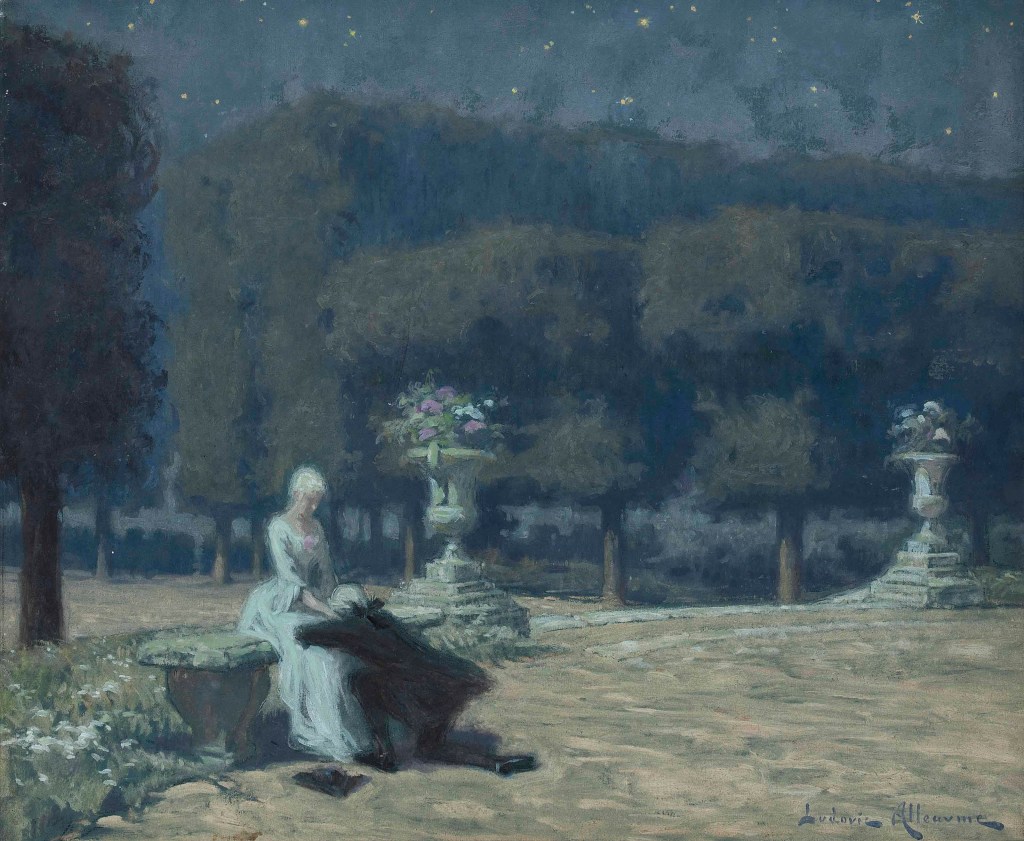
Artwork: Paradis Nocturne, Ludovic Alleaume


Leave a Reply