Years ago, I read a sentence in The Museum of Innocence:
It was the happiest moment of my life, though I didn’t know it.
At the time, I thought it was simply romantic in the melancholic way novels often are. I never imagined that one day I might understand it through my own life.
My way into existentialism was through trying to understand death itself. Since childhood, I often wondered what life meant, what people meant to one another, and how anyone could survive the loss of someone they deeply loved.
For years, one of my greatest fears was that I would one day have to adapt to life without someone I could not imagine losing.
Over time, my understanding of death changed. I realized that many things die before people do. Habits die. Identities die. Relationships die. A version of yourself can disappear while the body remains. Even hope can gradually die.
But somewhere inside me, I knew none of these would compare to the death of someone I loved.
So, I lived with that private fear for years, trying to place it somewhere in my brain, somewhere in my heart.
It was one of those beautiful spring days.
I had never liked spring the way others did. It always carried a quiet nostalgia for me, a sadness I could never explain. Looking back now, I sometimes wonder whether it was only association or whether some parts of us sense grief before we truly encounter it.
That day, everything was perfect. Almost flawless.
In the morning, I received a letter of acceptance from a country I had long wanted to know more deeply. I remember feeling bright from the inside out. Everything felt possible. I felt myself shining with happiness.
Then, in the middle of that brightness, the phone rang.
I rushed to the airport and flew home. Somewhere in the blur of movement, disbelief, and noise, I heard the sentence:
Sorry for your loss.
I immediately thought:
This has happened to me too.
Not sorrow at first. Just emptiness. A strange hollow space where feeling should have been. I searched inside myself for something more dramatic, something more recognizable, but grief did not arrive in the form I expected, and nothing in my life seemed to be replaceable with this reality.
It came as absence. My biggest fear arrived as absence.
That was when I understood what death truly means.
It is not death itself that devastates us. It is the ultimate absence of someone who once shaped the atmosphere of your life.
My father was not just my father. He was the starring actor of my memories, of my childhood, of many parts of my personality I had mistaken for being entirely my own.
While getting ready for the funeral, I looked at myself in the mirror. Features I had criticized for years suddenly became precious to me because they were his. My face was no longer only mine. It was evidence.
I had spent years fearing the death of one of my parents, and now I was living inside the very thing I feared.
Yet real grief has no interest in your theories. It is bitter, physical, slow. It humbles every abstract thought.
Shortly before my father died, I had been reading Marcus Aurelius. At the time, I believed he was right. Life should not be taken too seriously. Legacy was overrated. There was no need to burden oneself with thoughts of future generations.
But grief has a way of exposing the beliefs we only hold in comfort.
It may sound odd, but I stood at my father’s burial and thought the opposite.
I realized that I did not want to disappear from this world.
I wanted to contribute something. To leave something. To exist beyond the limits of a body. Whether through children, through work, through words—I did not know.
Sometimes I wonder whether this blog itself is part of that desire: a refusal to vanish silently.
My father did not vanish.
He remains in the people who loved him, in the habits he formed in us, in our gestures, in our instincts, in our memories. He remains in my face. He remains even here, in these sentences, where someone who never knew him now knows that he existed.
But everything truly begins after that period, when you are finally left on your own.
As a teenager, I had a rule for myself: if I felt something too deeply, whether joy or pain, I would give it five days. I would sit with it until I became desensitized, then make decisions rationally. It was my private method of self-control.
My father’s death taught me that some things do not obey systems.
Some pain cannot be optimized. Some losses cannot be reasoned into neat conclusions. Some experiences need to be digested.
I had to change my route, and I realized adulthood had begun at this very moment.
What struck me most after losing my father was not only sadness, but the feeling that I had lost my sparkle.
I had always been someone who could make meaning out of anything. Disappointment could become growth. Difficulty could become material. Whenever life gave me something inconvenient, my instinct was always:
What can I do with this? What is my role in it? How can I cultivate myself through it?
Then, for a while, I did not want to make meaning of anything.
That frightened me more than grief itself.
But grief changes shape.
Later, I began to understand that my father’s absence was only biological. Presence can survive form. I found him in small things: a gentle breeze, a butterfly passing too close, the reflection in my coffee, a sudden scent in nature, a dream vivid enough to quiet the morning, my stance in certain situations.
I thought I had lost my spark.
Perhaps I had only shed the one I carried as a teenage girl.
What came after was the slow work of building a different kind of light.
Grief is not a wound that simply heals and disappears. It is more like losing a landscape you once navigated by instinct. The world remains, but your orientation changes.
It does not truly pass.
It is not something to be cured, nor should it be.
You change. And then, you decide in which direction to continue.
Sometimes you are guided only by what is missing inside you.
It is not pain.
It is ache.
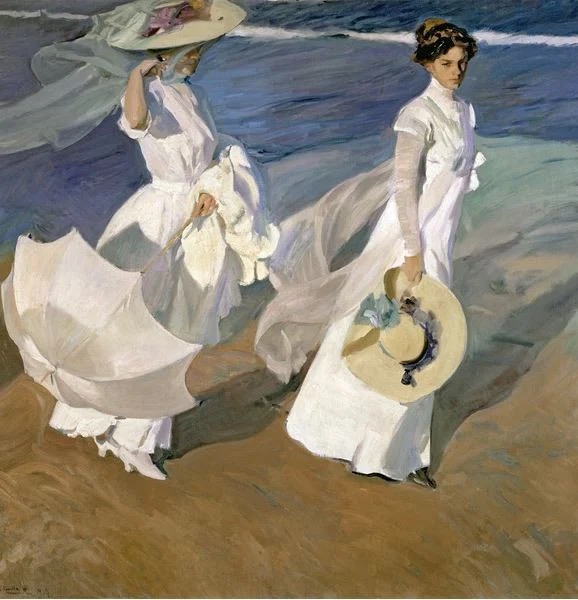
Artwork: Strolling along the Seashore, Joaquín Sorolla y Bastida


Leave a Reply