Hör du sparven lilla, far du inte illa,
när som vintern är så sträng och kall.
Utan mycken möda, lär du dig att föda,
som är nästan minst av fåglar all.
Listen, little sparrow, do you not suffer
when winter is so harsh and cold?
Yet with little effort, you learn to feed yourself,
though you are among the smallest of all birds.
This is how the Swedish folk song begins.
Most of the time, when we read literature, we try to understand all kinds of ideas. We turn the pages of numerous books, sit and think about answers, or try to find a meaning. Sometimes we are not even aware that we are searching for one, or that we are in need of one. But suddenly, a song catches your ear. Its melody gently invites your mind, and its lyrics take your hand into their unique universe.
Sometimes it is as simple as that.
Kan du fågel lätta, mig helt kort berätta,
från det allra första, minsta med det största.
Säg om dig behagar, om din levnads dagar,
ifrån början till din levnads slut.
Little bird, can you tell me briefly
of all things, from the smallest to the greatest?
Tell me, if you will, about your life,
of all your days, from its very beginning to its end.
Sometimes I wish I had a magic lamp or a magic sphere that could tell me what I need right now, why I want a certain thing, and why I have what I have. Then I realize that we already have something like that in our lives. The only difference is that it does not always come in the shape of a sphere or in the form of a lamp.
Sometimes it is a folk song.
Although I try to understand this “flow” and accompany it, I cannot help asking: Could this have beenthat instead? Could I have had this rather thanthat? Whythis? Why not that?
Stinn uti min kräva, hämtad utav näva,
klara vattendroppar utan silver koppar.
My belly is full, filled with clear drops of water,
offered by hand, without a silver cup.
I found one of the most persuasive truths in the lyrics of a Swedish folk song.
It was this, not that, because this was what I needed to have, what I needed to experience, what I needed to leave behind. Although this sounds like a cliché, it is not as easy to digest and accept as it may sound.
The sparrow found water. It had what it needed, without needing a silver cup. It needed water, and somehow, it found the water it needed.
Perhaps this is where I started thinking about how we live.
Schopenhauer famously described life as swinging like a pendulum between pain and boredom – the pain of unfulfilled desire and the boredom that follows when our desires are satisfied.
Sometimes I think that nowadays, instead of our lives simply swinging like a pendulum, we have become pendulums ourselves. But between what are we – pendulums – oscillating exactly?
Oscillating between possibilities and realities. Between what we hoped for and what we found.
Between what we wanted and what we got. Between what could have been and what actually happened.
We start with “what I want” and end with “what I could not get”.
Somewhere between these two ends, however, there is a life being lived.
And I sometimes think that this is the part we forget.
We become so occupied with the distance between what we hoped for and what we found that we stop seeing everything that happens in between. We look at one end and then the other, comparing, measuring, imagining alternatives. We wonder whether we should have had this instead of that, whether we should have been somewhere else, whether another possibility would have suited us better.
And while we are doing this, life is happening in the middle.
Are our lives, or our existence, really all about our desires and our failures? Why do we reduce everything to such simple terms when doing so does not even serve us? Why do we reduce ourselves to pendulums?
Why do we keep asking what we could have had while forgetting to notice what has already found its way to us?
Anything and everything may go right or wrong. You may have this and not have that now. It may be your failure or your success.
But perhaps there is something else happening too.
The sparrow needed water. It found water.
And perhaps we, too, keep meeting what we need in forms we would never have thought to ask for. Not because everything necessarily happens for a reason, and not because every experience is secretly designed for us, but because life is not made up only of what we hoped to find.
It is also made up of what we encounter along the way – what sustains us, what changes us, what teaches us, what we leave behind, and what allows us to continue.
Sometimes I wonder whether this is why certain things arrive in our lives exactly when they do.
We may never know.
Maybe you are served your coffee in a cartoon cup rather than a ceramic one because, at that moment, you were simply meant to have some coffee. Maybe the ceramic cup would have made no difference at all. Maybe you were protected from a possibility you could not see. Or maybe you are supposed to invent something out of the burning sensation in your hand.
Or maybe it was simply a cartoon cup.
Who knows?
We have our desires and our achievements. Where are they now?
What kind of feelings do your achievements awaken in you? And what about your desires?
I decided that I do not want to be a pendulum, missing my life while oscillating between “what could have been” and “what could be”.
I want to notice what happens in between.
This may also be a starting point. I will definitely continue wanting, wondering, imagining different possibilities, and maybe bargaining with the universe, but I decided to stop living in the void of the distance between what I hoped for and what I found. I do not want this spectrum to be the whole measure of my life.
I have come to see the simple yet warm sentence of Elizabeth von Arnim a little differently:
How grateful I felt to the kindly Fate that has brought me here and given me a heart to understand my own blessedness.
It may not be about believing that everything happened exactly as it was supposed to happen.
It may be about realizing that, somehow, we are here.
And that somewhere between what we hoped for and what we found, there was a life that brought us here.
The sparrow did not need a silver cup.
It needed water. And it found it.
Then it flew and landed in her garden.
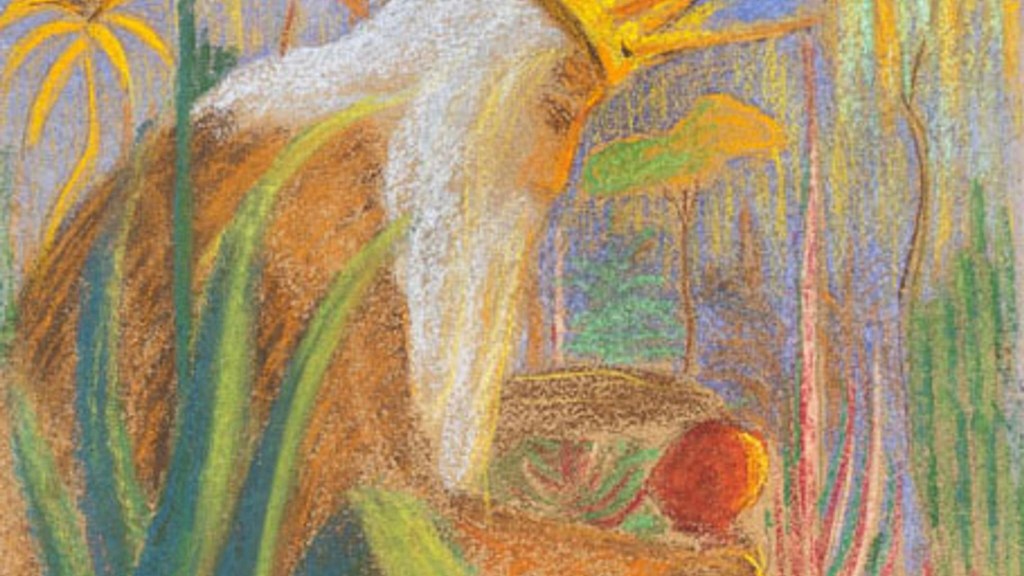
Artwork: Rex. I eskizas iš vitražų diptiko, Mikalojus Konstantinas Čiurlionis


Leave a comment