…To Better Understand My Life Path
I think anything and everything can be a means of understanding our minds, our lives, the dynamics surrounding us, and so on.
As I mentioned before, I have been interested in astrology for some time now. Honestly, I do not take astrology as fortune-telling or a way of predicting the future. I rather see it as a way of attributing some meaning retrospectively — a different lens through which I can look at my own life.
In order to better understand what my existence might mean to me, I decided to take my natal chart into account. Of course, none of this is science-backed or concrete. Still, there is something fascinating — even a little fluttering — about the thought that the universe, the planets, and their mathematical relationships might have left some kind of imprint at the very moment you started breathing in this world.
It may mean something. Or it may mean nothing.
But I find it interesting to look at it anyway.
Honestly, my natal chart seems to have received quite a generous share of oppositions and squares — the so-called challenging aspects — rather than conjunctions, trines, and sextiles, which are generally considered more harmonious. It is often said that having more harmonious aspects may indicate that life flows more easily.
Apparently, I was not given the smoothest possible version of the tutorial.
Sun Square Saturn
This is one of the most prominent aspects of my natal chart.
While the Sun represents core identity, self-expression, authority, and, traditionally, the father, Saturn is associated with restrictions, delays, responsibility, maturity, and limitations. When they form a square, no wonder it is considered a difficult aspect.
I have even come across a few places saying something along the lines of, “We feel very sorry when we see this aspect in a woman’s chart.” One can easily be convinced that this aspect means lower self-esteem, hardships in life, delays in self-realization, problems with authority, even difficulties involving one’s father, and so on.
But I think there is something easily underestimated here.
If you were born under this aspect, and if Sun Square Saturn is one of the main themes of your life, then never forget that you are a Sun Square Saturn, too.
You develop endurance because your life requires it. You become patient because things take time. You learn to think strategically because not everything can be forced.
And once you realize and accept that this is simply one of the ways your life tends to unfold, you stop spending so much energy asking, “Why me?”. Instead, you start moving forward consciously, knowing what you are dealing with.
Here is the perk of a difficult aspect: not an easy life, but a stronger self. And a stronger self knows how to appreciate what it has achieved.
You know how much effort, patience, and intention went into it. You appreciate it more consciously and more maturely, because you know exactly what it took to get there.
And what you build may stay with you longer, simply because you were an active and conscious part of building it.
Moon Opposition Mercury-Jupiter-Uranus-Neptune
My Cancer Moon forms oppositions to all of the planets I mentioned above in Capricorn, with the exception of my Aquarius Uranus.
This opposition is also considered one of the more challenging configurations, as it creates a tension between the Cancer-Capricorn axis.
According to astrology, my life would always be somewhat of a rollercoaster between my emotional and material needs.
And honestly, my emotional side can be in turbulence almost all the time.
Yet, I am still grateful for the tension this aspect represents.
First of all, I know and respect my feelings.
I know how my body and mind tend to react to a certain feeling. I have learned to recognize my emotional surges. I am learning when to simply feel and when to step back and think.
I have learned to get to know both my mind and my emotional side because of this turbulence.
Maybe Saturn saved me with its trine in this case. Who knows?
The more I read about astrology and think about life paths, the more I realize that perhaps everything we go through can somehow navigate us towards what we are supposed to do.
From an astrological perspective, the North Node is said to give us clues about our journey in this lifetime.
North Node in Libra in the 5th House
The more I looked into my chart, the more I became interested in the idea of the North Node.
Mine is in Libra, a sign associated with harmony, diplomacy, justice, partnership, and balance. It is also in the 5th house, traditionally associated with pleasure, joy, creativity, art, self-expression, and the things we do simply because they make us feel alive.
So perhaps all the turbulence I mentioned above is also leading me somewhere very different from where I might instinctively go.
Perhaps I am meant to learn to express myself without putting pressure on myself to be flawless.
To deliberately choose the lightness of life. To enjoy art and music.
To spend time with people and build meaningful bonds. To allow myself to experience pleasure without feeling that I first have to earn it.
And maybe, most importantly, to understand that life does not always have to be a problem that needs solving.
But what did my chart give me to work with in order to get there, apart from all the rollercoaster rides?
Jupiter Conjunction Mercury & My Gemini Ascendant
When I retrospectively analyze my natal chart, I like to think that this aspect points towards one small corner of the direction suggested by my North Node.
Jupiter conjunct Mercury is said to be associated with an interest in writing, a love of learning, curiosity, broad thinking, problem-solving, and many other things that I happen to enjoy.
My Gemini Ascendant seems to reinforce the same theme. Gemini is associated with curiosity, communication, collecting information, making connections between ideas, and, naturally, words.
So maybe the universe did not necessarily want me to have an easy life.
Maybe it wanted me to exist among all the crises while feeding my brain, trying to understand who I truly am, and sharing what I think — even if what I think is not exactly rocket science.
Perhaps this is why writing feels less like a separate activity and more like one of the ways I make sense of all of it.
And Apparently, I Have the Potential to Be an Alchemist
There is another interpretation of my chart that I find particularly amusing.
When the aspects in my chart are interpreted as a whole, I am said to have the potential of an alchemist — someone who can transform difficulties into something meaningful, turning the heavier experiences of life into something valuable.
I have to admit; I am not quite there yet. I am still in the phase of turning my life experiences into panic attacks rather than alchemy.
Apparently, I still have some work to do.
I am still learning how to navigate my difficult moments. I am still figuring out what certain experiences are trying to teach me, and sometimes I am simply trying to get through them.
Maybe that is also part of the process.
Perhaps we do not always have to become as impressive as our supposed potential suggests.
Maybe not being the “alchemist”, our chart promises us to be just yet is also a way of flowing with life.
Maybe we are allowed to be ordinary while becoming who we are supposed to become.
Maybe This Is What the Chart Is For
Life — or simply the dynamics around us — makes us face a lot of challenges.
I do not think squares and oppositions have to be interpreted as punishments, just as I do not think trines and sextiles are guarantees of an easy life.
Perhaps they can simply be ways of looking at the things we repeatedly encounter in ourselves.
The point, for me, is not whether my natal chart actually predicted my life. It probably did not.
The point is that looking at it made me notice things I had already experienced but had never put into words.
It made me look at my difficulties from a little distance.
It made me think about what they have taught me, what they have taken from me, and, perhaps more importantly, what they have given me.
Perhaps, in this lifetime, we are meant to learn when to be selective like Saturn — to practice Schopenhauer’s hedgehog dilemma, finding a distance where we are close enough to form a warm circle, but far enough not to reach each other’s spines. Perhaps Saturn’s rings remind us that stability does not always mean keeping the world away, but having enough gravity to decide what becomes part of our orbit.
Perhaps we are meant to become aware of our power like the Sun — of the fact that the same force that nourishes can also burn — and learn to shape that power through our will and reason.
Perhaps we are meant to learn from the Moon that nurturing does not mean having no boundaries. That we can care deeply for others while still protecting the parts of ourselves that need protection.
Perhaps we are meant to become mature enough, like Jupiter, to decide what deserves to grow.
Because not everything we encounter needs to be expanded.
Not every thought needs more attention, not every desire needs to become a pursuit, and not every possibility needs to become a reality.
Maybe that is what all these symbols are ultimately pointing towards: not becoming someone who has mastered every aspect of life, but becoming someone who knows what to do with what the flow has given them.
Maybe we are not meant to get rid of all those sharp corners in our charts, but to smooth them out until we create our own version of a harmonious flow.
Maybe we are meant to look at our squares and oppositions as aesthetic objects, move through them, and use them as portals to a more mature version of ourselves.
Or maybe we are simply meant to find our conjunctions and sextiles without constantly bumping into the corners of our squares and bruising ourselves along the way.
Maybe we are allowed to decide what it all means.
Maybe what we want is exactly what is supposed to happen.
Or maybe even thinking that way is part of the plan.
Who knows?
Note: If you are interested in the symbolic and romantic meanings attached to the planets, you might also want to listen to Gustav Holst’s The Planets. It is a completely different way of imagining the planets. Another way of hearing the harmony in all of this.
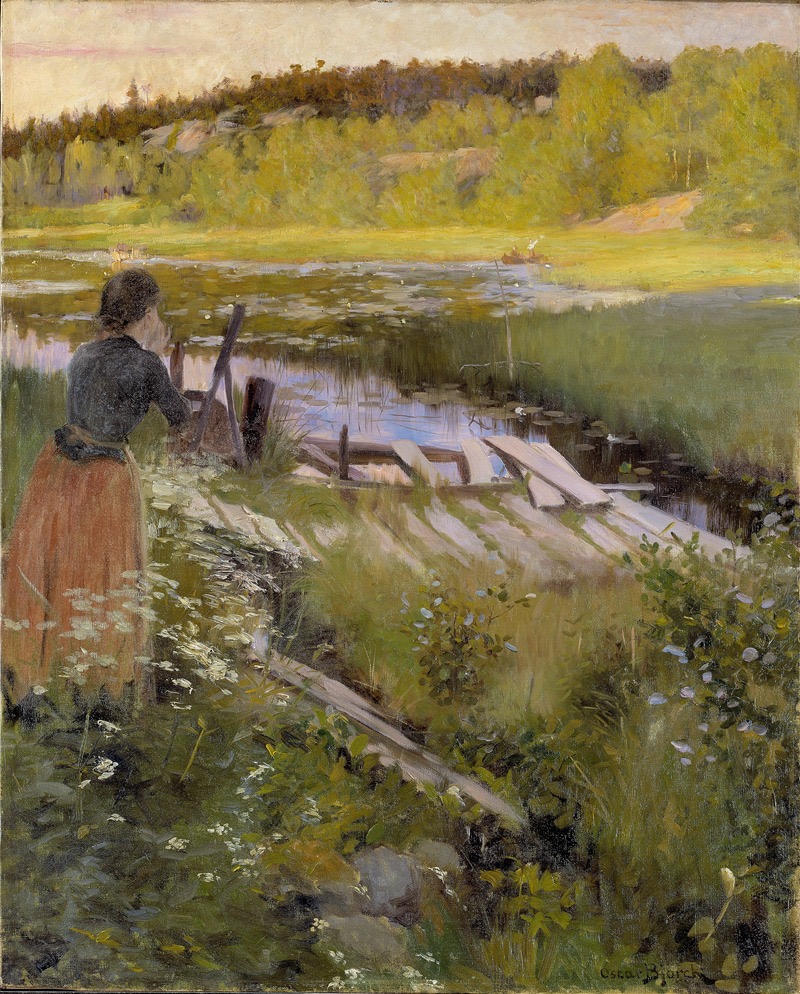
Artwork: Vid insjön. Motiv från Balingsta, Oscar Björck
 Between Everywhere and Nowhere
Leave a comment