Tag: art and feelings

  • What Do You Feel?

    What Do You Feel?

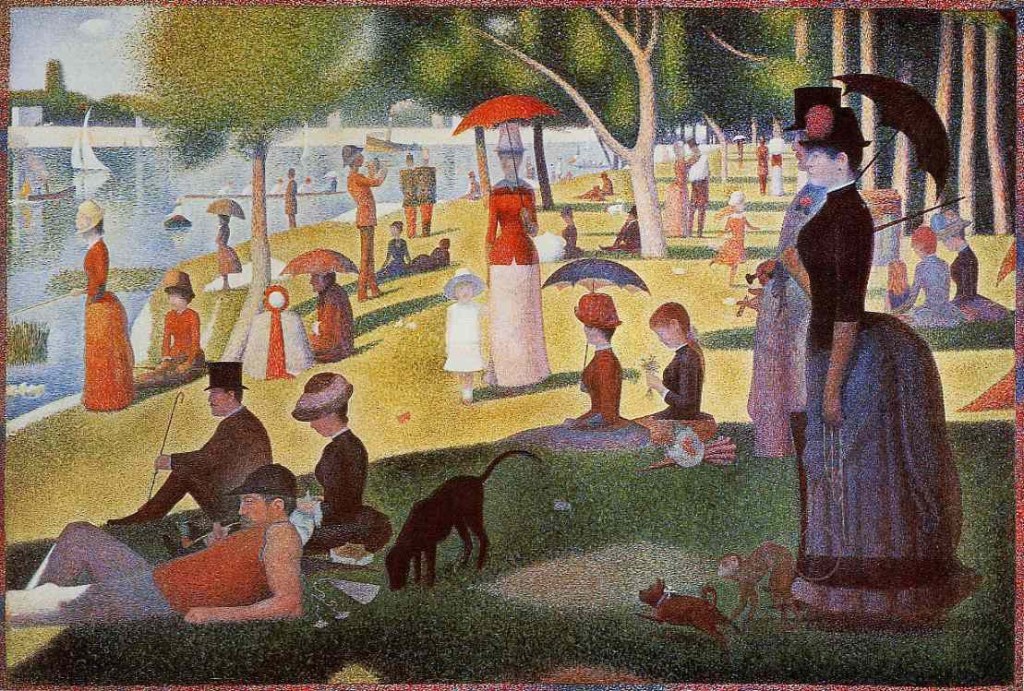
    A Sunday Afternoon on the Island of La Grande Jatte, Georges Seurat

    You woke up and started the day.

    What do you truly feel?

    Busy schedules, traffic jams, overpriced tags on the shelves…
    Life moves fast, almost mechanically.

    But somewhere in between all this — what is it that you actually feel?

    Have you ever paused, even for a minute, to notice what is passing through your mind, your heart, your body?
    Not only to explain or justify it, but simply to notice it.

    What is “to feel” anyway?
    Dictionaries define it simply as experiencing something physical or emotional. A simple definition for something that rarely feels simple.

    We know many names for what we feel: happy, sad, overwhelmed, devastated, embarrassed, angry.

    But there are moments when none of these quite fit — moments when language feels insufficient, and we find ourselves explaining a single feeling with entire paragraphs.

    Maybe the problem is not that we don’t feel enough.
    Maybe we just don’t always have the words.

    And when we don’t have the words, we sometimes begin to treat the feeling itself as if it doesn’t quite belong — as if it is too vague, too much, or simply unnecessary.

    But perhaps it is not the feeling that is unfamiliar, only the language surrounding it.

    I have never been someone who is consumed by emotions, nor someone who ignores them.

    I tend to sit with them, to make sense of them — sometimes at length.

    I could write pages about a single feeling.

    And yet, sometimes, what I look for is just one word.
    One term that reminds me I am not the only one who has felt this.

    This is where languages quietly step in.

    What has always fascinated me about them is this:
    Some seem to have paused longer on certain emotions — long enough to give them a name.

    There are moments when time suddenly feels limited — when you start measuring your life against invisible deadlines, and a quiet anxiety settles in.
    Not loud, not dramatic, but persistent.
    In German, there is a word for this: Torschlusspanik.

    Or those rare moments when you are completely immersed in the present — when nothing else seems to exist beyond what you are living right now.
    A kind of joy that is calm rather than loud.
    In Welsh, they call this Hwyl.

    Or the restless anticipation of waiting for someone — checking the door, looking outside, feeling time stretch in an almost physical way.
    In Inuit, this becomes Iktsuarpok.

    And then there is that quiet, almost bittersweet awareness that something is beautiful precisely because it will pass.
    Not despite its impermanence, but because of it.
    The Japanese have a word for this: Mono no aware.

    Even the darker corners of being human have found their place in language.

    That subtle, uncomfortable moment when someone else’s misfortune brings a sense of satisfaction you didn’t ask for.
    In German: Schadenfreude.

    If you notice closely, these words do more than describe emotions.
    They carry their weight, their rhythm, their texture.
    Some feel light, others heavy. Some linger longer than others.

    And perhaps this is where something deeper reveals itself:

    Being human may be a shared condition, but the way we are allowed to experience it is not always the same.

    Some cultures make space for certain emotions, while others leave them unnamed — and therefore, often unnoticed.

    And when a feeling has no name in the language we live in,
    it becomes easier to overlook it.
    Not because it is insignificant, but because it has nowhere to stay.

    Yet these experiences are not foreign to us.

    Perhaps learning new words for emotions is not just about language.
    Perhaps it is a way of recognizing parts of ourselves we couldn’t quite name before — not because they were absent, but because they were never fully acknowledged.

    Because to feel is not always loud.
    It is not only a racing heartbeat or a visible reaction.
    Sometimes it sits quietly — in your chest, in your stomach, behind your eyes — waiting to be noticed.

    And when a feeling feels too complex, too layered to be named,
    it might help to remember this:

    Somewhere else, in another language, shaped by another way of seeing the world, someone has already felt it deeply enough to name it.

    You are not alone in your feelings — even when your own language does not seem to have a place for them.

    And maybe learning these words is not only about understanding others, but about finally making space for ourselves.

    If you are curious to explore more of these emotions and the words that hold them, you might enjoy The Book of Human Emotions by Tiffany Watt Smith.

    2 responses to “What Do You Feel?”

    1. The Luttie Board Avatar

      I like how incredible you are in the way you blend emotion, culture, and language together.

      Liked by 1 person

      1. betweeneverywhereandnowhere Avatar

        Thank you! I’m really glad you felt that!

        Like

    Leave a comment

  • Just Praising the Color Green

    Just Praising the Color Green

    The Equatorial Jungle by Henri Rousseau

    Have you ever realized that one single color can quietly occupy almost every corner of your life — and mostly in a gentle, reassuring way?

    We eat green to feel lighter, put our feet on green to ground ourselves, rest our eyes on green to soften our vision, and even speak of “earning green” when we talk about surviving, sustaining, continuing.

    It is December now, when red dominates the visual world with its urgency and celebration, green remains its silent companion — calmer, steadier, and somehow more enduring.

    I have always perceived green as a color that does not demand attention but earns it. It exists before interpretation, before symbolism, before we even needed a word to name it. Only later did language catch up: the word green derives from Old English grene, rooted in the Proto-Germanic grōni- and ultimately connected to the idea of growth — living, expanding, becoming. The color of growing plants was not defined first by sight, but by movement and vitality.

    Across mythologies and cultures, green has consistently been linked to life. In Greek mythology, it symbolized fertility and love; in Norse mythology, the evergreen tree represented cosmic order and eternal life. Folk traditions associated it with freshness, permanence, knowledge, liberty. Of course, green also carries less comforting connotations – unripe fruit, mold, decay, decomposition. Yet even these are not contradictions. They are warnings, transitions, signs that one phase is ending so another can begin.

    Perhaps this is why I experience green almost instinctively as a positive presence. An unripe fruit promises ripeness ahead, decay signals caution and awareness. Green does not deny discomfort — it integrates it into a broader cycle. It reminds me that life does not move in clean lines, but in layered processes.

    The color of life, of sources, of quiet hope – green announces itself without noise. You can sense it by stepping onto grass, by breathing near seaweed along a coast, by letting your eyes rest on forms shaped in green.

    And in art, green does something similar: it slows me down, steadies my perception, and invites me to feel rather than rush to understand.

    I began to recognize this feeling most clearly when green appeared not in nature, but in art – carried onto the canvas by gifted minds, through pigments synthetic in matter yet organic in awareness.

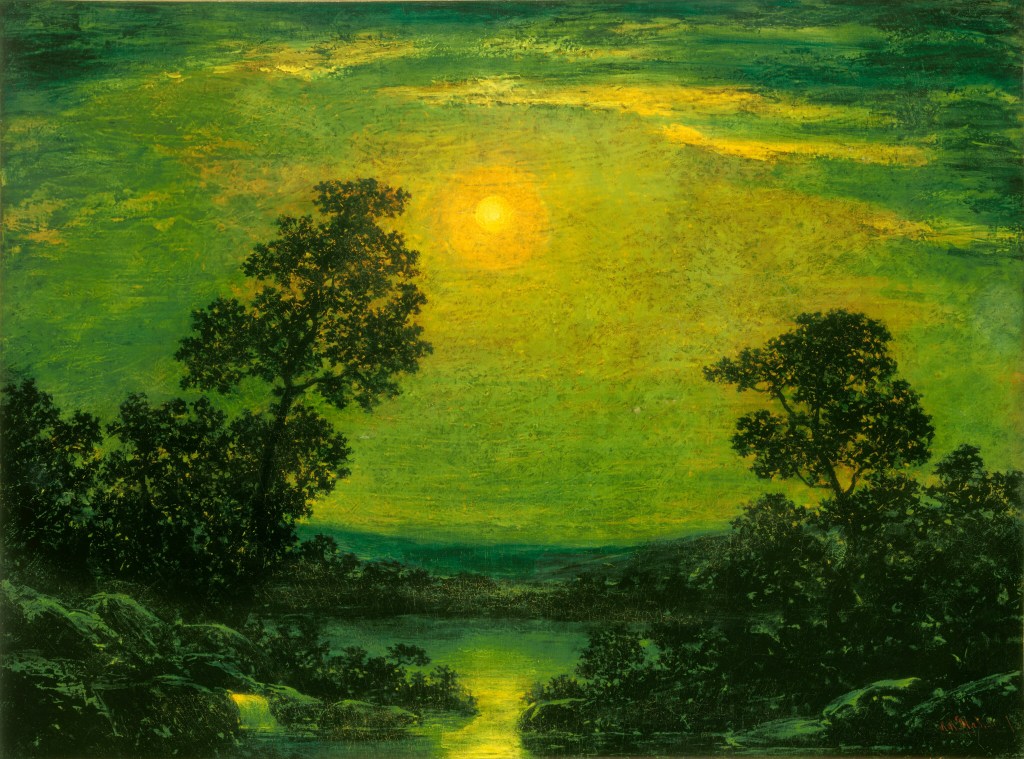
    Just look at the green moonlight in Ralph Albert Blakelock’s Moonlight. Do not analyze it too quickly – look and let yourself feel the harmony first. This is not a light that exposes; it is a light that settles. The green hue spreads softly across the landscape, not illuminating every detail, but allowing enough visibility to feel safe within the darkness.

    I imagine sitting under this quiet miracle: the green light resting on my skin, a gentle breeze brushing through my hair or catching the edge of my jacket. The night does not feel cold here; it feels attentive. And strangely, I find myself almost smelling the color green – damp earth, leaves holding onto moisture, air that has learned patience. Blakelock’s green is not decorative; it is immersive. It does not ask to be observed from a distance, but to be inhabited.

    In this moonlight, green becomes a mediator between shadow and reassurance. It does not promise clarity, but it offers presence – the kind that calms the mind without demanding explanation.

    Blakelock’s night feels inward. It asks for depth – the kind that requires honesty. It evokes a night in which you recognize the need for transformation, stop resisting it, and allow yourself to question who you are without defense or urgency.
    The green in his moonlight is not comforting; it is clarifying, it is empowering.
    The color green pats you on the back – encouraging, without insisting.

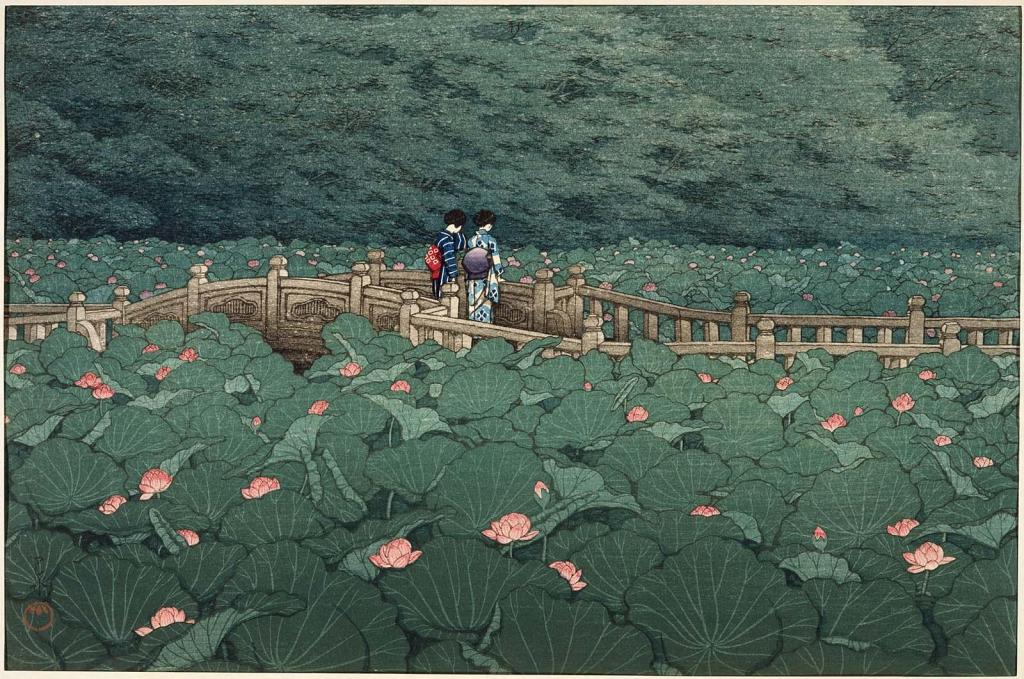
    I move on to The Pond at Benten Shrine in Shiba by Hasui Kawase:

    Serenity at its finest. Where Blakelock turns me inward, Hasui opens the scene outward. His green belongs to the day: calmer, steadier, almost ordinary – not because it lacks meaning, but because meaning has already settled. It is the moment when things fall into place, when you pause and realize where you are and how far you have come. No resistance, no transformation demanded, only presence.

    And Litzlberg on the Attersee by Gustav Klimt:

    Green feels like the clearest sign of a complete and secure life. A quiet certainty: I can live here. I can exist here. I can breathe deeply here.

    In Klimt’s landscape, I feel surrounded by green nature – hugged by trees, greeted by mountains. And the water, with its gentle reflections, gives us a kind of family portrait of the green we already possess.

    My reflections may not align with academic interpretations of these works, and my reading of green may remain incomplete. But perhaps art has always been about perception – about noticing, attributing meaning, and finding even the smallest space where we are allowed to speak.

    💌hello@betweeneverywhereandnowhere.com

    Leave a comment