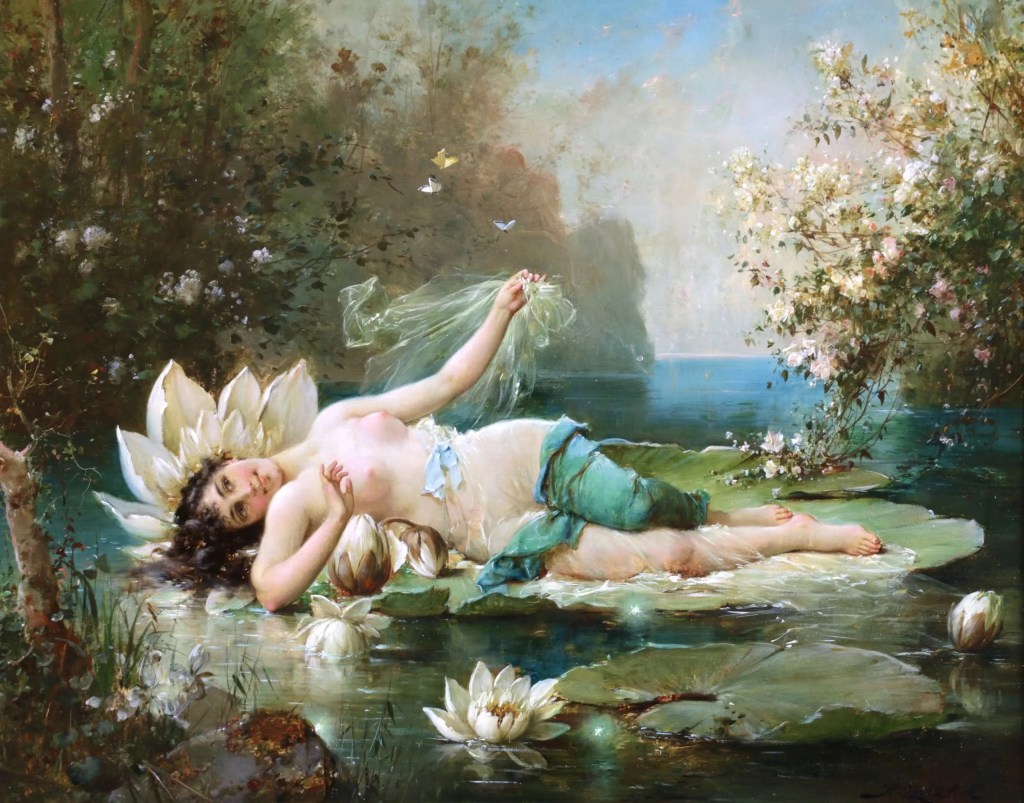
Water Nymph, Hans Zatzka
There are many ways a person can reflect the tangible version of their true essence, and just as many ways to conceal it.
Perfume sits somewhere in between.
It is one of the most subtle yet striking expressions of the self — visible and invisible, present yet intangible.
Perfume is often defined as a mixture of fragrant essential oils or aroma compounds, historically used for masking odors, healing, rituals, or even status signaling.
Today, it feels more like an accessory. Sometimes a refined field of interest, sometimes simply an identity in the form of a spray. But it is never only about notes and compositions.
We carry two kinds of scent.
One that we construct — something we choose, apply, and project.
And another that exists without our intervention — something biological, innate, entirely our own.
I won’t go into the anthropological or biological depth of it. But it does raise a quieter question: How true do we remain to our raw existence through what we choose to smell like?
Modern life already distances us from that rawness. Artificial food, synthetic fabrics, constant stress — all of it interferes with something that was once more instinctive, more unfiltered.
Of course, hygiene is essential. That is not the question here.
The question is something else.
Isn’t perfume almost too personal?
It begins with something natural — herbs, spices, flowers — reduced, distilled, transformed. And then it becomes something we carry on our skin, in our hair, on our coat.
One spray.
Tiny particles enter the air, reach the senses, and settle somewhere between memory and instinct. They can revive something, signal something, suggest where you belong or simply where you are going.
That is a lot for something so unseen.
I tend to see anything personal — anything that reflects my own taste — as something almost intimate. Even when it is something as simple as a scent.
If I am drawn to something, I don’t arrive there casually. I try, I eliminate, I return.
And when I finally find something that feels right, it feels earned.
Lately, I’ve found myself observing people in perfume sections — the way they test, compare, return to the same strip again. There is a certain kind of attention there, almost like tasting wine or olive oil. A quiet expertise, or maybe just a refined curiosity.
And I find myself wondering — should something experienced with that much sensitivity really belong to everyone’s perception equally?
Because when that scent finally settles on me, it feels contained — almost like it belongs within a boundary I cannot quite define. And yet, with a single movement, it dissolves into the air, becoming something anyone can perceive.
Sometimes that feels like a quiet injustice to the process itself. And I ask myself — does this make me selfish?
Or am I simply assigning too much meaning to something that was never meant to be this private?
We engage so many of our senses, consciously or not, to arrive at what we like.
Maybe we use scent just to reset ourselves, to strengthen our very presence in a certain place, or to maintain a certain emotional state.
But then another question follows:
How much of something that can shape my emotional state should belong only to me, and how much of it should spill into the world?
Scent carries a certain kind of power. And even the same scent settles differently on every person. Quiet, but persistent.
So, what do we actually mean when we wear a perfume?
Is it an open declaration of who we are, or a controlled version of it?
Something we leave behind freely, letting it linger in every space we pass through?
Or something more contained — something that requires proximity, even permission?
Should what we choose to smell like remain everywhere we briefly exist, in every person we unknowingly pass?
Or is it enough, simply, to have a sensory existence at all?
Maybe it is not even that deep anymore.
Maybe it is just a habit — a gesture, a routine, a background presence, like music in a film.
Or maybe it is simply our way of saying we were here — in the language of scented particles, or more precisely in a language no one sees, but somehow remembers.
 Between Everywhere and Nowhere
Leave a comment