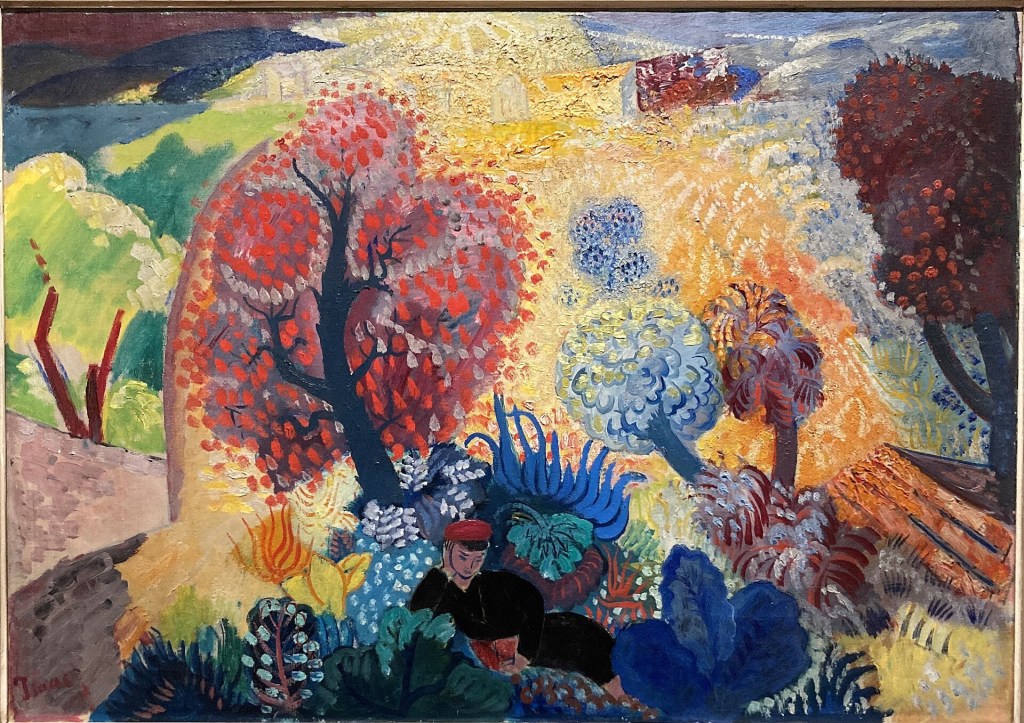
🎨 I Fantasins Värld, Isaac Grünewald
Some questions don’t start with belief. They start with curiosity.
Since my earliest memories, I’ve been trying to understand something beyond daily routines—something about potential, existence, and why we are here at all. Like many who get lost in such questions, I found myself moving between ideas, systems, and ways of explaining life.
The more I read, the more I noticed something I couldn’t ignore: the universe feels incredibly vast. Yet, I keep returning to something very close: this planet and the bodies surrounding it.
The Moon moves the oceans, causing tides to come and go. And at some point, I began wondering: if it can move entire oceans, could it influence something within us, even in ways we do not yet fully understand?
Perhaps the question is not about proof, but about what we are willing to feel without measuring it.
For the past few months, I’ve explored astrology—not daily horoscopes, but its symbolic language: planets, asteroids, and fixed stars. Not as predictions, but as a framework people use to interpret life. I even use my own experiences as a personal experiment to see how it resonates.
During this learning process, one sentence resonated with me: “The Moon represents the left eye, while the Sun represents the right.”
At first, it sounded poetic, metaphorical, nothing more. But I remembered something I had never questioned before: my right eye has always been more sensitive; I instinctively avoid direct sunlight. The Moon, on the other hand, has always felt different—calm, quiet, and easier. Moon chasing and moon bathing have been my favorite nighttime activities for years.
Could there be a connection? Or was I merely trying to find one? To test it, I did something simple: one day, at midday, I went outside and stood under the Sun, almost like declaring a small, personal ceasefire. Since then, my right eye has given more stable results at the ophthalmologist.
Was it coincidence, conditioning, or did my body respond to something it actually needed? I don’t know. Perhaps that uncertainty is part of the experience itself.
There are so many things in life beyond my control—timing, outcomes, other people, opportunities. Sometimes, that lack of control feels heavier than expected. Perhaps this is where astrology becomes tempting. Not because it provides answers, but because it offers direction; a sense that moments carry meaning, that something might be aligned even if I don’t fully understand it.
Maybe astrology is not really about planets. Maybe it is about how we deal with uncertainty. How we look for patterns when we feel we cannot control outcomes. It may not make it true, but it doesn’t make it meaningless either.
The moment I started studying astrology in depth, seeing my existence through its symbolic “mathematical” lens gave me great excitement. It is an interesting experiment to see Saturn as a harsh mentor or Jupiter as a spiritual protector. I even unlocked a new adjective for myself: Saturnian—someone under the intense influence of Saturn.
I found astrology surprisingly consistent with the layered structure of human experience: the Ascendant representing our outer experience, the Moon representing emotional tendencies, and so on.
During this process, I also reflected on the Barnum effect—a cognitive bias where vague statements seem personally meaningful. Yet, I noticed astrology is ultimately about potential. Believing, doubting, or cherry-picking is up to each person. Darker, shadowy aspects of myself caught my interest more, for example.
Also, when I shared my “new” curiosity with a friend familiar with the astrology, she said: “Of course you’d get into astrology. You have Neptune in the 9th house and a retrograde Mercury in the 8th house.” I didn’t know whether to laugh or take it seriously.
Astrology may not be something we strictly believe in. But, for me, it gave goosebumps through its consistency. Then I thought: “Of course it reflects me—it’s a mathematical mapping of who I am.”
Perhaps it’s something we hold onto when certainty is unavailable, or when we are rediscovering our potential. A lens through which we attempt to make sense of randomness, find patterns, and navigate life with intention.
Ultimately, maybe astrology is less about planets and more about ourselves—our curiosity, our reflection, and the ways we seek connection in uncertainty.
It can even feel like a subtle collaboration with the planets, fixed stars, and our unique universe.
 Between Everywhere and Nowhere
Leave a comment