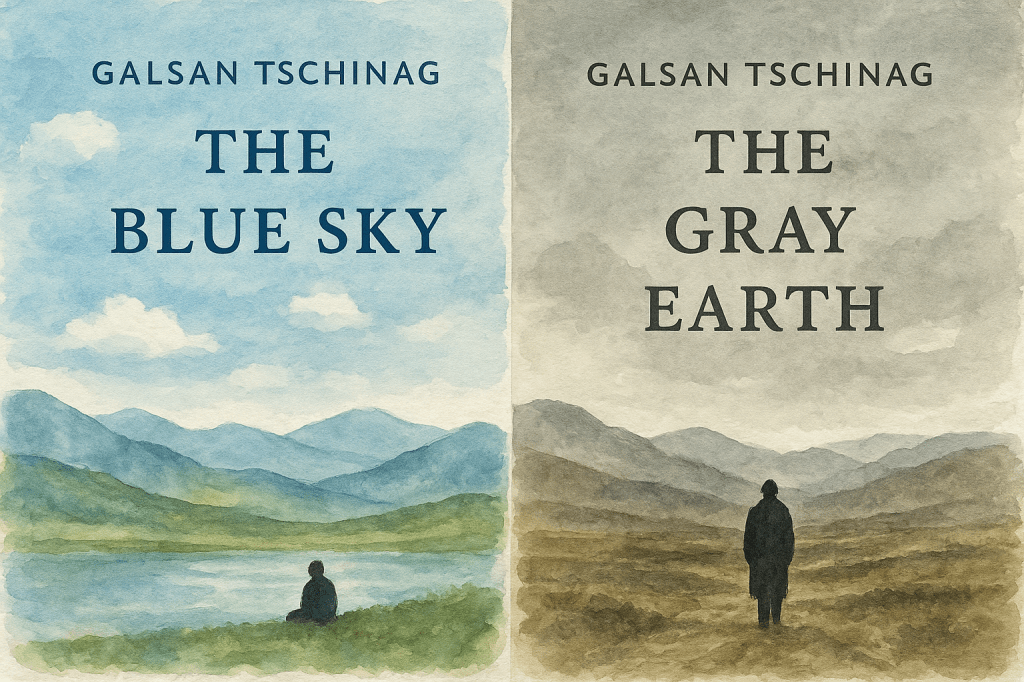
I recently discovered Galsan Tschinag through two parts of his The Blue Sky series — The Blue Sky and The Gray Earth. Tschinag is a Mongolian author with Tuvan roots who writes in a deeply autobiographical way about the nomadic life of the Tuvan people.
I read the books in Turkish translation, and right at the beginning, a small note caught my eye:
“The author chose to leave Tuvan–Mongolian words as they are. We respect this choice and keep them untouched.”
That intrigued me. Would these words feel distant? Would they interrupt the flow?
To my surprise, as an Anatolian Turk, they rarely felt foreign. Most of the time, I read fluently, almost seamlessly, as if those words had always been part of my own language.
Some examples included:
| Tuvan | Turkish | English |
|---|---|---|
| Arzılan | Aslan | Lion |
| Höl | Göl | Lake |
| Harlıg | Karlı | Snowy |
| Sarıg | Sarı | Yellow |
| Beğ | Bey | Lord / Chief |
A Note on the Tuvans and Their Language
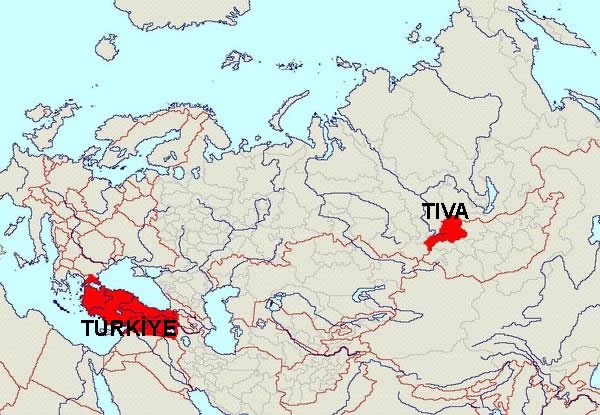
The Tuvans are a Turkic-speaking people living mainly in the Tuva Republic in southern Siberia, Russia. Their language, Tuvan, belongs to the Turkic language family and shares historical roots with Turkish. Around 300,000 people speak Tuvan today.
Historically, the Tuvans and Turks share common ancestry from Central Asia. Over centuries, migrations, nomadic movements, and intermixing with neighboring peoples shaped the cultures and languages of both groups.
Knowing this makes the familiarity of certain words in Tschinag’s books even more fascinating, as echoes of a distant but connected linguistic and cultural heritage emerge across centuries and geography.
Cultural Echoes Across Lands
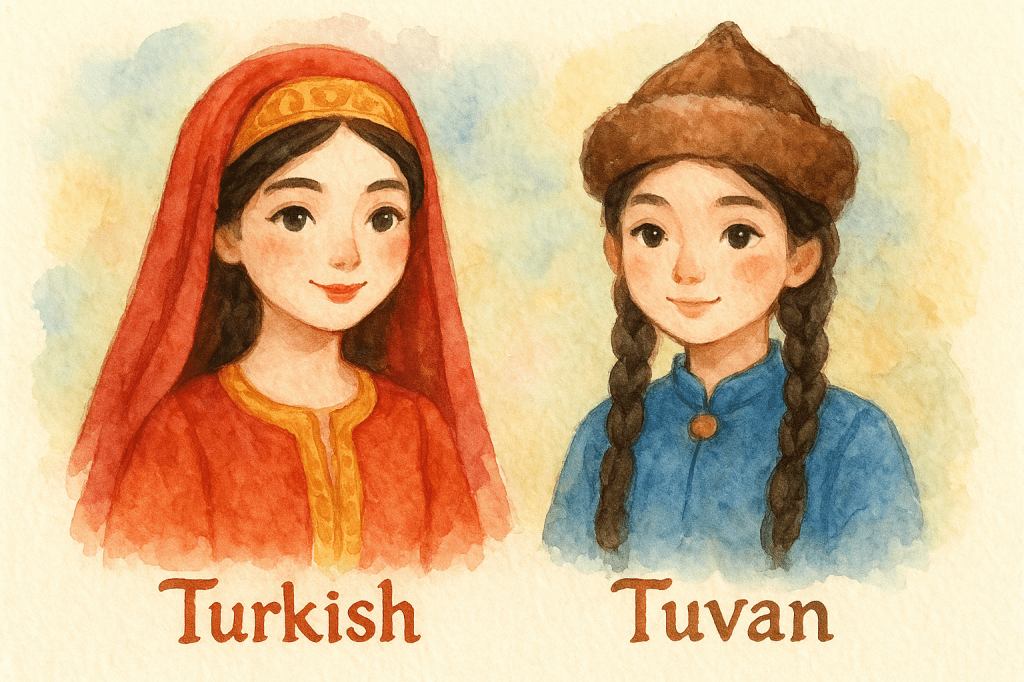
What struck me even more were the subtle cultural echoes. In one passage, the Tuvans deal with bad dreams in a unique way: instead of telling anyone, they dig a small hole in the ground and spit three times into it.
In my own culture, we do something strikingly similar — when you wake from a bad dream, you turn to your left side and spit three times to ward it off without telling anyone.
Two traditions, worlds apart, yet connected by the same instinctive gesture.
Language as the Vessel of Identity
That experience reminded me of something powerful: language is the true vessel of cultural memory. You can mix with other peoples, migrate to new lands, or adopt different faiths — but your language holds the essence of who you are.
It carries the echoes of your ancestors: their struggles, joys, survival, and traditions. Here I was — a 28-year-old Anatolian Turk — suddenly understanding, mostly, the Tuvan words of a writer born in 1944 in Mongolia. Across geography, decades, and lives, there was a quiet recognition.No matter what the world tells you, identity lives in language. It is the thread that ties you to those who came before, and the voice you pass on to those who come after.
Reflections on My Own Roots
We, Anatolian Turks, are a people whose identity has been constantly shaped and reshaped: through our nomadic past, settled lives, and encounters with countless other communities.
Reading Tschinag made me reflect on these layers — on how language, ritual, and memory carry the essence of who we are, often transcending borders and time.
Although the ties between the Tuvans and Turks are historically known, what felt extraordinary to me was the immediacy of the recognition. Despite centuries of distance — geographic, cultural, and historical — I found myself transported into that world within the pages of a book. The traditions and words did not feel foreign; they resonated.
It reminded me that no matter how far we move, how much we mix with others, or how much time passes, language remains our essence and our ancestor. It is the quiet force that brings us back to our identity — a bridge across time, distance, and generations, connecting us to who we are and who we might become.
Carry the dignity and elegance of your identity by honoring your language, using it in the most poised and graceful way.
💌hello@betweeneverywhereandnowhere.com
 Between Everywhere and Nowhere
Leave a comment