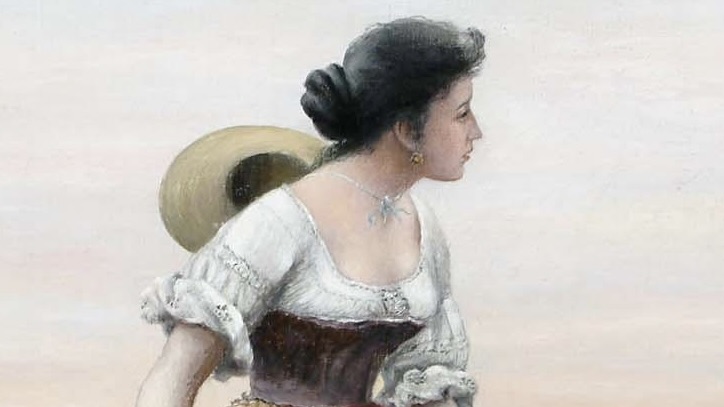
…or do we just mean not to fit in?
I længselsfulde tanker, Wenzel Tornøe
We are born within certain borders, raised according to them, and over time we internalize what those borders and their communities show us. A tailored persona is handed to us early on. But does our essence actually accept this persona that borders and their dynamics impose on us?
Maybe yes.
Maybe no.
Maybe intentionally yes.
Maybe intentionally no.
A while ago, I was reading Ett nytt land utanför mitt fönster (literally, A New Land Outside My Window) by Theodor Kallifatides.
As he described his dilemmas, I kept finding echoes of my own thoughts. He is Greek, I am a Turk, and at certain points, our perspectives overlapped almost uncomfortably well.
That made me think: maybe being someone who cannot fully fit in is not unique at all. Maybe it is universal. And maybe there is nothing special about it, which is, in itself, unsettling.
In my culture, we are taught very early to “give the best to the other.” To be considerate. To host well. To sacrifice quietly.
Now, in my young adulthood, I sometimes feel that this land keeps the best for others, while keeping the guest room permanently locked for me. The space is there, clean, prepared, but never really mine.
Sometimes I try to look at this from the opposite angle. I tell myself that maybe my essence is different because this land also needs difference. But difference is far more easily embraced when you are not considered an integral part of society. When you are an outsider, tolerance has a wide threshold. Difference becomes interesting, even charming.
Once you are labeled as “one of us,” however, the expectations change. You are then required to behave according to a very specific, carefully tailored script. Difference, at that point, becomes deviation.
This is not about leaving one’s land or hating one’s own people. Except for extreme circumstances, I do not find that healthy, at least not in my case. Still, in this modern world, being a responsible citizen matters deeply to me.
I keep thinking: if you live among like-minded people, you must assume all the responsibility required to deserve life within that particular border and among that particular group.
I have become many things within my own society:
a daughter,
a big sister,
a best friend, a
student who excelled in languages,
a student who insisted on not being good at math,
a reliable colleague, and so on.
But… being a migrant? Could I become a migrant? Would I ever be capable of carrying this hat, too?
I am aware that it takes a long time to deserve being an integral part of a society if you arrive later. And if someone were to look at my face and say, “You are not wanted here,” what would I do?
Unlike my usual personality, I probably would not say anything. Perhaps because I think the native has that right, or perhaps because I am not as certain about my own anymore.
Recently, I found myself experiencing a different kind of dilemma, what I call losing my religion. Not necessarily faith itself, but something closer to frustration and desperation, to losing the ground beneath my feet.
I wonder what it would be like to live among people who think similarly. What could I achieve there? Would I be more useful, more productive? Or was the whole point living with a different essence in my own land all along?
But then again: is it actually my land?
Sometimes, while jogging through the park, a sentence forms in my mind:
this country blooms its cities with our tears.
Then I find these thoughts ridiculous, too dramatic, and make fun of myself and my way of thinking.
Maybe all the magic lies in living in your own country while carrying a different essence. Or maybe, in another place, I would become nothing at all: typical, standard, unremarkable.
Being “the spicy one” is not a sustainable trait when you cannot convert that spice into something tangible, something productive, into energy, or at least into light. Also, will I have enough space to enjoy my different essence while blending a new personality with my brand-new identity of “migrant”?
Maybe it is all about the need to feel important. Or different. Or necessary. Or just being able to meet the ends.
And yet, at its core, it may have always been something very ordinary.
Maybe it is not the right time yet.
Maybe the planets do not allow it.
Maybe they push you forward.
Maybe God has a plan.
Maybe it is karma.
Maybe it is frequency.
Maybe it is all about vibe.
Or maybe it is just coincidence.
Should it happen?
I do not know. Not yet.
 Between Everywhere and Nowhere
Leave a comment