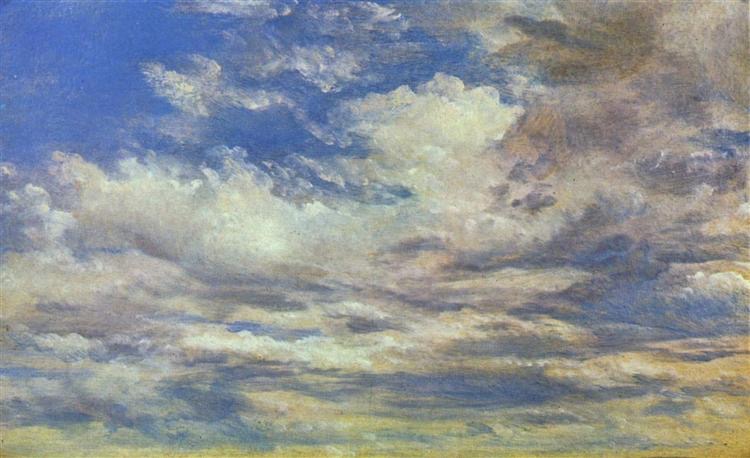
🎨 Cloud Study, 1822, John Constable
We actually live on a planet.
Not metaphorically. Not poetically. Literally.
A massive sphere drifting through an endless universe, carrying oceans, mountains, cities and us.
And yet, most of the time, we hardly feel it.
We wake up, scroll, work, eat, sleep, as if this is the only reality there is.
As if the ground beneath our feet were fixed, stable, permanent.
As if we were not suspended in space at this very moment.
Sometimes I catch myself looking around and wondering how much of this I truly notice.
How aware are we of the world we inhabit?
Or more unsettling: do we really belong to it?
Because when you think about it, the planet is not equally welcoming everywhere.
Some places freeze you.
Some burn you.
Some suffocate you.
Some simply do not allow you to stay.
It is as if the Earth quietly draws invisible boundaries, deciding:
Here, you may live.
Here, you may not.
For most species, that is the end of the story.
They live where they can.
And nowhere else.
Humans, however, are different.
Not long ago, I watched a couple of videos that stayed with me long after they ended.
Not only because they were spectacular, but also because they made something very clear: we do not truly belong to some places on our own planet.
In one, ski mountaineer Andrzej Bargiel climbs Everest without supplemental oxygen.
Not rushing, just moving one step at a time. At that altitude, even breathing is uncertain. Each step grows heavier than the last. Not because the mountain is steep, but because the body resists where it is.
His rhythm is no longer his own; it is dictated by oxygen, sunlight, survival.
It does not look like mere freedom.
It looks like freedom in negotiation.
In another, explorer Chris Brown and his team journey to Point Nemo, the most remote place in the ocean.
The deeper they go, the more their bodies resist.
Dizziness. Nausea. Vomiting.
It feels as if the water itself pushes them back, a reminder that this was never meant for us.
And yet, they persist.
Not because the place suddenly becomes hospitable, but because we find ways to exist within it.
And this is what struck me.
In these moments, I did not merely witness landscapes or feats.
I saw what happens when humans refuse to accept the boundaries of where they are “allowed” to be.
We do not simply remain where it is easy.
We go where it is difficult: climbing where there is no oxygen, diving under crushing pressure.
We live in extremes of cold, heat, isolation.
And somehow, we endure.
Not because the planet grows gentle, but because we adapt.
And here is the most fascinating part:
It is not only our bodies that adapt.
It is our minds.
Our curiosity.
Our determination.
Our intelligence.
And, perhaps above all, our culture.
We do not face the world alone.
We create knowledge. We share it. We build upon it.
We develop tools, technologies, and ways of living that allow us to survive in places never meant for us.
We turn the “impossible” into the “manageable.”
We observe. We learn. We strategize.
Step by step, we expand the map of where we can exist.
And sometimes I wonder: is this adaptation or something else entirely?
Are we learning how to belong?
Or simply refusing to accept that we do not?
Perhaps the planet does draw boundaries. But humans are the only species that negotiate with them.
We do not merely accept limits.
We test them. We stretch them.
Sometimes, we even redefine them entirely.
In doing so, we transform not only our environment, but ourselves.
We are shaped by the planet, yet constantly reshaping our place within it.
And that tension is mesmerizing.
It leaves us suspended somewhere in between.
Between restriction and freedom.
Between nature and intention.
Between being placed and choosing where to stand.
Perhaps this is what it means to be human:
Not simply to adapt, but to learn how to move within the world.
We may not belong everywhere. Yet still, we keep going.
 Between Everywhere and Nowhere
Leave a comment