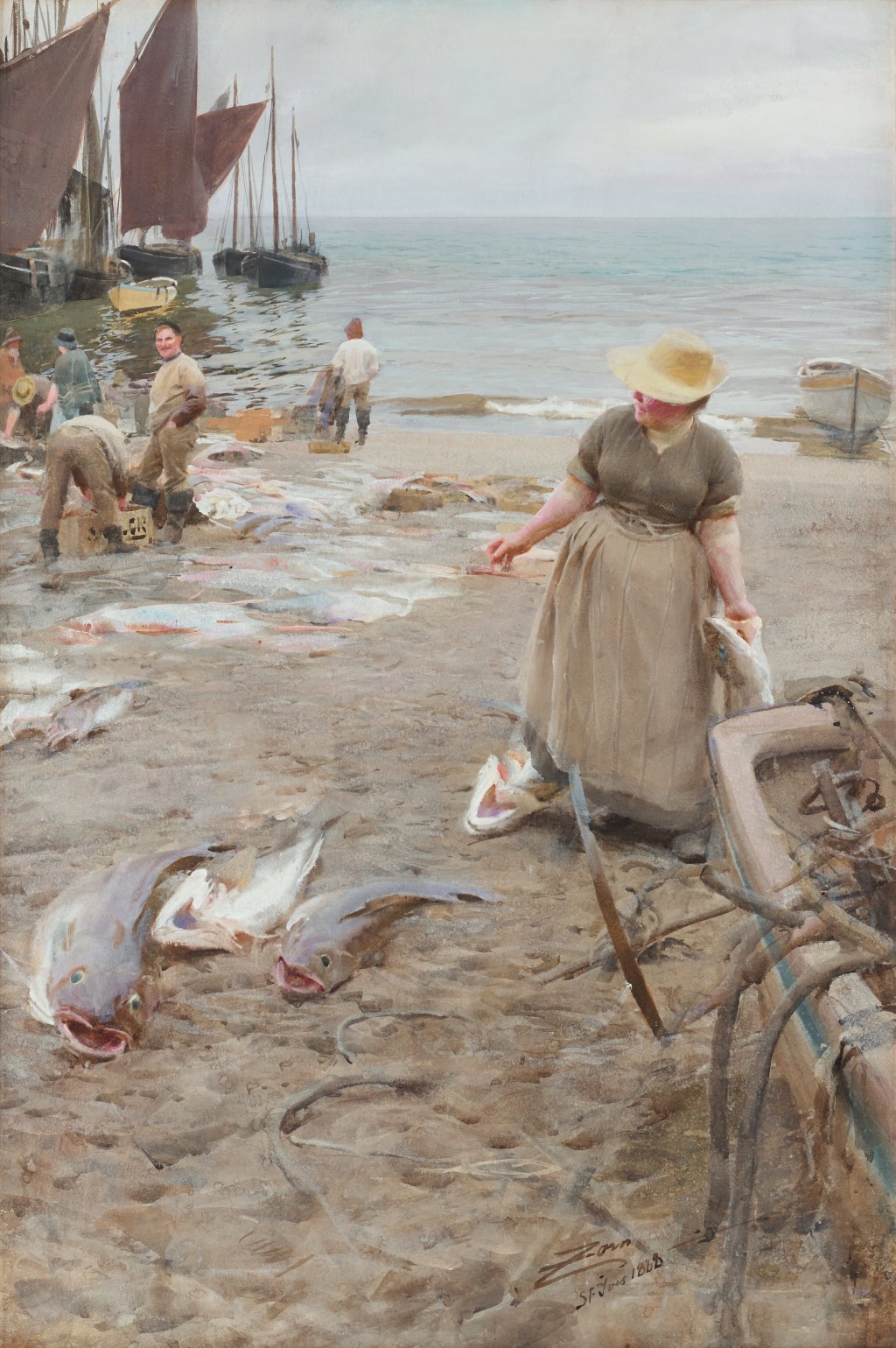
Fiskmarknad i St. Ives, Anders Zorn
Lately, Greenland has been appearing in the news again. This time caught in a turbulent agenda between the United States and Denmark. Considering the aftermath of the Russia–Ukraine war and the growing security concerns surrounding the Nordic region, this renewed attention is hardly surprising. Yet Greenland rarely appears as the main subject; more often, it functions as a surface onto which larger powers project their anxieties, ambitions, and strategic calculations.
Still, Greenland is not a new topic. Some time ago, I remember coming across discussions linking Greenland to the United States, alongside the autonomy demands voiced by Greenlandic people themselves. Even then, it felt like more than a geographical matter, more like a quiet reminder of how fragile “belonging” can be for small lands in a world shaped by powerful interests.
What I am about to write is neither political nor scientific. I do not have the qualifications to produce a paper, nor do I intend to analyze treaties, military strategies, or economic forecasts. This is simply an observation that emerges when I place two names side by side: the United States of America and Denmark.
If we put history aside for a moment — imperialism, colonialism, wars, and all the heavy baggage humanity carries — we are left with two very different representations of what a “successful country” looks like.
On one side, there is the United States. A global leader in almost everything: economic power, military capacity, cultural influence, technological dominance. A country that shapes the world, often without asking for permission. Admired, feared, envied — sometimes all at once.
On the other side, there is Denmark. A country that, for many, represents a kind of modern utopia. A place where I have personally witnessed genuine calm and happiness in people’s eyes. Trust. A sense that life is not constantly lived under pressure.
In my country, there is a saying: Being an enemy of the United States is hard, but being a friend of it is harder.
This sentence has stayed with me for years because it does not speak only of hostility or alliances; it speaks of power. Of the cost of proximity to power. Of the subtle ways in which strength demands loyalty, compromise, and silence.
I want to state my thoughts independently of the current leaders of these countries. Leaders come and go; names change; faces change. But states operate through structures that outlast individuals. At their core, they serve agendas far larger than any single person. There are always bigger plans above smaller plans, systems layered over systems. Almost everyone knows this, even if we rarely articulate it openly.
What troubles me is the comforting illusion that such dynamics belong only to “unstable regions” or “less developed societies.” As if democracy indices, welfare systems, or economic rankings could somehow exempt a country or its people from being tested. As if development itself were a shield.
But history keeps proving otherwise. These moments of tension are not exceptions; they are examinations. And they do not discriminate based on development levels or political self-images. They test how power behaves when opportunity arises and how quietly it expects acceptance in return.
If the Russia–Ukraine war was not enough to remind us of this reality, the Greenland issue certainly should. Not because everything is uncertain, but because nothing is guaranteed when control lacks legitimacy. Not borders, not alliances, not even the moral positions we assume to be stable.
Yet power does not operate only through states and institutions; it also reveals itself in ordinary reactions, far from negotiation tables and official statements.
When a devastating earthquake struck my country, I remember reading comments online from some Nordic users saying, “This is karma. God punished them for blocking Sweden and Finland’s entry into NATO.” What disturbed me was not only the cruelty of those words, but how effortlessly they surfaced. How easily judgment replaced responsibility when faces disappeared behind screens.
That moment stayed with me because it revealed something uncomfortable: no society is immune to moral shortcuts. No level of development erases the human tendency to justify harm once it is framed as deserved, strategic, or necessary.
This is not resentment. Every land has its own version of “those people.” And it is always easier to spill poisonous ideas when there is no real identity, no real face looking back at you.
Because societies, no matter how advanced, are ultimately shaped by individuals, these impulses do not disappear; they simply learn new, more acceptable languages.
Perhaps this is what we keep missing when we say, “This wouldn’t happen in our time.” We forget that no matter how advanced our institutions become, we are still dealing with human impulses: fear, dominance, self-interest. We no longer call it conquest; we call it security. We no longer say control; we say stability. The titles evolve, but the instinct remains.
Both countries and the people I have encountered from them have shaped me in different ways. Denmark, for instance, gave me Kierkegaard in the simplest form: not merely as a philosopher, but as a reminder of quiet responsibility. For that reason, my thoughts come from closeness, not detachment.
It may be right or wrong, but there is one thing I have always acknowledged about the United States: it is relentlessly loyal to its own interests. There is a brutal clarity in that. What troubles me is not this pursuit itself, but the way such interests often define the boundaries for everyone else, including those too small to negotiate on equal terms.
Perhaps this is why Greenland feels like an “issue” again. Not because it suddenly matters more, but because it exposes an old truth we prefer to ignore: in a world governed by interests, control without legitimacy is never neutral. And small lands are often expected to accept it quietly, while the rest of us watch, comforted by the illusion that democracy, development, or distance will always keep us safe.
 Between Everywhere and Nowhere
Leave a comment